01
Emergency response
Blocked mains, burst supply, failed water heaters, and anything that has stopped a business trading. Dispatch is answered around the clock.
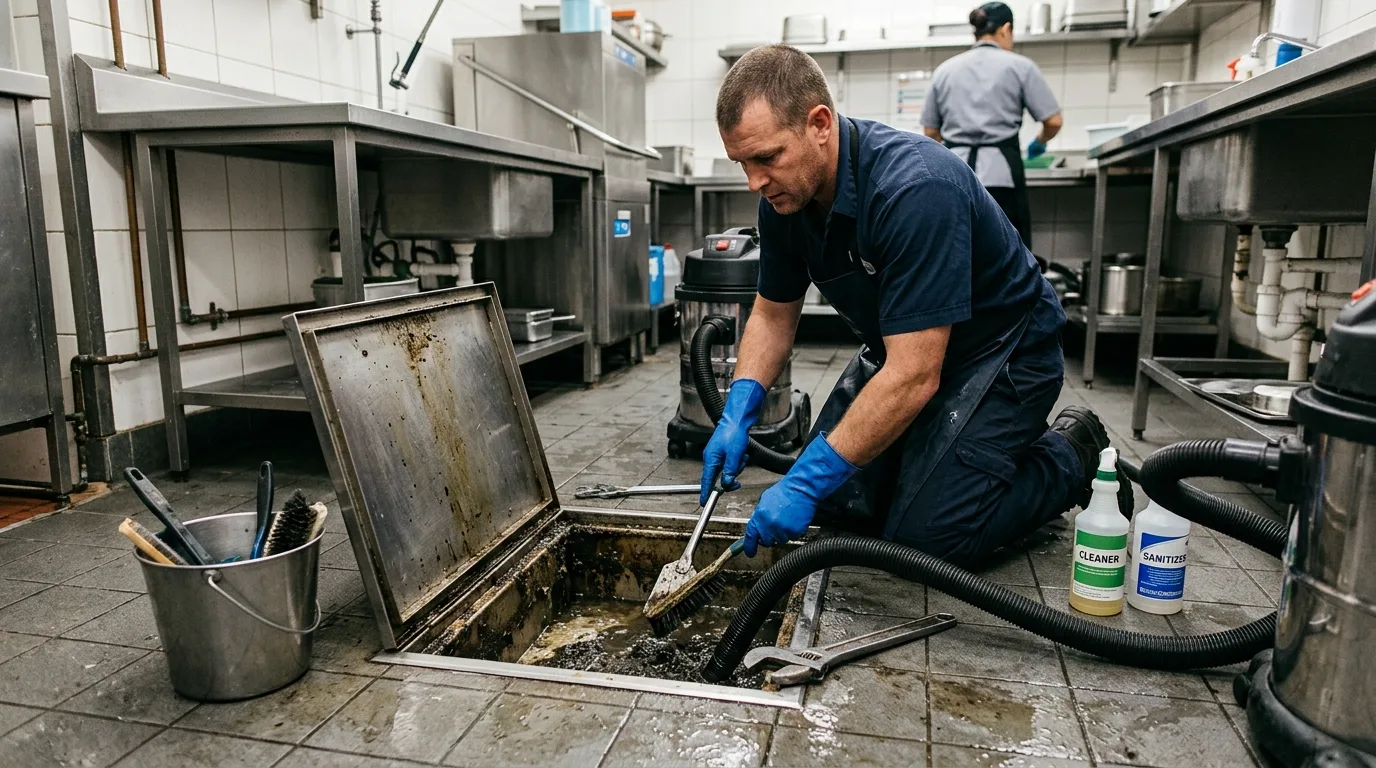
Commercial · Corona, CA
A plumbing failure in a business is not an inconvenience; it is closed doors, lost covers, and in a food operation a health department problem. Response time is most of the value.
Answered 24/7 · after-hours and before-open scheduling to protect trading time
The difference
The pipes are larger and the fixtures are tougher, but that is not what actually distinguishes commercial work. Three things do.
Downtime has a price. When a house has a blocked drain, the family is inconvenienced. When a restaurant has one during service, the operation stops: covers lost, staff sent home, and a reputation event on top. The economics of the repair are dominated by how quickly it happens and whether it can happen outside trading hours, which is why we schedule commercial work before open, after close, and overnight as a matter of routine rather than as a favour.
There is a regulator involved. Food service operations answer to the health department. Backflow assemblies must be tested annually by a qualified backflow tester and the results filed. Grease interceptors have service and record-keeping requirements. A plumbing problem in a commercial setting frequently arrives with a compliance obligation attached, and the paperwork is part of the job rather than an afterthought.
Usage is relentless. A commercial fixture sees more cycles in a month than a residential one sees in a year. Flushometer valves, floor drains, mop sinks, and prep sinks are all in constant use, and they wear on a schedule that makes planned maintenance genuinely cheaper than reactive repair. This is the single biggest difference in how a business should think about plumbing: the goal is not fast repairs, it is fewer failures.
We work with restaurants, cafes and bars, retail units, offices, medical and dental suites, salons, gyms, warehouses, and light industrial premises across Corona and the surrounding cities. What those have in common is not the plumbing; it is that a failure costs money by the hour.
The main event
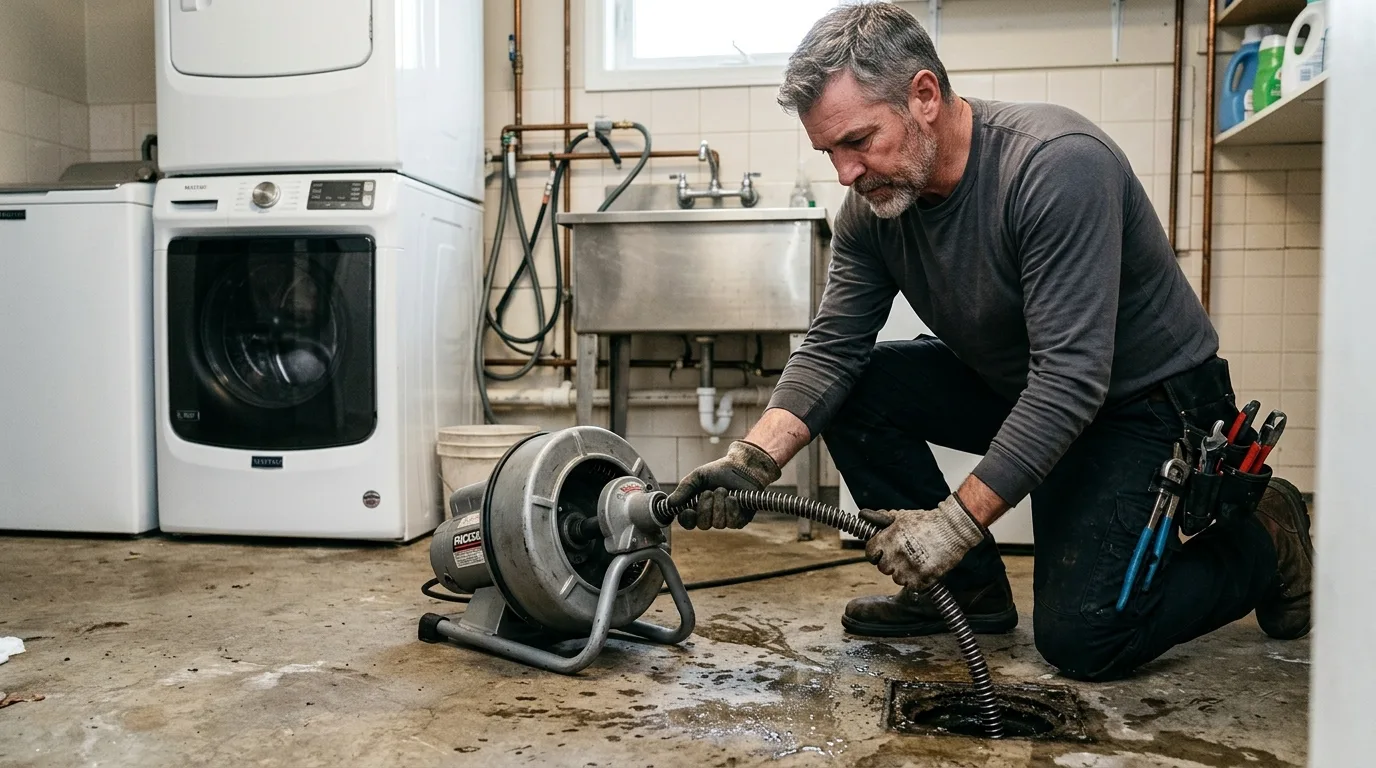
In food service, one problem accounts for the overwhelming majority of emergency calls: the grease line. Understanding why it fails explains why the standard response to it is wrong.
Fats, oils, and grease leave the kitchen as warm liquid. They cool in the horizontal run and deposit on the pipe wall, and each layer gives the next something to adhere to. The build is circumferential and progressive, the pipe does not block at a point, it narrows everywhere at once until an ordinary day’s volume no longer fits through it.
Which is why cabling a grease line is a temporary measure. A cable punches a channel through the deposit. Water flows, the call closes, and eighty percent of the coating is still on the wall. The next failure is already scheduled. Operators who have been cabled three times in a year are not unlucky; they are on a treadmill.
Hydro jetting scours the pipe wall back toward full diameter with high-pressure water and a rotating head. It takes longer and costs more per visit, and it is the only approach that resets the clock rather than deferring it.
The right model is a scheduled program, with the interval set by what the camera shows rather than by a default. A busy kitchen might need quarterly. A cafe with light frying might be fine annually. Either way the work happens overnight, on a date you chose, instead of at seven on a Friday evening with a full book.
And the interceptor matters. A grease interceptor that is undersized, overdue for service, or bypassed sends everything it was meant to capture straight into the line. If the line keeps failing on a good interval, the interceptor is where we look next.
Scope
Reactive when you need it, planned where it saves you money.
01
Blocked mains, burst supply, failed water heaters, and anything that has stopped a business trading. Dispatch is answered around the clock.
02
Scheduled and reactive jetting of kitchen waste lines, with camera verification so you can see the pipe wall rather than take our word for it.
03
Main line clearing, camera inspection, locating, and repair including trenchless options where excavation would close a car park or a dining room.
04
Installation, repair, and replacement of testable assemblies, and coordination of the annual backflow test your water purveyor requires.
05
Tank and tankless systems, recirculation, mixing valves, and sizing for kitchens and multi-fixture premises where residential logic does not apply.
06
Flushometer valves, floor drains, mop and prep sinks, hand-wash stations, and commercial gas connections for kitchen equipment and heating.
Sequence
Built around your trading hours, not ours.
Trading hours, the fixtures and lines that cannot fail, and what a closure actually costs you. That determines how we prioritize and when we schedule.
Emergency dispatch where something has stopped, or a planned survey with camera work where you want to know the condition of what you have.
Camera footage, pressure readings, and photographs rather than assertions. You get the recording, and it goes in your file.
Scope, cost, and how long you will be affected, including the option to do the work overnight or before open at a different number.
Work scheduled for closed hours wherever the job allows it. Where it cannot be, we stage it to keep as much of the premises operating as possible.
Written record for your compliance file, camera verification on drain work, and a recommended service interval so the next one is planned rather than urgent.
24/7
Dispatch, including overnight and weekends
Annual
Backflow assembly testing requirement
Quarterly
Common jetting interval for a busy kitchen
Camera
Verification on every drain program
Why here
The same water and ground conditions that shape residential plumbing here hit commercial premises harder, because commercial systems run at higher volume with less tolerance for downtime.
Hard water at commercial volume. Fifteen to twenty grains through a high-throughput water heater, a dish machine, an espresso machine, or an ice maker produces scale at a rate that residential experience does not prepare anyone for. Commercial heaters here fail early without treatment, and equipment warranties frequently require it. For most food service operations, softening or scale treatment is not an upgrade; it is the difference between a heater lasting its rated life and lasting half of it.
Pressure. Corona’s elevation range means many premises receive static pressure above the code limit. Commercial flushometers, mixing valves, and equipment solenoids are all sensitive to it, and a business replacing the same component repeatedly is usually looking at a pressure problem it has never measured.
Older commercial stock. Premises around downtown Corona and the Circle City district include buildings with cast iron waste lines, and cast iron scales internally into a rough tuberculated surface that grease grips readily. A kitchen line in cast iron needs a shorter jetting interval than the same kitchen in ABS, and pretending otherwise produces emergency calls.
Tenant improvement history. Retail and food service units change hands and get remodeled repeatedly. Every fit-out adds fixtures, moves drains, and occasionally leaves something undersized, unvented, or capped behind a wall. When a unit has a persistent problem nobody can explain, the cause is often three tenants back. A camera survey at lease signing is one of the better small investments an operator can make.
One practical note on scheduling: much of Corona’s commercial activity sits along the 91 corridor and around Dos Lagos and the retail centers, where access windows and center management rules constrain when work can happen. We plan around those rather than discovering them on arrival.
Straight answers
| Factor | Why it changes the number |
|---|---|
| When the work happens | Overnight, weekend, and pre-open scheduling costs more per hour and almost always costs less overall than closing during trading. We quote both so you can compare properly. |
| Line size and length | Commercial waste lines are larger and longer than residential, and jetting a long grease run with multiple branches takes proportionally more time and equipment. |
| Access and cleanouts | Accessible cleanouts make drain work fast. Missing, buried, or built-over cleanouts mean finding access first, and installing proper ones is usually worth doing once. |
| Pipe material and condition | ABS is forgiving. Cast iron that has scaled internally needs more aggressive treatment, shorter intervals, and sometimes lining or replacement rather than cleaning. |
| Reactive versus programmed | A scheduled jetting program is materially cheaper per year than the emergency call-outs it replaces, before counting the trading time it protects. |
| Compliance requirements | Backflow testing, documentation, and health department expectations add time. It is not overhead; it is the part that keeps you operating. |
| Equipment specification | Commercial heaters, mixing valves, and flushometers are specified to the load and the fixture count, and sizing correctly costs more up front than sizing optimistically. |
| Restoration and surfacing | Excavation in a car park, a loading area, or a dining room floor carries restoration costs that often justify a trenchless approach instead. |
Line backing up during service?
Emergency clearing tonight, jetting and a camera afterwards so the next Friday is not the same Friday.
Answered 24/7 · after-hours scheduling available
Related work
Coverage
Running a kitchen?
A grease line on a maintenance interval does not back up during service. That is the entire business case.
Independent local contractors · documentation provided for compliance files
Commercial FAQs
Yes, and for most commercial clients that is the preferred arrangement. Dispatch is answered 24 hours a day, and planned work is routinely scheduled overnight, before open, or on closed days.
After-hours labor carries a premium, but for any business that trades, it is almost always cheaper than losing operating hours. We quote both options so the comparison is explicit.
It depends on volume, menu, pipe material, and the condition of the interceptor. A busy kitchen with heavy frying may need quarterly. A cafe with light food service may be fine annually.
We set the interval from what the camera shows after the first clean rather than applying a default. The point of a program is that it is matched to your line, not to an average.
Because cabling punches a channel through a grease deposit that coats the entire pipe wall. Water flows again and the call closes, but most of the build is still there and the next failure is already on its way.
Jetting scours the wall back toward full diameter. It costs more per visit and it is the only approach that resets the clock instead of deferring the problem a few months.
Testable backflow assemblies generally require annual testing by a qualified backflow tester, with results submitted to the water purveyor. Requirements vary by jurisdiction and by the hazard classification of the premises.
We install, repair, and replace assemblies and coordinate the annual testing so the filing happens on time. Missed testing is a common and entirely avoidable compliance problem.
Often, yes. Where a job can be staged, we isolate sections so part of the premises keeps operating, and we schedule the disruptive stages for closed hours.
Some work genuinely requires the water off or a floor open. In those cases we tell you the honest duration up front so you can plan around it rather than discover it mid-shift.
We handle the plumbing side, the lines in and out, the connections, and diagnosing when an interceptor is undersized, bypassed, or overdue in a way that is causing line failures.
Pumping and disposal is a specialist hauling function and is handled by a dedicated contractor. If your line keeps failing on a reasonable jetting interval, the interceptor is the next place we look.
In Corona, scale is the usual answer. Fifteen to twenty grains of hardness through a high-throughput commercial heater deposits on the tank bottom or the heat exchanger, insulating the burner from the water and driving both fuel use and failure rate.
Undersizing is the other cause, a heater specified on residential logic cannot keep up with a dish machine and a hand-wash line. We size to actual fixture load and recommend treatment where the equipment warranty requires it anyway.
Yes, and we would encourage it. Retail and food service units accumulate tenant improvement history, and problems are frequently inherited from a fit-out two or three tenants back.
A camera survey of the waste lines plus a pressure and fixture check is a modest cost against the risk of taking on someone else’s undersized drain or unvented branch.
Restaurants, cafes and bars, retail units, offices, medical and dental suites, salons, gyms, warehouses, and light industrial premises across Corona and the surrounding cities.
What matters more than the category is the operating pattern, when you trade, what cannot fail, and what an hour of downtime costs. That is what shapes how we schedule and prioritize.
Yes. Drain work comes with camera footage and a written record, and we provide documentation suitable for compliance files and for health department inspections.
For clients on a maintenance program we keep the service history, so the interval is adjusted by evidence over time rather than guesswork.
Corona, CA · commercial dispatch
After-hours scheduling, documented work for your compliance file, and a jetting program that stops the emergency happening in the first place.
Dispatch answers 24/7 · same-day and emergency response available