01
Static pressure too high
Foothill pressure zones plus a pressure-reducing valve that stopped regulating. The pipe did not fail because it was old; it failed because it has been over-stressed for years.
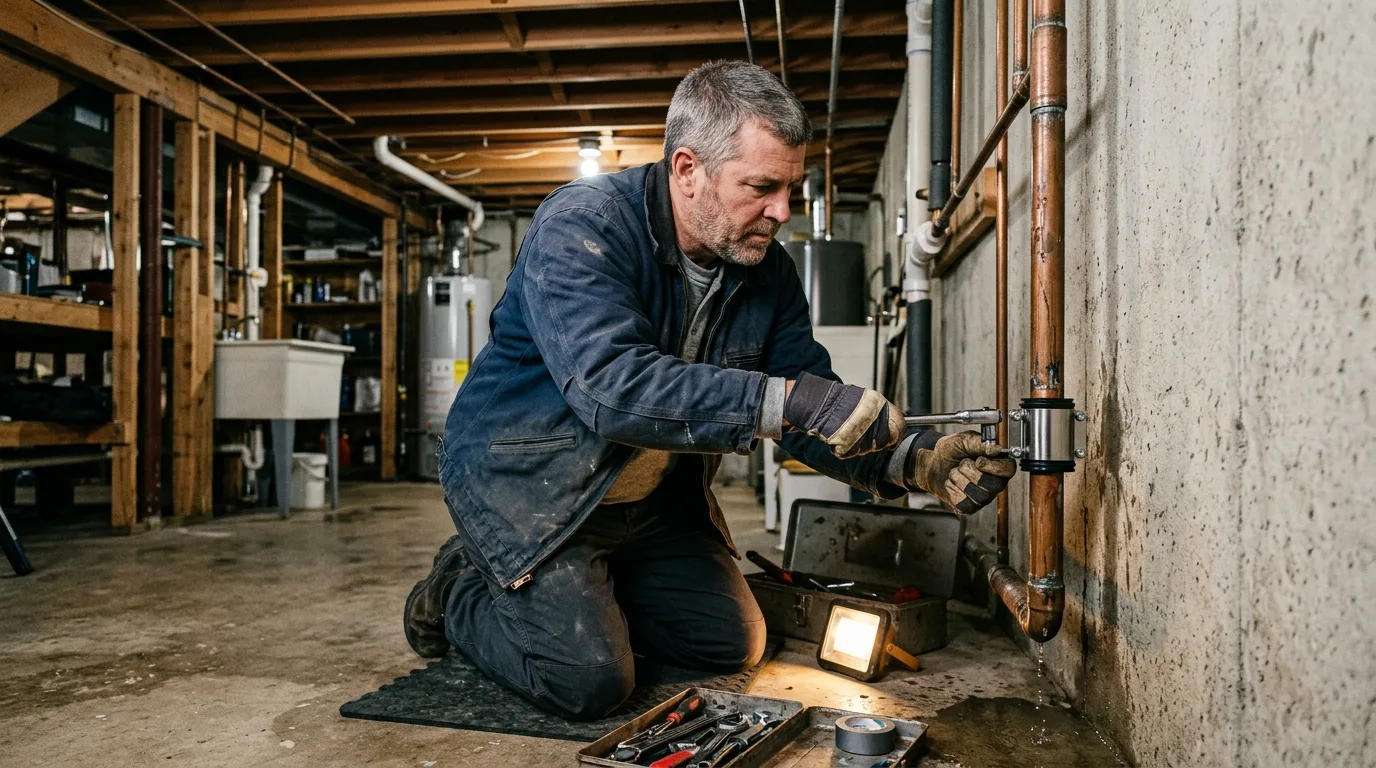
Emergency repair · Corona, CA
A split supply line moves several gallons a minute into whatever is next to it. Shut the main, then call; we connect you with a plumber who can find the break, cut it out and put the house back together.
Do not wait for daylight on a pipe that is still leaking. Damage cost climbs faster than repair cost.
Located, not guessed at
Pressure testing and acoustic tools find the break before drywall comes off.
Copper, PEX, galvanized
Different materials, different repairs. All three are common in Corona.
Cause addressed too
A pipe that burst from high static pressure will do it again if nobody checks the regulator.
First moves
A half-inch supply line under normal residential pressure delivers roughly six to eight gallons a minute. A quarter of an hour is a hundred gallons into a wall cavity. Speed matters more than diagnosis here, so do this in order and worry about the cause later.
Do not turn the water back on to check whether it is still leaking. If the break is inside a wall, that one test can double the damage. Leave the main closed until a plumber has isolated the run and can pressurise it deliberately.
Why pipes burst here
Freezing is at the bottom of this list, not the top. In this valley, pressure and minerals do most of the damage.
01
Foothill pressure zones plus a pressure-reducing valve that stopped regulating. The pipe did not fail because it was old; it failed because it has been over-stressed for years.
02
Hard water and stray currents pit copper from the inside. A pinhole weeps for months behind drywall, then opens into a slit and becomes a flood in one afternoon.
03
In pre-war downtown homes, galvanized supply corrodes inward until the wall thickness is gone. When one section lets go, the rest of the run is usually the same age and condition.
04
A slamming valve or a fast-closing appliance solenoid sends a shock wave down an unsecured run. Repeated hammer works fittings loose and cracks joints, especially at unsupported horizontal runs.
05
A nail or screw through a stud bay during a remodel, a trencher through an irrigation feed, an anchor bolt into a wall line, a garage shelf bracket into a copper riser.
06
Real but narrow. Uninsulated hose bibs, garage lines on an exterior wall, and above-ground irrigation risers are what actually freeze on the handful of genuinely cold nights.
Method
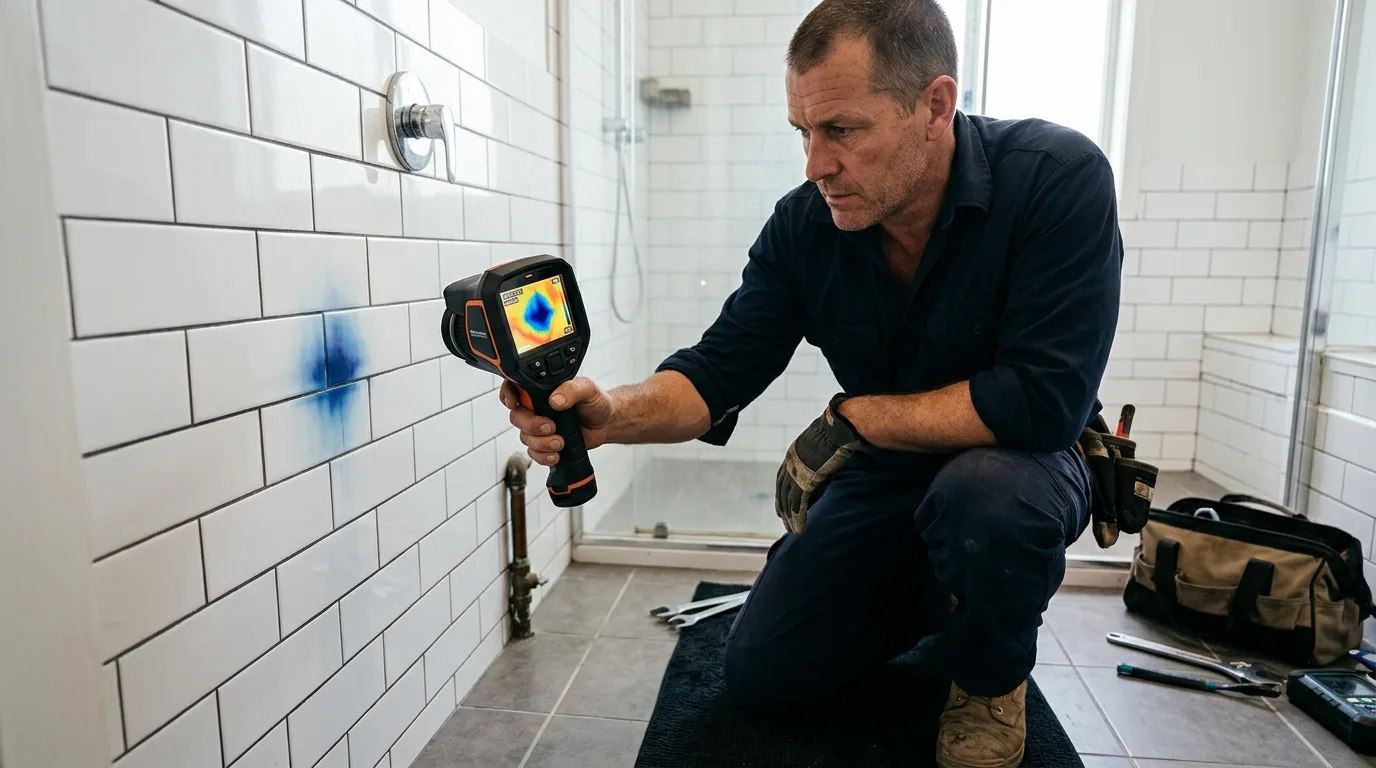
The expensive mistake in burst pipe work is opening the wrong wall. Water travels along framing and pools where gravity takes it, which is frequently nowhere near the failure. A stain on a hallway ceiling can come from a line two rooms away.
So the sequence is location first, demolition second:
Then the repair: cut out the failed section, replace with the right material and fittings for the run, pressure test the repair, and only then close it up. If the same run has more thin spots, normal in galvanized and in pitted copper, the plumber will tell you, and you can decide between another spot repair and repiping that section.
The visit
Emergency does not mean improvised. The order of operations is the same at 3am as at 3pm.
First act on arrival, before any diagnosis. If you have not managed to close the main, that happens now.
Isolation, pressure testing and acoustic or thermal tools. Nothing gets cut until the plumber can say where the failure is and why they believe it.
Including what has to be opened to reach it, and what putting it back involves. You approve before tools come out.
Cut back to sound pipe on both sides. Repairs that stop at the visible damage on corroded galvanized or pitted copper are the ones that leak again in six weeks.
Correct material and fittings for the run, properly supported, then brought back up to pressure and watched before anything is closed.
Static pressure read at a hose bib, the pressure-reducing valve inspected, hammer arrestors and pipe support looked at. A burst pipe is a symptom, and leaving the cause in place guarantees a repeat.
8
Roughly what a half-inch supply line delivers into a wall
80
Common upper limit for residential fixtures, some zones arrive above it
24/7
Emergency dispatch across Corona and western Riverside County
5
92879 through 92883, all covered
Local detail
What burst, and what to do about it, depends almost entirely on when your house was built. Corona has at least three distinct eras of plumbing in the ground, and they fail in different ways.
Galvanized steel supply, cast iron and clay on the drain side, and services that were sized for a house with one bathroom. Galvanized corrodes from the inside out, so a run can look fine and have almost no wall thickness left. When one section bursts, the honest conversation is not about that section. It is about whether the rest of the run is next, and whether the money is better spent on a planned repipe than on a series of emergencies. We will show you the cut-out section; you can usually see the remaining wall thickness with your own eyes.
Mostly copper, often with original angle stops and original valves. This is the stock where pinhole failures show up most: decades of hard water, some stray-current pitting, and a pressure regulator that was never replaced. A repair here is usually genuinely local, but it is worth having the static pressure read while the plumber is on site, because a house running above eighty psi will keep producing pinholes wherever the copper is thinnest.
Slab-on-grade, copper or PEX, softener loops and builder-grade fittings. Bursts in these homes are frequently under the slab rather than in a wall, which changes the whole job; that is a slab leak repair, decided between re-routing the line overhead or opening the concrete. Above the slab, the common failures are builder angle stops, washing-machine hoses that were never replaced, and copper runs in an unconditioned garage wall.
It comes up on nearly every burst pipe call in the higher zones. Corona climbs from about 500 feet at the freeway junction to well over 1,000 feet against the foothills, and the water system is zoned to serve that spread. Your house is protected by one part: the pressure-reducing valve on the main. Reading static pressure takes a plumber about two minutes with a gauge on a hose bib. If it comes back high, dealing with the valve is the cheapest plumbing you will ever buy, because it stops the next three failures.
Judgment call
Both are legitimate. Which one is right depends on what the cut-out section looks like.
Still leaking?
Shut the main and call. We will get a plumber on the way and talk you through the rest while you wait.
24/7 across Corona, Norco, Riverside, Eastvale, Chino Hills, Yorba Linda and Lake Elsinore.
Related work
Burst pipe FAQs
A half-inch supply line at normal residential pressure runs roughly six to eight gallons a minute, and a three-quarter-inch line considerably more. Fifteen minutes is around a hundred gallons.
That is the whole reason the first instruction is always to shut the main rather than to investigate. Diagnosis can wait two minutes; the water cannot.
A repair clamp or tape on an accessible, visible pinhole can buy you time, and if that is all that stands between you and a flooded room, use it.
But treat it as a tourniquet, not a repair. It does not address why the pipe failed, it will not hold at full pressure indefinitely, and on corroded galvanized the clamp frequently just moves the failure a few inches along.
Usually a small section, yes, but far less than people expect when the leak is located properly first. A confirmed location means one targeted inspection opening rather than a run of drywall removed on a hunch.
Plumbers handle the plumbing and the opening. Drywall finishing, texture and paint are normally a separate trade, and the plumber will tell you plainly which is which so nothing falls between the two.
Sudden, accidental water damage is commonly covered, while the failed pipe itself and any long-term seepage often are not. Policies vary enormously and we are not the ones to advise you on yours.
What helps your claim: photographs taken before you clean up, the date and time you discovered it, the plumber’s written description of the failure, and the invoice. Ask for the cause to be written down explicitly rather than just the work performed.
Because freezing is a minor cause in this valley. The two big ones are sustained high static pressure and internal corrosion from hard water, both slow processes that produce a sudden event.
That is why static pressure gets read on the visit. If the number comes back high, the pipe was not unlucky and the next one will not be either.
Not automatically, but look at the evidence. Galvanized corrodes uniformly from the inside, so if the cut-out section has lost most of its wall thickness, the rest of that run is the same age, the same water and the same condition.
Ask to see the piece that came out. If it is nearly closed with rust, a planned repipe is usually cheaper over five years than a string of emergency spot repairs, each with its own after-hours rate and its own hole in a wall.
An accessible copper or PEX repair is often an hour or two once located. Add time if the break is behind tile, above a finished ceiling, inside a two-story wall or under a slab.
Location is the variable. A visible spray in an open garage wall is quick; an audible leak somewhere in a single-story slab home takes proper detection work before any repair begins.
Yes, meaningfully. Under-slab work means either opening the concrete at the located point or abandoning the run and re-routing new pipe overhead through walls and attic.
Which one is right depends on where the break is, how the house is laid out, what flooring is over it and whether the rest of that line is worth keeping. It is covered on our slab leak repair page.
Yes. The service area covers Norco, Riverside, Eastvale, Chino, Chino Hills, Yorba Linda and Lake Elsinore alongside every Corona neighborhood.
Drive time varies. Sierra Del Oro and Green River sit out at the Orange County line, and Temescal Valley runs well down the canyon. You will be told a realistic window rather than an optimistic one.
Three things, in order of how much difference they make. Get the static pressure read and the pressure-reducing valve corrected if it is high; that is the single biggest lever in the foothill zones.
Then replace braided appliance supply lines on a schedule rather than waiting for them to fail, and if the water’s mineral load is chewing through fixtures and heaters, consider softening it. Finally, if the failed material was galvanized, plan its replacement rather than reacting to it.
Corona, CA · 24/7
Emergency response any hour, honest pricing before the work starts, and a plumber who checks why it happened before they leave.
Copper, PEX, galvanized and main lines. Upfront pricing. No hidden fees.