01
Galvanized steel
Common in Circle City and downtown Corona homes from before the mid-fifties. Rusts from the inside out, chokes down to a fraction of its bore, and fails at threaded joints. A spot repair on galvanized buys time and little else.
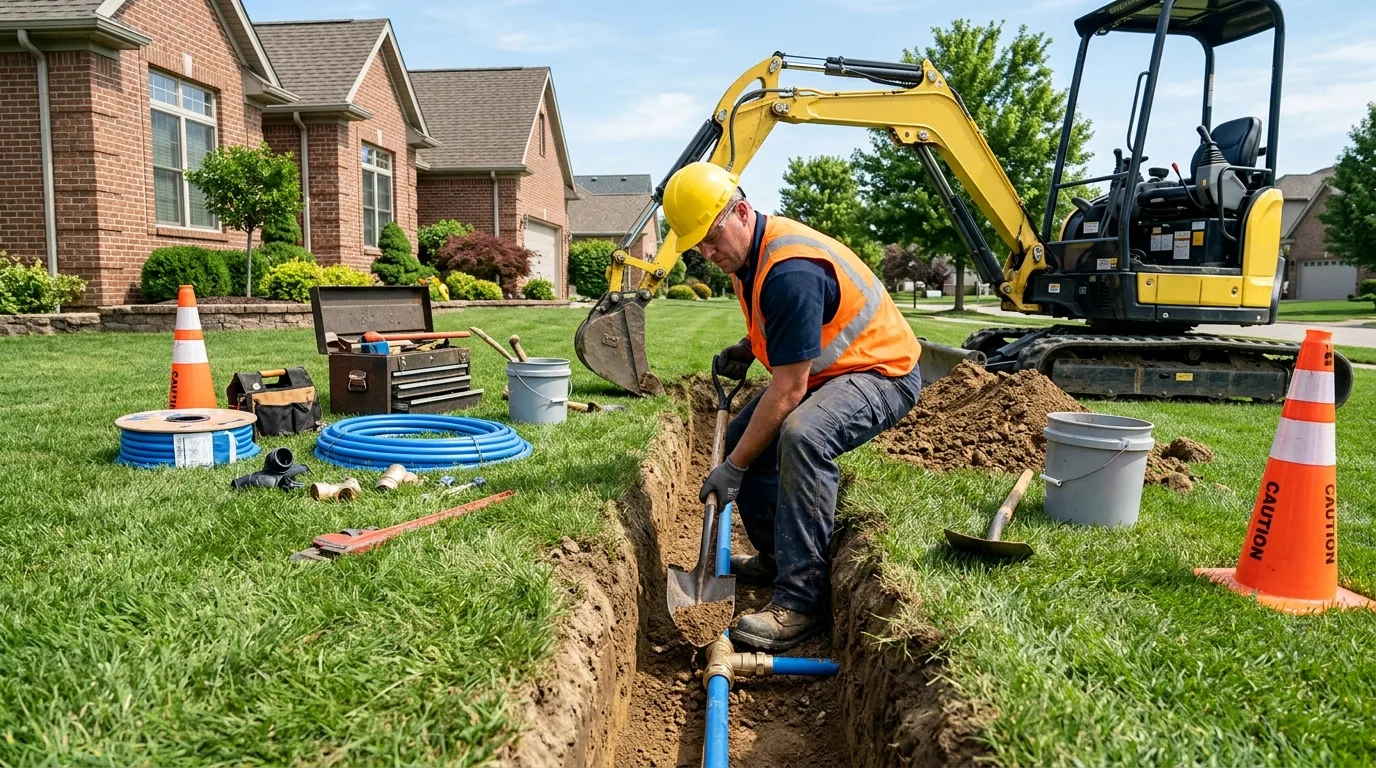
Meter to house · Corona, CA
The line between your meter and your house carries every drop you use, and it fails quietly. If your meter dial is turning with every tap shut off, we can find the break and give you both repair and replacement numbers before anything gets dug.
Answered 24/7 · independent local contractors · upfront pricing before excavation
24/7
Dispatch, including nights and weekends
Trenchless
Pull-through replacement where the run allows
Upfront
Repair and replace priced side by side
The symptom list
Your water service line is the single pipe that runs from the city meter at the curb, under your yard and driveway, to the point where water enters the house. It is usually the longest continuous run of pressurized pipe on the property, it is buried where nobody looks at it, and it is under pressure twenty-four hours a day. When it starts to fail, the house rarely gives you a dramatic signal. It gives you a set of small, easy-to-explain-away ones.
The clearest test is also the cheapest. Shut off every fixture in the house, including the irrigation controller and the ice maker, then walk out to the meter and watch the low-flow indicator, the small triangle, star, or dial that spins on any measurable flow. If it moves at all with the house completely still, water is going somewhere between the meter and your fixtures, and on a slab-on-grade Corona house the service line is one of the two prime suspects.
Beyond the meter test, the pattern usually looks like this: a water bill that steps up thirty or forty dollars and stays there; a patch of lawn near the driveway or the side yard that stays green and soft through a Corona July when the rest of the grass has given up; pressure that has dropped everywhere in the house at once rather than at one fixture; a faint hiss in the wall near where the line enters; or a slow bloom of efflorescence and dampness on a garage wall or a stem wall. On sloped lots in Sierra Del Oro and Green River, the water often surfaces downhill of the actual break, which is exactly why guessing at the dig location wastes money.
None of those symptoms tells you where the break is or whether the pipe is worth patching. That is what the visit is for. We locate the line, pinpoint the loss, and then talk about the two honest options in front of you.
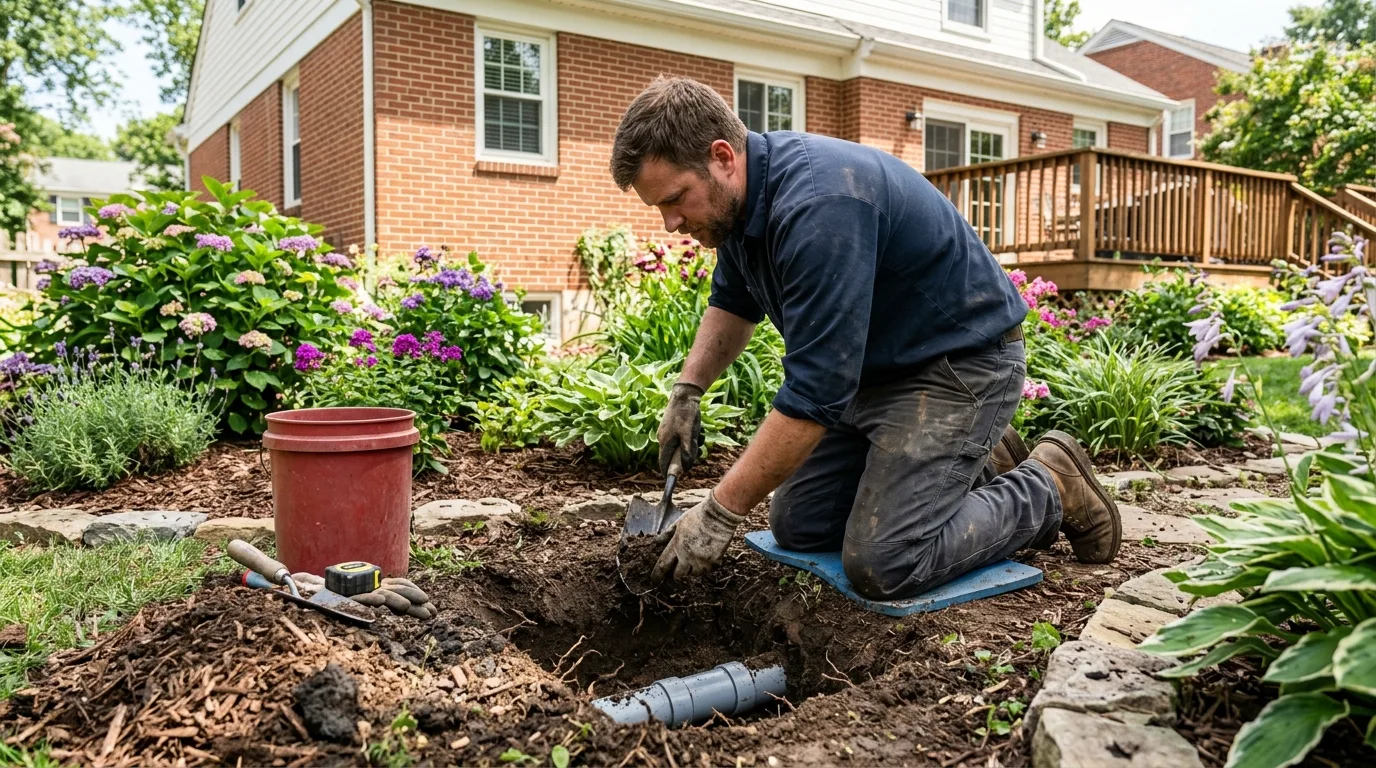
Locating
A main line break is a pressurized leak, and pressurized leaks make noise. The work starts with a pressure test at a hose bib to confirm the loss is real and to measure how fast the system bleeds down when it is isolated from the meter. That single number tells us a great deal: a slow bleed points at a pinhole or a weeping joint, while a fast one points at a split or a pulled fitting.
From there we trace the pipe. A line locator follows the metallic run or a transmitter pushed through it, and the path gets marked in paint so everyone can see where the pipe actually goes, which, on Corona tracts built in the eighties and nineties, is frequently not the straight line from meter to house that homeowners assume. Then acoustic gear listens along that marked path for the specific frequency signature of water escaping under pressure through soil.
Where the ground is covered by stamped concrete, pavers, or a long decorative driveway, we take extra care with the pinpoint, because a mistake there costs a great deal more than a mistake in a lawn. On those jobs we will often confirm the location a second way, tracer gas or a correlation reading from two points, before anything is cut.
You get told where the break is, how deep the line runs, what it is made of, and what the surface above it is, before a shovel comes off the truck.
What is under your yard
What your service line is made of drives almost everything about the repair conversation, whether a spot fix is reasonable, and how long the rest of the pipe has.
01
Common in Circle City and downtown Corona homes from before the mid-fifties. Rusts from the inside out, chokes down to a fraction of its bore, and fails at threaded joints. A spot repair on galvanized buys time and little else.
02
The standard for decades and generally a good pipe. Fails from outside corrosion where it sits in aggressive soil, from abrasion against rock, and from electrolysis where a dissimilar metal fitting was used. Single-point repairs are often legitimate.
03
Gray plastic with crimped fittings, installed in a window of late-seventies to mid-nineties construction. Fails at the fittings and gets brittle with chlorine exposure. When we find it, replacement is almost always the recommendation.
04
What a modern replacement is made of. Continuous, no joints between meter and house, flexible enough to be pulled through the old path, and immune to the corrosion mechanisms that killed whatever it replaced.
05
Older Corona homes were plumbed for one bathroom and a hose bib. If the house has since gained a bathroom, a jetted tub, or a full irrigation system, a three-quarter-inch service line is now the bottleneck, and upsizing during replacement solves it.
06
On some older lots, the service line crosses a neighbor, splits to a detached structure, or runs alongside an abandoned predecessor. Tracing before digging keeps the crew from replacing the wrong pipe.
Sequence
From the first phone call to the final inspection, so you know what day you get your water back.
Meter test, isolation test at the bib, and a pressure drop measured over time. If the loss turns out to be irrigation or a running toilet, you find that out in the first twenty minutes instead of after a trench.
The pipe path gets located and painted, the leak position gets marked, and depth is confirmed. Utility marking is called in before any excavation where required.
A spot repair number and a full replacement number, with the honest case for each based on the pipe material, its age, and how many other weak points the trace revealed.
City of Corona permitting is handled where the scope requires it. Water gets shut at the meter, and you get told how long the house will be dry.
A spot repair is excavated, cut back to sound pipe, and rejoined with a full-flow coupling. A replacement is pulled or bored through as continuous pipe from a pit at the meter to a pit at the house, so the lawn and driveway between them stay intact.
The new line is pressure tested and chlorinated where required, the connection is inspected, the trench is backfilled and compacted, and hardscape and sod are restored to the condition agreed in the estimate.
24/7
Dispatch answered, every day of the year
2
Prices given: repair and replace
0
Hidden fees added after the work
Why here
Service lines do not wear out on a national average schedule. They wear out according to the ground they sit in, the water that moves through them, and the pressure that water arrives at. Corona stacks all three against the pipe.
Expansive soil. Much of the Corona basin sits on clay-rich soils that swell when they get wet and shrink hard when they dry. Our rainfall arrives in a few concentrated winter events and then stops for six months, so the ground around a buried pipe moves through a large annual cycle. That movement puts bending load on rigid pipe and on every fitting in the run, and it is the reason threaded galvanized joints and crimped polybutylene fittings in this valley let go earlier than they do in milder climates.
Hard water. Corona’s supply blends local Temescal basin groundwater with imported State Water Project water, and the result is hard, commonly in the fifteen to twenty grain range. Hardness by itself does not eat pipe, but the scale it deposits narrows old galvanized lines further and makes a partially blocked service line feel like a pressure problem long before it is diagnosed as a pipe problem.
Static pressure. Corona is built across a substantial elevation range, from the Santa Ana River corridor up into the hillside tracts. Neighborhoods sitting low in a pressure zone can see static pressure well above what residential plumbing is designed around. Higher pressure means every existing weak point leaks sooner and harder. This is why we check static pressure at the hose bib on every main line call, and why a replacement conversation sometimes includes a pressure regulator that should have been there all along.
Age clusters. Corona built in waves, which means whole neighborhoods reach end of pipe life together. The pre-war and post-war housing near downtown and Circle City is on galvanized that has already outlived its design life. The eighties and nineties tract expansion through El Cerrito, Corona Hills, and Chase Ranch is deep into the window where copper service lines start showing soil-side corrosion and where polybutylene is on borrowed time.
Straight answers
| Factor | Why it changes the number |
|---|---|
| Length of the run | A meter at the curb on a compact lot is a short pull. A long driveway in Eagle Glen or a deep setback in Orange Heights can triple the footage of new pipe and the machine time to get it in. |
| What is on the surface | Lawn and dirt are cheap to open and cheap to put back. Stamped concrete, pavers, mature landscaping, and decorative driveways carry real restoration cost, which is exactly why trenchless pulling is worth pricing. |
| Depth and soil | Deeper lines and rocky or heavily compacted ground mean more excavation time. Hand digging near other utilities costs more than machine time. |
| Repair versus replacement | A single clean break in sound copper can be a same-day spot repair. Galvanized or polybutylene, or a line with multiple weak points on the trace, pushes the honest answer toward full replacement. |
| Trenchless feasibility | A straight, traceable path with room for entry and exit pits allows a pull-through and preserves the surface. Tight bends, obstructions, or unknown routing may force an open trench. |
| Upsizing | Going from three-quarter to one inch on a house that has outgrown its original line adds material cost but fixes a pressure complaint permanently. |
| Permits and inspection | Scope that touches the meter connection or replaces the service generally requires a permit and an inspection. That is quoted, not surprise-billed. |
| After hours | A break flooding a yard at midnight gets dispatched at midnight. Emergency response is priced differently than a scheduled morning, and you hear that number on the phone. |
Every number is given before work starts. If what we find in the ground changes the scope, work stops and you approve the revision first.
Meter still spinning?
Tell us what the meter is doing and what you are seeing in the yard. Dispatch can usually tell you on the phone whether this needs a truck tonight or a scheduled morning.
Answered 24/7 · upfront pricing before excavation
Related work
Coverage
Before you dig
Locating first is not an upsell. It is the difference between one small pit and a yard full of exploratory holes.
Independent local contractors · workmanship guarantee on completed work
Main line FAQs
The dividing line is almost always the meter. The city owns and maintains the main in the street and the meter itself; everything on the house side of that meter is private property and the homeowner’s responsibility, including the entire run under your yard and driveway.
That is why the meter test matters so much. If the leak is on the street side of the meter, the utility handles it. If the dial is spinning and the loss is on your side, it is your line. We confirm which side the loss is on before quoting anything.
A straightforward spot repair on an accessible copper line is usually a few hours of dry house, most of it excavation rather than pipe work. A full service line replacement is typically a one-day shutoff, with water restored the same evening in most cases.
Longer runs, hardscape removal, or a required inspection before backfill can push a replacement into a second day. You get told which of those you are looking at before the crew starts, not partway through.
Often, yes. A pull-through or bore replacement needs an entry pit near the meter and an exit pit near the house, and the new continuous pipe is drawn through the ground between them. The driveway, lawn, and hardscape in between stay where they are.
It is not universal. Sharp direction changes in the original route, unknown obstructions, other utilities crossing the path, or a line running under a structure can force an open trench for part or all of the run. We tell you which method the site allows after the trace, and we price it both ways when both are genuinely possible.
It comes down to material and history. A single mechanical break in otherwise sound copper, whether from a rock, a shovel strike or one bad fitting, is a reasonable patch, and we will say so.
Galvanized steel that has been in the ground seventy years, polybutylene with crimped fittings, or any line where the trace found multiple soft spots is a different situation. Patching those means paying for excavation now and paying for it again in a year or two. When the honest math favors replacement, we show you why rather than just asserting it.
It is one of the top candidates, alongside a failed pressure regulator and a partially closed main shutoff. A restricted or leaking service line lowers the volume available to the whole house, so every fixture weakens together.
The diagnosis is quick: we measure static pressure at a hose bib, then measure again under flow. The relationship between those two numbers separates a supply restriction from a regulator problem, and it costs nothing extra to check on a service call.
A spot repair on a private line is usually straightforward. A full service line replacement, or any work at the meter connection, generally requires a permit from the City of Corona and an inspection before the trench is closed.
The contractor who takes the job handles the permitting and schedules the inspection as part of the scope, and the cost appears in your written estimate. Skipping the permit to save a few dollars creates a disclosure problem the next time you sell the house.
The honest answer is that it depends on footage, depth, and what is on the surface, and any number quoted sight-unseen is a guess dressed up as a price. A short run under lawn on a compact lot is at the low end of the range. A long run under a stamped concrete driveway with mature landscaping is at the high end.
What we will commit to is process: we locate first, we measure the run, we look at the surface, and then you get a written number before a machine arrives. If the ground reveals something the trace could not, work stops and you approve the change.
Pressure, often yes, especially if we upsize an undersized original run or if the old line was choked with corrosion. That is a common and satisfying outcome of a replacement.
Hard water, no. Hardness is a property of the water Corona delivers, not of the pipe carrying it. A new service line will not soften anything. If scale is the underlying complaint, that is a water softener conversation, and a replacement is a convenient moment to plan for one.
Water follows the path of least resistance underground, not a straight line to the surface. It will travel along the pipe trench, follow a gravel bed, run down the slope of the lot, or wick sideways through a soil layer before it finds daylight.
On Corona’s sloped lots this is routine, surfacing twenty or thirty feet downhill of the actual break is common. It is also the single best argument for acoustic pinpointing rather than digging at the puddle.
Sometimes. A very slow loss with no structural involvement can reasonably be scheduled, and we would rather help you plan the work than pressure you into it.
What should not wait: water surfacing near a foundation or stem wall, a loss fast enough to move the meter dial visibly, any dampness appearing inside the house or garage, or a sinkhole or soft depression forming in the yard. Those are moving-soil problems as much as plumbing problems, and moving soil under a slab is expensive. If any of that describes your situation, call now and we will get eyes on it today.
Corona, CA · service line specialists
Locate, pinpoint, and two honest prices, before anything is cut, dug, or committed to.
Dispatch answers 24/7 · same-day and emergency response available