01
Under the slab
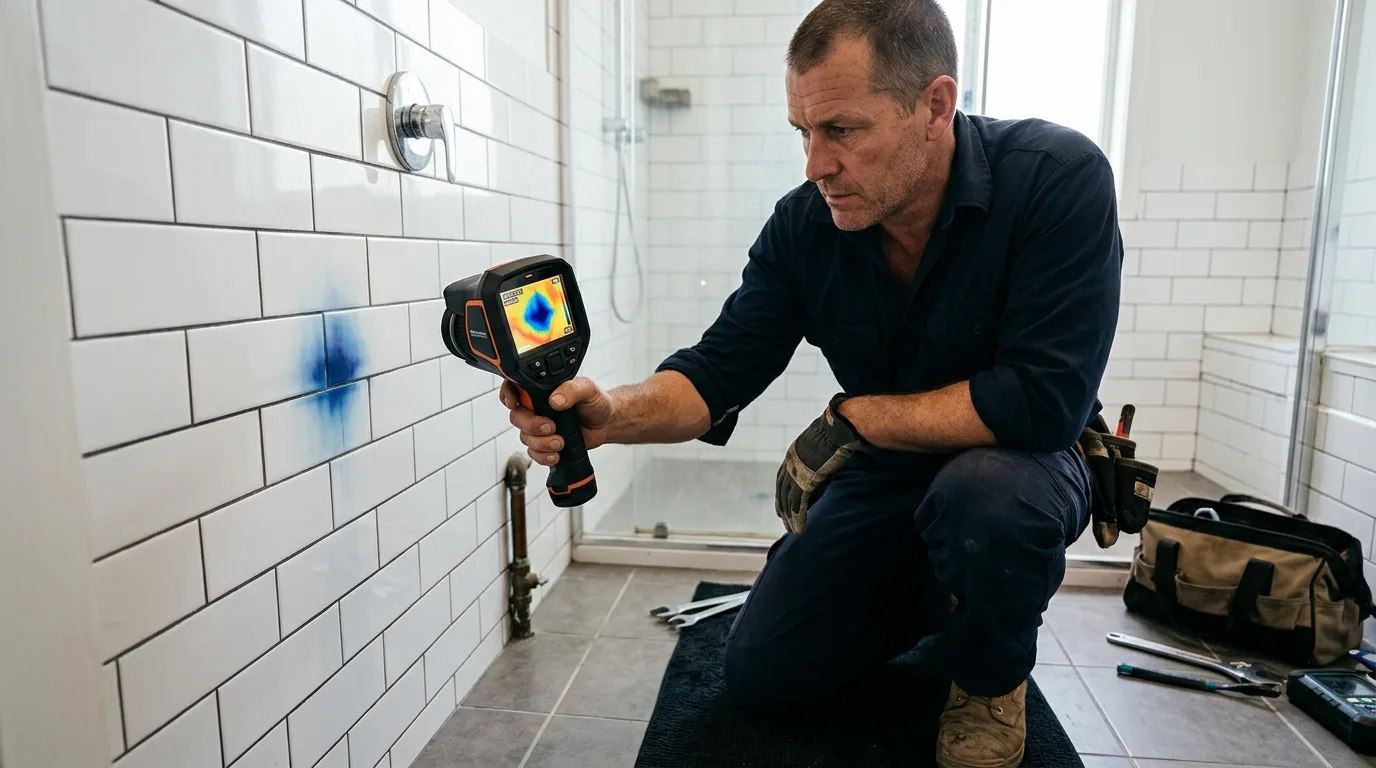
Hot-side copper abrading against concrete. Warm patch on the floor, running-water sound, no puddle. The most common hidden leak in south Corona tract housing.
Non-destructive location · Corona, CA
Your bill jumped, the meter is turning and there is no puddle anywhere. Finding the leak is a separate skill from fixing it, and doing it properly is what keeps a repair from becoming a demolition.
Do the meter test before you call. It takes two minutes and makes everything after it faster.
Located, then priced
You get a marked position and the evidence for it before any repair number is discussed.
Four methods, not one
Acoustic, pressure isolation, thermal imaging and tracer gas, whichever the house needs.
Slab, wall, yard or main
Under concrete, inside a wall, beneath hardscape or out at the meter.
Before you call
Leak detection sounds like a service you buy blind. It is not; you can do the first step yourself, and it changes the conversation entirely.
That last distinction alone tells a plumber which tools to bring. Tell us the result when you call.
Before assuming a hidden leak, drop food colouring in each toilet tank and wait twenty minutes without flushing. Color appearing in the bowl means a failed flapper is quietly passing water, the single most common cause of a mystery bill, and a ten-dollar part. Same logic for irrigation: a stuck valve or a cracked lateral can waste more than most house leaks and never touch the building.
What we look for
The visible symptom is almost never above the leak. Water runs along framing and pipe until gravity gives it somewhere to go.
01
Hot-side copper abrading against concrete. Warm patch on the floor, running-water sound, no puddle. The most common hidden leak in south Corona tract housing.
02
A pinhole in copper weeping for months behind drywall. Shows up as a stain on a ceiling one room away, or a baseboard that never quite dries.
03
The private service line, often under a driveway, a lawn or newer hardscape. Symptom is a spinning meter with the house valve closed.
04
A weeping relief valve, a corroded fitting, or a tank seam starting to go. Small now, forty gallons on a garage floor later.
05
A cracked lateral, a stuck valve, or a pool losing more than evaporation explains. Often the whole answer to a bill nobody can account for.
06
Not under pressure, so no acoustic signal and no meter movement. Found instead with dye, smoke or a camera in the line.
Toolkit
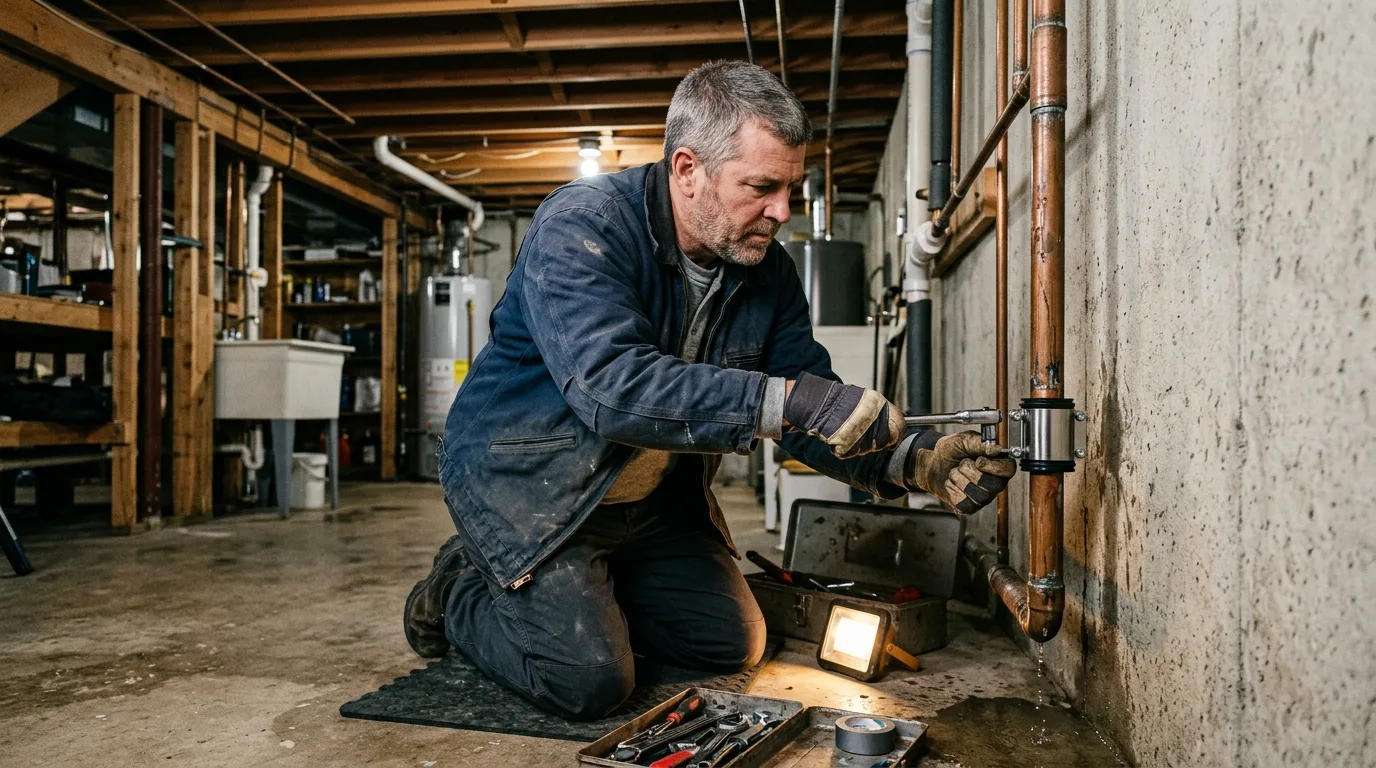
No single method works on every house. A competent detection visit moves between them and uses each to confirm the others.
Sections of the system are shut off in turn and watched to see which ones hold. Hot and cold are tested separately. This is unglamorous and it is the backbone of the job; it turns a whole-house mystery into one run of pipe.
Pressurised water escaping through a small opening makes a specific, narrow-band noise. Ground microphones and amplifiers pick it up through concrete, tile and drywall. In practised hands the leak lands within about a foot.
Wet material holds temperature differently from dry material, and a hot-water leak heats what surrounds it. An infrared camera shows the shape of the wet area and often the path of the pipe, which is how you avoid opening the wrong bay.
When a leak is too quiet to hear, a very small opening, or a line under deep fill, the drained pipe is charged with a safe inert gas mix that migrates up through concrete or soil and is picked up at the surface. It is the method of last resort and it works when nothing else does.
Line and pipe tracing runs alongside all of it, because plans lie and remodels move things.
The visit
You are buying a location and an explanation. Repair is the next decision, made with information rather than without it.
Meter observation with the house isolated, so we know there is a leak, roughly how big it is, and whether it sits inside or outside the building.
Toilets, irrigation, pool fill, water heater, hose bibs, the softener drain line. Cheap causes get eliminated before expensive investigation begins.
Hot versus cold, branch by branch, until the losing section is identified. Everything downstream of this step gets faster.
Acoustic first, then thermal, then tracer gas if needed. The result is a marked spot on your floor, wall or yard, not a general area.
You should be able to hear the amplified leak or see the thermal image yourself. If a plumber can only tell you the conclusion, be skeptical.
Spot repair, re-route or replacement, each with what it means for concrete, drywall and flooring. Then you decide, in daylight, without pressure.
1
Typical pinpoint accuracy of good acoustic work
2
How long the meter test takes you before you call
4
Detection methods used, cross-checked against each other
24/7
Line answered whenever the meter will not stop turning
Local detail
Detection is a general skill applied to a specific building stock. Corona has a few characteristics that change how the work goes.
In the tracts south of Ontario Avenue, South Corona, Eagle Glen, Chase Ranch, Sycamore Creek, Dos Lagos, Temescal Valley, supply lines were run in or under the concrete before the pour. There is nowhere to look and nothing to see, so acoustic and thermal work does all the lifting. It also means the first symptom is often a warm floor or a large bill rather than water, which is covered in more depth on the slab leak repair page.
Inland Empire water carries a heavy mineral load, and the failures it causes are pinholes and pitting rather than clean breaks. Small openings are quiet openings, which is exactly the case where acoustic detection struggles and tracer gas earns its keep. It is also why a house here can leak for six months before anybody notices.
Corona climbs from about 500 feet at the freeway junction to over 1,000 feet against the Santa Ana Mountains foothills, and the system is zoned accordingly. Where the pressure-reducing valve has failed, static pressure can sit above what residential piping is rated for. That has two effects on detection: leaks are easier to hear, and there is frequently more than one. A house that produces two separate pinholes in a year does not have bad luck, it has a pressure problem.
Downtown and the Circle City district have housing from around 1910 with decades of alterations on top, galvanized to copper transitions in odd places, capped runs that were never actually capped, additions over slab, converted porches. Line tracing matters more here than anywhere else in the city, because where the pipe runs is genuinely unknown until it is traced.
Older neighborhoods have deep-rooted trees over service lines, and newer ones have pavers, stamped concrete and pools laid over them. Both raise the cost of guessing wrong about a yard leak by a great deal, which is the entire argument for paying for detection before paying for excavation.
Worth knowing
Straight answers
| Factor | Why it matters |
|---|---|
| How loud the leak is | A leak under decent pressure is found quickly. A slow weep through a pinhole can take several methods and real time. |
| Construction over it | Bare slab and tile read well. Thick fill, engineered hardwood, a two-story layout or dense hardscape all slow the work. |
| Whether it is inside or outside | Yard and main line leaks bring in line tracing and sometimes ground-listening across a long run rather than one room. |
| How much has been ruled out | If you have already done the meter test and the toilet dye test, the plumber starts several steps in. |
| Number of leaks | High-pressure houses often have more than one. Finding a second changes both the visit and the repair conversation. |
| Access | Furniture, storage, a full garage or a locked irrigation box all add time. Clearing access before arrival is free and helps. |
Detection is priced as its own piece of work. That is deliberate; it keeps the incentive on finding the leak accurately rather than on selling the biggest repair.
Meter still turning?
Every dollar spent locating a leak accurately saves several on drywall, tile and concrete that never needed to come out.
Same-day appointments available across Corona and western Riverside County.
Related work
Leak detection FAQs
Good acoustic work on a pressurised line typically pinpoints to within about a foot, and thermal imaging plus line tracing tightens that further by confirming where the pipe actually runs.
Accuracy drops when the leak is very small, the fill is deep or the flooring is thick. In those cases tracer gas is the fallback, and a competent plumber will tell you honestly how confident they are rather than presenting a guess as a location.
No. The whole point is that detection happens before any opening. Acoustic, thermal, pressure and tracer methods all work through concrete, tile and drywall.
The first cut should be one small, deliberate inspection opening at the marked point, and that already belongs to the repair, not the detection.
Yes, and the meter test tells you in advance that is where it is: if the meter keeps moving after you close the house shut-off, the loss is between the meter and that valve.
Yard work uses ground microphones along the traced route, plus tracer gas if the ground is soft or the leak is quiet. It is well worth doing before anyone opens a driveway or a lawn, see main water line repair.
Very. A slab leak drains into subgrade, a yard leak drains into soil, and a passing toilet flapper sends clean water straight down the sewer. None of them produce a puddle.
Start with the toilet dye test and the irrigation system, since those are the cheapest causes to eliminate. If both are clear and the meter still moves, you have a hidden leak worth locating.
Water leak detection is a different discipline from gas. If you smell gas, get everyone out of the house and call the gas utility from outside; that is the correct first call, always.
Once the property is safe, we can get a plumber out for the gas line repair or pressure test.
Most residential detection visits run one to three hours. A loud slab leak in a single-story tile-floored house can be found in well under an hour; a quiet leak in a two-story home with hardwood, or a long yard run, takes considerably longer.
You will be given a realistic expectation when you book, and told if the job is heading beyond it.
You can, and sometimes that is the right call on a small, obvious job. But water tracks along framing and pipe before it drops, so the stain is often nowhere near the failure.
Opening drywall on a hunch is how one small repair turns into three holes and a painter. Detection exists precisely to avoid that.
A marked location, a description of what was found and by which method, the meter observations, and the repair options with prices. Ask for the cause to be stated explicitly, not just the work.
That document matters if you go to an insurer, and it matters if you decide to think about the repair for a few days before committing.
Irrigation, yes, stuck valves, cracked laterals and broken risers are a routine part of the same investigation, and they are a common answer to an unexplained bill. See hose bibs and irrigation.
Pool shell and plumbing work is generally a pool-specific specialty. We will tell you if that is where the evidence points rather than charging you to keep looking in the house.
Often yes, if it is accessible and the parts are on the van. An open-wall copper repair or a failed angle stop is usually done on the spot.
Slab work, re-routes, main line replacement and anything needing concrete cutting or a permit gets scheduled properly. Rushing those is how you get a repair that has to be done twice.
Corona, CA · 24/7
Electronic, acoustic and thermal detection, a marked location, the evidence explained, and repair options priced before anything is opened.
Upfront pricing before work begins. No hidden fees. Workmanship guarantee on completed work.