01
Leak testing and location
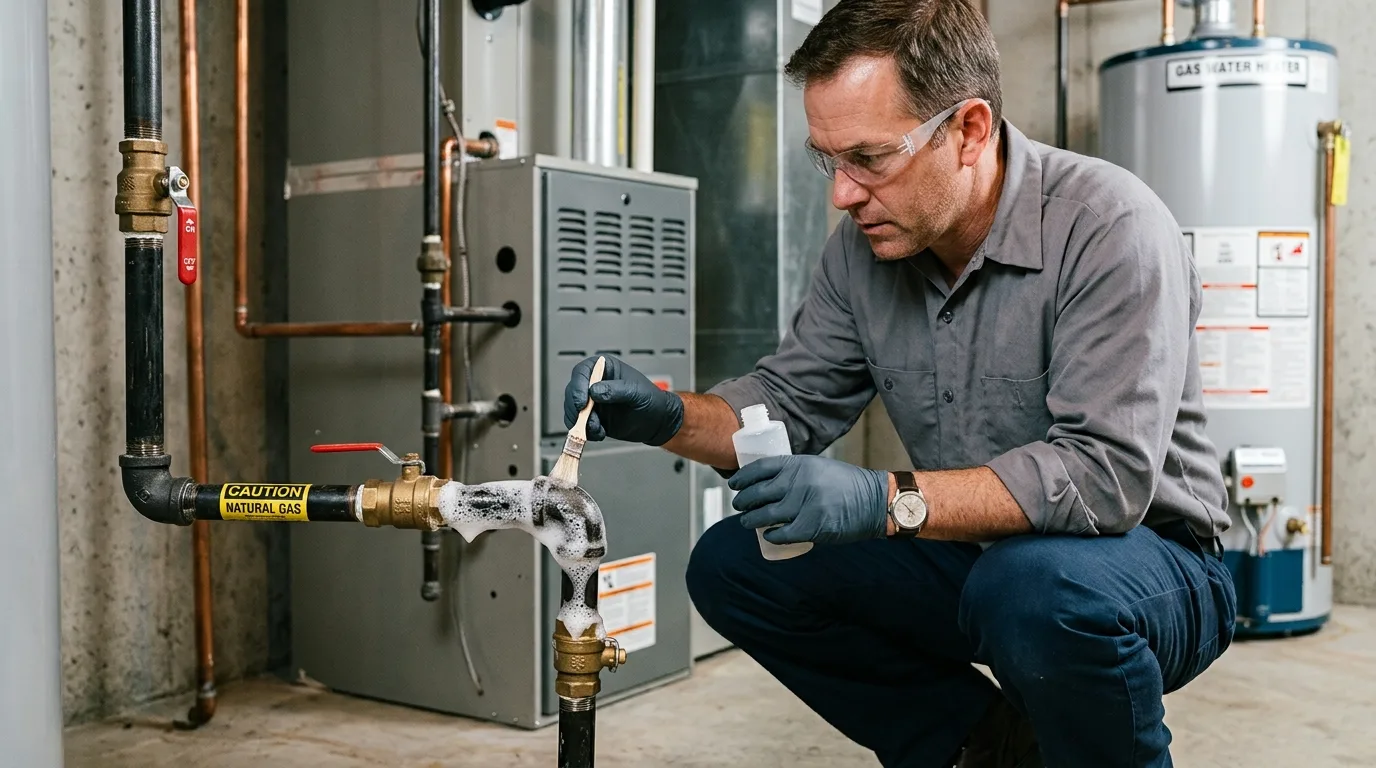
Pressure testing of the system, electronic detection at joints and fittings, and isolation of the affected section so the rest of the house can be restored safely.
Gas lines · Corona, CA
Gas work is the one area of plumbing where there is no acceptable margin for approximation. Every line we touch is pressure-tested and, where the scope requires it, permitted and inspected.
Smell gas? Leave the building first, then call from outside · dispatch answers 24/7
First things first
Natural gas is odourised with mercaptan specifically so that a leak announces itself. If you can smell it; that distinctive sulfur or rotten-egg note, treat it as real, every time, without exception.
Leave the building. Do not switch lights on or off, do not use a phone indoors, do not start a vehicle in an attached garage, and do not attempt to find the source yourself. Any of those can provide the ignition source that turns a leak into an event. Once you are outside and clear, call the gas utility’s emergency line and then call us.
If you can safely reach the main gas shut-off at the meter on your way out, a quarter turn on the valve with a wrench, so the tang sits across the pipe, do that. If reaching it means going back inside or through the smell, do not.
Symptoms other than smell are worth knowing too. A hissing sound near a line or appliance. Dead or discoloured vegetation in a line above a buried run in an otherwise healthy yard. Bubbles rising in standing water above a buried line. An unexplained rise in gas usage. And, most seriously, headaches, dizziness, or nausea that improve when you leave the house, which can indicate combustion problems rather than a raw gas leak.
We treat every gas call as a priority dispatch. There is no version of this where waiting until Monday is the right advice.
How it is done
The two things that separate competent gas work from the alternative are sizing and testing, and neither is visible in the finished job.
Sizing is arithmetic, not judgment. Every appliance has a BTU input rating. The pipe feeding it must deliver that volume at adequate pressure across the actual length of the run, accounting for every elbow and tee along the way. Undersize it and the appliance starves, a range that will not reach temperature, a furnace short-cycling, a tankless heater that cannot hit its rated output and throws a fault. The failure is not dramatic; it is a system that never quite works and nobody can explain why.
This matters most on tankless conversions. A tank heater might draw 40,000 BTU. A whole-house tankless unit can demand 199,000. The existing line is very often inadequate, and a quote that does not mention the gas line has probably not calculated it.
Testing is non-negotiable. New and repaired lines get isolated and held at test pressure on a gauge for a defined period. A line that holds is proven. A line that has merely been checked with soap at the joints is not. We also test existing systems on request, which is a sensible thing to do when buying a house or after any significant ground movement.
Permits apply to new lines and significant alterations. They exist so an independent inspector verifies the work, and they matter at resale, unpermitted gas work is a genuine problem in escrow and a genuine problem with an insurer after an incident. We pull them where the scope requires it and hand you the documentation.
Scope
Repair, extension, replacement, and everything that needs an inspector.
01
Pressure testing of the system, electronic detection at joints and fittings, and isolation of the affected section so the rest of the house can be restored safely.
02
Corroded, damaged, or failed sections replaced in appropriate material, with proper transitions and supports rather than patched fittings.
03
Ranges, dryers, furnaces, water heaters, and pool heaters, with the line sized for the appliance and the rest of the load it shares with.
04
Firepits, built-in barbecues, patio heaters, and outdoor kitchens, run in the correct material for exposure and burial with a dedicated shut-off at the appliance.
05
The gas-side work that whole-house tankless conversions usually require, calculated against the unit’s full-fire input rating rather than an estimate.
06
Appliance shut-off valves, drip legs and sediment traps where required, and flexible connectors replaced with current-rated components.
Sequence
Leak response is immediate. Planned work follows a fixed order for a reason.
On a suspected leak, the system or the affected section is isolated before anything else happens. Diagnosis comes second to safety, always.
Meter, regulator, main run, branches, and every appliance connection. A leak at one joint often means the rest of that vintage of fitting deserves a look.
Total connected BTU, longest run, fitting count, and available pressure. This is what determines pipe diameter, and it is done on paper before anything is quoted.
New lines and significant alterations get permitted. We handle the application and coordinate the inspection rather than leaving it with you.
Correct material for the location and exposure, properly supported, with sediment traps and shut-offs where code calls for them.
Held pressure test on a gauge, inspector sign-off where applicable, then every appliance relit, checked for correct combustion, and left working.
199k BTU
Typical whole-house tankless demand
~40k BTU
Typical tank water heater demand
0
Acceptable leaks on a completed test
24/7
Dispatch for a suspected gas leak
Why here
Gas lines do not wear the way water lines do; there is nothing flowing through them to erode or scale the inside. What they suffer from is external, and Corona supplies several sources of it.
Soil and irrigation. Buried steel gas line corrodes from the outside, and the rate depends on soil chemistry and moisture. Landscape irrigation running daily over a buried run creates a persistently damp environment that accelerates it considerably. Yards where the sprinklers have been on the same schedule for twenty years are where we find external corrosion on older runs.
Ground movement. Expansive clay soils in parts of the region swell and shrink with moisture, and slab foundations move with them. Gas lines are rigid. A run that passes through or under a moving slab, or through a foundation penetration that shifts, accumulates stress at the joints over time.
Seismic activity. This is Southern California, and a gas system is one of the things worth thinking about before rather than after. An earthquake shut-off valve, a seismic valve at the meter that closes automatically above a set ground acceleration, is inexpensive relative to what it protects against. Some jurisdictions require them on certain work; we can fit one regardless.
Age and material. Older Corona properties commonly have black iron throughout, which is durable but corrodes at threads and where coatings have failed. We also encounter historic runs in unsuitable material, exposed to weather without protection, or buried at insufficient depth, all of which fail an inspection and, more importantly, deserve to.
One further local pattern: outdoor living is popular here, and outdoor kitchens, firepits, and pool heaters get added by a wide range of contractors, not all of whom pull permits or size lines. If your patio setup was installed as part of a landscaping package, it is worth having tested. It costs very little and we find problems in this category more often than any other.
Straight answers
| Factor | Why it changes the number |
|---|---|
| Length and routing | A short run in an open attic or crawlspace is straightforward. A long run through finished space, around obstructions, or under a slab is a different job entirely. |
| Pipe diameter | Diameter is set by the load calculation, not by preference. A larger appliance or a longer run means bigger pipe, more material, and heavier fittings. |
| Material | Black iron is standard for most interior work. Exterior, buried, and exposed runs need appropriate protection or different material, and coated or wrapped line costs more. |
| Permit and inspection | Where the scope requires a permit, the fee and the coordination time are part of the job. It is money well spent and it protects you at resale. |
| Access and finishes | Attic and crawlspace access, wall and ceiling penetrations, and any drywall or stucco that has to be opened all add labor and restoration. |
| Trenching | Buried runs need trenching to correct depth with proper backfill and marking. Landscaping, hardscape, and irrigation in the path add to that. |
| Meter and regulator capacity | Adding significant load sometimes exceeds what the existing meter can deliver, which means coordinating an upgrade with the utility. We identify this early. |
| Emergency versus scheduled | A suspected leak is an immediate dispatch at any hour. Planned installation work in normal hours costs less. |
Smell gas?
Do not use switches or phones indoors. Leave the building, call the utility, then call us for the repair.
Priority dispatch for gas calls · answered 24/7
Related work
Coverage
Adding a tankless heater?
A 199,000 BTU unit will not run correctly on a line sized for a tank heater. The calculation comes before the quote, not after.
Independent local contractors · permits pulled where required
Gas FAQs
Leave the building immediately. Do not operate light switches, appliances, or phones inside, and do not start a car in an attached garage, any of those can provide an ignition source.
Once outside and clear, call the gas utility emergency line, then call us. If the main shut-off at the meter is on your way out and you can reach it safely, close it with a quarter turn so the tang sits across the pipe.
There is a valve on the pipe at the meter with a rectangular tang. When the tang is in line with the pipe, gas is on; a quarter turn so it sits across the pipe shuts it off. It needs a wrench, a proper meter key or an adjustable spanner.
Keep a wrench near the meter so nobody is looking for one in an emergency. Once the gas is off, do not turn it back on yourself, appliances need relighting and checking by someone competent.
For new lines and significant alterations, yes. Permits exist so an independent inspector verifies the installation, and gas is exactly the category where that is worth having.
It also matters commercially. Unpermitted gas work causes real problems in escrow and can complicate an insurance claim after an incident. We pull the permit where the scope requires it and give you the documentation.
Because it fires at a far higher rate. A tank heater might draw around 40,000 BTU and heat slowly into storage. A whole-house tankless unit heats on demand and can demand up to about 199,000 BTU at full fire.
The existing line is frequently inadequate for that, and an undersized line means the unit cannot reach its rated output and may fault out. Any honest tankless quote includes the gas calculation.
There is no fixed lifespan, nothing flowing inside wears them out. What limits them is external corrosion, physical damage, and stress at joints, so condition and location matter more than age.
Buried steel in damp irrigated soil, line at threaded joints, and anything that has been through ground movement are the usual failure points. A pressure test on an older system is inexpensive and tells you where you stand.
Yes, and it is common work here. The line has to be correct material for exterior exposure and burial depth, properly protected, with a dedicated shut-off at the appliance.
Sizing matters as much as it does indoors, the new load is added to whatever the house already draws, and if the total exceeds what the existing line or meter can deliver, that has to be addressed as part of the job.
It is worth serious consideration in this region. A seismic valve at the meter closes automatically when ground acceleration exceeds a set threshold, shutting the gas off before anyone can get to the meter.
Some jurisdictions require them on certain work or at sale. Even where not required, the cost is modest relative to what it is protecting against.
It can be. An undersized or partially obstructed line, or a total connected load beyond what the line can deliver, starves appliances, and the symptom is exactly this: something that works but never quite performs.
It is worth checking the load calculation against what is actually installed, especially in houses where appliances have been added over the years without anyone revisiting the pipe sizing.
Yes. It is a sensible thing to do when buying a property, after significant ground movement, after any work by another trade near gas piping, and on outdoor installations added as part of a landscaping package.
The test isolates the system and holds it at pressure on a gauge. Either it holds or it does not, and if it does not, we locate the section responsible.
No. Appliance connectors are single-use components, once a fitting has been made up and disturbed, it should be replaced, not re-tightened. They are inexpensive and they are a known failure point.
Older connectors of certain vintages have been subject to safety recalls and should be replaced on sight. We fit current-rated connectors whenever an appliance is disconnected.
Corona, CA · permitted gas work
Sizing calculated rather than assumed, every joint pressure-tested, and permits pulled where the work requires them.
Dispatch answers 24/7 · same-day and emergency response available