01
Count simultaneous flow
Add up the fixtures that genuinely run at the same time. A shower is roughly 2.0–2.5 GPM, a kitchen faucet 1.5, a tub filler considerably more. Two showers at once is a very different unit than one.
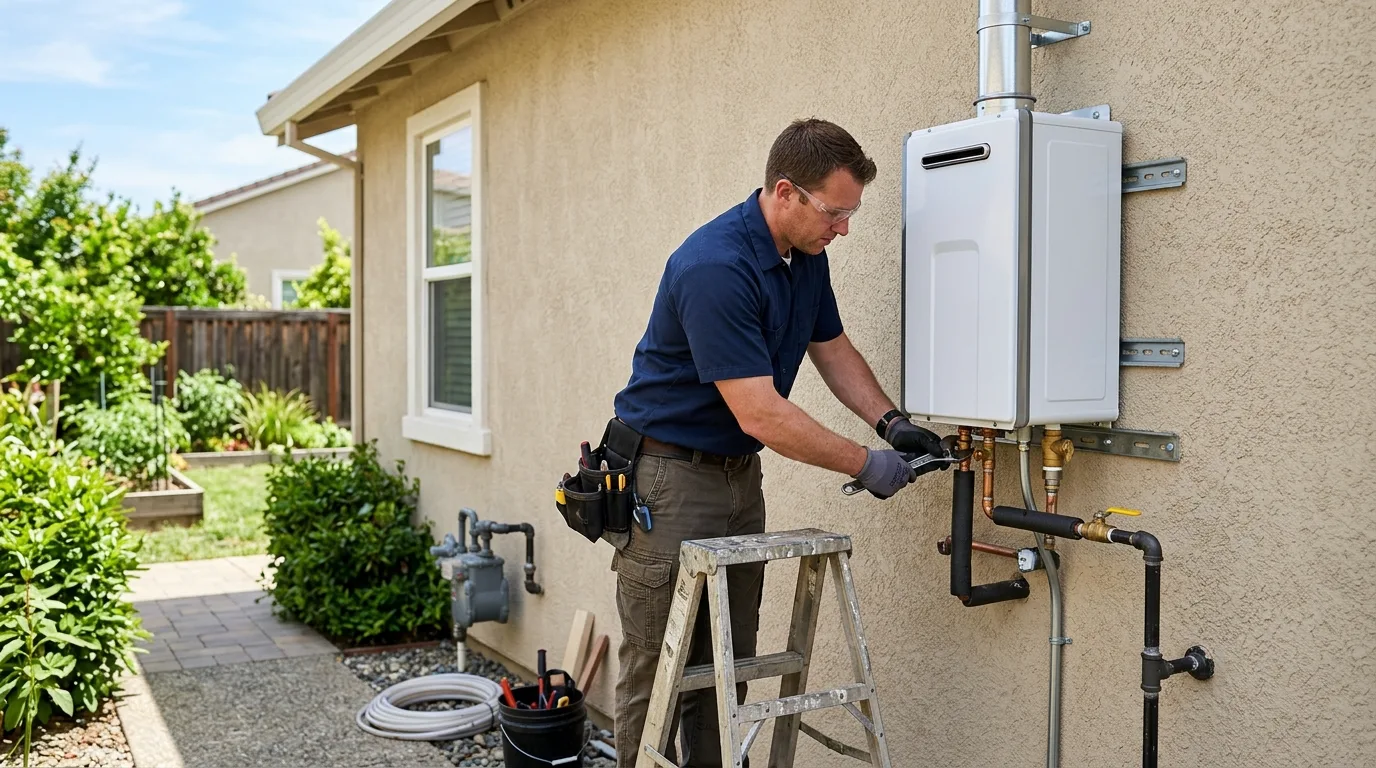
Conversion · Corona, CA
Endless hot water and a wall instead of a cylinder, provided the gas line, the venting, and the hard-water plan are all handled. We tell you what the conversion really involves before you spend anything on it.
Answered 24/7 · honest feasibility assessment · full conversion scope quoted up front
Endless
Hot water limited by flow, not by tank size
20+ yrs
Typical life with proper descaling
Honest
We say no when the site says no
The honest pitch
A tankless water heater heats water as it flows, on demand, instead of keeping a reservoir hot around the clock. The benefits are real and worth stating plainly.
What it does well. It does not run out, a long shower, a bath, and a dishwasher in sequence is not a scheduling problem. It has no standby loss, so you stop paying to keep fifty gallons hot at three in the morning. It takes up a fraction of the space, mounted on a wall, which is meaningful in a Corona garage where the water heater is competing with a car and a softener. A well-maintained unit commonly runs twenty years or more, roughly double a tank. And when it does fail, it fails as a device, not as eighty gallons of water on your floor.
What it is not. It is not instant. Water still has to travel from the unit to your faucet, so on a long run to a far bathroom you may wait as long as before, the fix for that is a recirculation loop, not a tankless unit. It is not unlimited: it is limited by flow rate, so a unit sized for two simultaneous showers will disappoint if you run three plus a dishwasher. It is not maintenance-free, and in Corona that caveat carries more weight than anywhere else in the conversation. And it is not always a straightforward swap, the conversion cost, not the appliance cost, is what decides most of these projects.
Our first job on a tankless inquiry is telling you which of those apply to your house. Sometimes the answer is that a high-recovery tank plus a recirculation loop solves your actual complaint for a lot less money. We would rather say that than sell you a conversion you did not need.
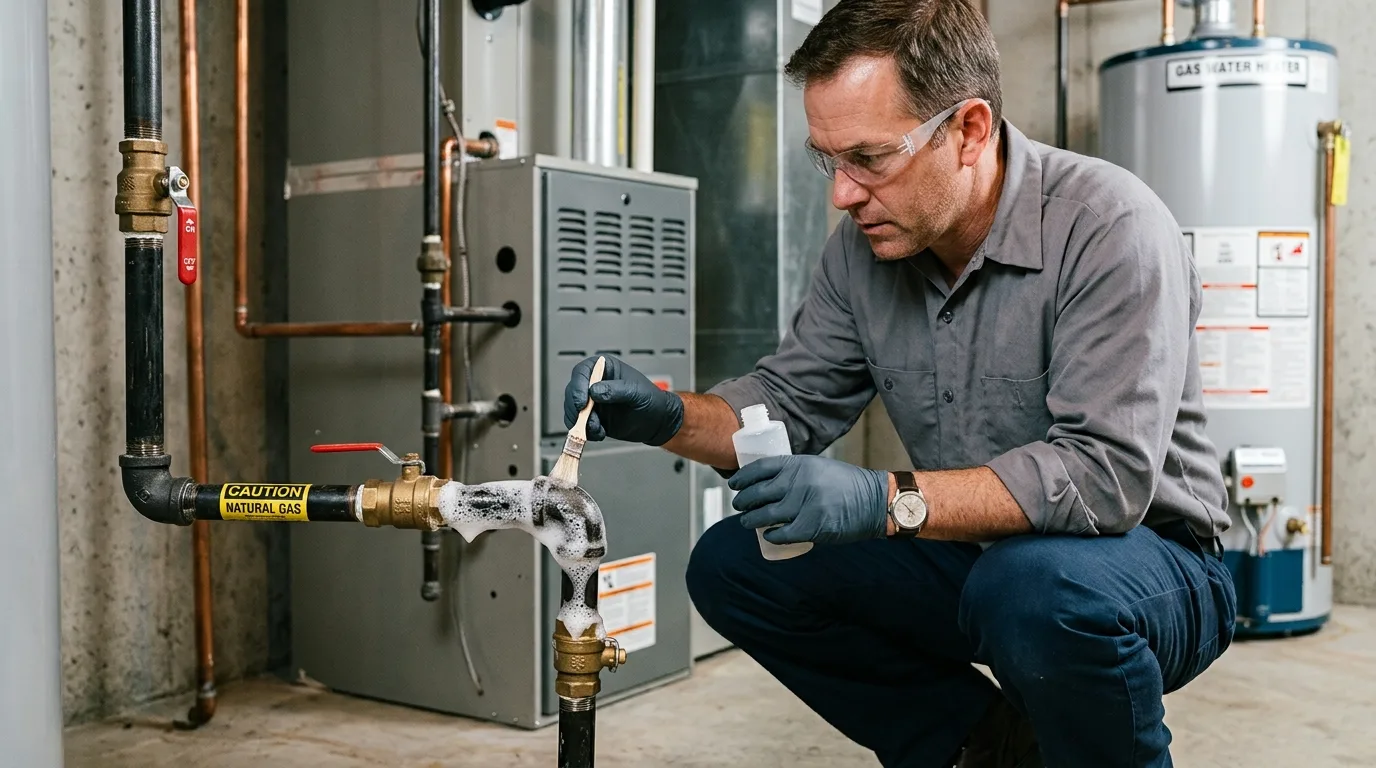
Feasibility
Gas capacity. A tank heater might draw 40,000 BTU. A whole-house tankless unit commonly needs 180,000 to 199,000. That is not a small increase, and the existing half-inch branch that fed your tank frequently cannot deliver it at the required pressure. The assessment involves the meter capacity, the total connected load of everything else in the house, the pipe size, and the run length. Sometimes a gas line upgrade is required, and that is often the largest single line item in a conversion.
Venting. A tankless unit is a sealed-combustion appliance. It cannot use the old atmospheric flue. It needs dedicated stainless or approved PVC venting, terminated at an approved location with correct clearances from windows, doors, and intakes. If the heater sits on an interior wall, the vent run gets longer and more complicated. Where the unit can go on an exterior garage wall, which is common in Corona’s tract layouts; this gets a lot simpler and cheaper.
Condensate. High-efficiency condensing units produce acidic condensate that needs a drain and, in some cases, neutralization. In a garage installation that is usually straightforward. In a location with no nearby drain it is another item to design around.
We check all three before quoting, because a tankless quote written without verifying gas capacity is a guess that turns into a change order.
Sizing
Tank heaters are sized in gallons. Tankless units are sized in gallons per minute at a given temperature rise, and in Corona the temperature rise varies more than people expect.
01
Add up the fixtures that genuinely run at the same time. A shower is roughly 2.0–2.5 GPM, a kitchen faucet 1.5, a tub filler considerably more. Two showers at once is a very different unit than one.
02
Output depends on how far the unit has to lift the incoming water. Corona’s inlet temperature swings meaningfully between an August afternoon and a January morning, and a unit sized on summer numbers underdelivers in winter.
03
We size against the winter rise, not the annual average. This is the single most common reason homeowners are disappointed by a tankless unit someone else installed.
04
If your complaint is waiting for hot water rather than running out, sizing will not fix it. A recirculation loop, with a compatible tankless unit and a buffer tank or dedicated return, is the actual answer.
05
Large homes with genuinely high simultaneous demand are sometimes better served by two smaller units linked together, which also gives you redundancy if one needs service.
06
For a modest household with a single bathroom and a tight gas supply, a right-sized high-recovery tank is often the better engineering answer. We will tell you when that is the case.
Sequence
Usually one to two days. Where that time goes:
Gas meter capacity and connected load, existing pipe size and run, candidate mounting locations, vent path and termination options, condensate drain, electrical for the unit’s controls.
Flow demand calculated against winter temperature rise, unit selected, and the full scope priced, including any gas upgrade and venting, so the number does not move later.
Pulled with the City of Corona. A tankless conversion touches gas, venting, and water; it is not a job to do off the books.
Old heater drained and hauled. Mounting location prepared, gas line run or upsized, vent penetration made and sealed, condensate drain established.
Unit hung, gas and water connected, isolation valves with service ports installed; these are what make future descaling a routine job instead of a teardown, and we fit them as standard.
Gas pressure verified under load, combustion checked, flow and temperature tested at fixtures, error log cleared, controls set. Inspection scheduled, warranty registered, and your descaling interval explained.
1–2
Typical days for a full conversion
199k
BTU a whole-house unit may demand
20+
Years of service with proper descaling
Why here
This is the part of the tankless conversation that gets skipped by people selling tankless units, so we lead with it.
Corona’s water blends local Temescal basin groundwater with imported State Water Project supply, and hardness commonly sits in the fifteen to twenty grain range. A tankless unit heats water very rapidly across a narrow heat exchanger with small passages. Rapid heating is exactly what drives calcium and magnesium out of solution, and small passages are exactly what scale blocks fastest.
Scale in a tankless heat exchanger does not settle harmlessly at the bottom the way it does in a tank. It coats the passages, restricts flow, insulates the burner from the water, and forces the unit to work harder for less output. The symptoms arrive in a predictable order: temperature that fluctuates during a shower, output that drops off, error codes about flow or overheating, and eventually a heat exchanger that needs replacing, the single most expensive part of the appliance.
None of that is an argument against tankless in Corona. It is an argument for installing it correctly and maintaining it. Three things make the difference:
Isolation valves with service ports, fitted at installation. Without them, descaling means cutting into the pipe. With them, it is a routine annual service. We install them as standard, not as an option.
An annual descaling at minimum, a circulated descaling solution that dissolves the deposits. In our water, skipping this for three or four years is how a twenty-year appliance becomes an eight-year one. We cover the service in detail on the descaling page.
Water treatment. A softener ahead of the unit dramatically slows scale formation and protects everything else in the house at the same time. For homeowners spending real money on a tankless conversion, treating the water is the investment that protects the investment.
Straight answers
| Factor | Why it changes the number |
|---|---|
| Gas line work | Usually the biggest variable. If the existing line can carry the load, you save significantly. If a new or upsized run from the meter is needed, that is real pipe, real labor, and sometimes a meter conversation with the utility. |
| Venting run and termination | A unit on an exterior garage wall with a short through-wall vent is the cheapest case. An interior location with a long vent path through finished space is the most expensive. |
| Condensing or non-condensing | Condensing units are more efficient and can use less expensive vent material, but need a condensate drain and sometimes neutralization. The right choice depends on the site, not on a brochure. |
| Unit capacity | A single-bathroom household needs far less unit than a five-fixture home running two showers at once. Sizing up costs more in equipment and in gas supply. |
| Recirculation | Adding a dedicated return line or a compatible pump and buffer tank for fast hot water at distant fixtures is an additional scope, and worth pricing if your real complaint is waiting. |
| Water treatment | A softener installed alongside the conversion is an additional cost that materially extends the appliance’s life here. We price it separately so you can decide with the numbers in front of you. |
| Electrical | Tankless units need power for controls and ignition. If there is no suitable outlet at the mounting location, that is a small added item. |
| Permit and inspection | Included and itemized. Gas and venting work is precisely the category where inspection protects you. |
We will not quote a tankless conversion without seeing the gas supply. Anyone who does is quoting a number they intend to revise.
Thinking about it?
Gas capacity, vent path, and sizing against a Corona winter. If the answer is that a tank suits you better, we will say so.
Answered 24/7 · full scope quoted before commitment
Coverage
Already have one
If your existing tankless unit is throwing codes or losing output, it likely needs descaling rather than replacing.
Independent local contractors · workmanship guarantee on completed work
Tankless FAQs
No, and this is the most common misunderstanding. The unit heats water instantly as it passes through, but that water still has to travel the length of pipe between the heater and your tap. If the master bath is sixty feet away, you wait about as long as you did before.
If waiting is your actual complaint, the solution is a recirculation system, either a dedicated return line or a compatible pump arrangement. Some tankless models are built for it. We would rather solve the right problem than let you spend on a conversion that does not address it.
A correctly sized unit will supply your realistic simultaneous demand. The constraint is flow rate, not volume: a unit rated for, say, 7 GPM at your winter temperature rise can comfortably run two showers, and will struggle with two showers plus a tub filler.
This is why we count fixtures and ask about actual habits. Large homes with genuinely high peak demand are sometimes best served by two units in parallel, which also means you are not without hot water if one needs service.
Often, yes, and it is usually the largest cost in the project. A tank heater might draw 40,000 BTU where a whole-house tankless unit needs 180,000 to 199,000.
Whether your existing line can carry it depends on pipe size, run length, meter capacity, and what else in the house is drawing gas. That is a calculation, not a guess, and we do it before quoting rather than after.
The unit is the predictable part. The variable is the conversion work: gas supply, venting, condensate, electrical, and mounting. Two houses on the same street can differ substantially based on where the heater is and what the gas line looks like.
What we commit to is assessing before pricing, and giving you the full itemized scope in writing. If a gas upgrade is needed, it is in the original number, not a change order two days in.
Annually, at minimum. In our hardness range, some households running high volume benefit from twice a year. This is not a manufacturer’s upsell; it is the maintenance that determines whether you get eight years or twenty out of the appliance.
It is also why we install isolation valves with service ports at the time of installation as standard. With them, descaling is a routine visit. Without them, it means cutting pipe every time.
It will slow scale formation dramatically and extend the interval, and it protects your fixtures, valves, and every other appliance at the same time. It will not make maintenance unnecessary.
Think of it as the difference between descaling a lightly filmed heat exchanger once a year and descaling a heavily crusted one. The first is quick and the appliance stays at full output. The second is where heat exchangers die.
No. A tankless unit needs electricity for its controls, ignition, and flow sensing, so it stops when the power does. Notably, so does a modern tank heater with electronic ignition.
An older standing-pilot tank heater will keep delivering whatever is already hot in the tank during an outage, which is the one real advantage tanks retain. If outage resilience matters to you, that is worth weighing.
Yes. Outdoor-rated models are common and are a good fit for Corona’s climate, no vent run needed, no combustion air question, and freezing is a rare and manageable concern here rather than a disqualifier.
Outdoor units do sit in full sun and summer heat, which is worth considering for longevity, and they still need a power connection and a condensate path on condensing models. A shaded exterior garage wall is usually the ideal spot.
Every tankless unit has a minimum activation flow. Below it, the burner will not fire and you get cold water. Modern units have low thresholds, but a very lightly opened faucet or an old low-flow fixture can still fall under it.
In practice this is rarely a problem in normal use. Where it does show up is with certain single-handle mixing valves set to a whisper, or with a slow-fill application. We check fixture flows during commissioning so you know about any before you discover it in the shower.
Sometimes not, and we will say so. If you have one bathroom, modest hot water use, an existing gas line that cannot carry a tankless load, and no space problem, a right-sized high-recovery tank is often better engineering and considerably cheaper.
Tankless earns its keep where there is genuine simultaneous demand, where space matters, where you want twenty-plus years from the appliance, or where standby loss on a large tank is a real cost. If none of those describe you, spending the conversion money on a softener and a good tank often delivers more.
Corona, CA · tankless done properly
Feasibility first, honest sizing second, and a maintenance schedule that protects what you spent.
Dispatch answers 24/7 · upfront pricing before work begins