01
Sediment only
The minimal, low-cost option. Right where the complaint is grit in aerators, particles after a main break, or protecting a new softener and water heater. Does nothing for taste.
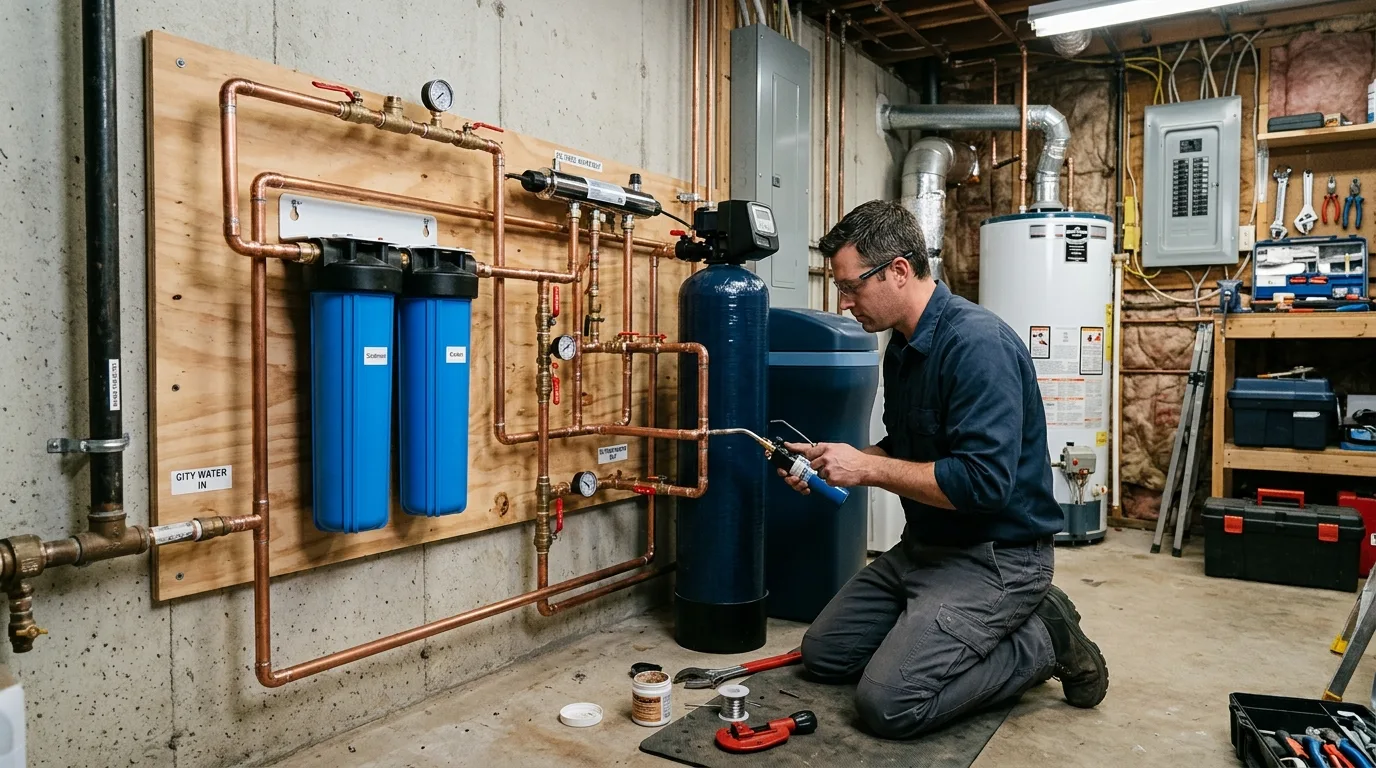
Point of entry · Corona, CA
Filtration and softening are different jobs, and conflating them is how homeowners end up with equipment that does not solve their complaint. We start by asking what you actually taste, see, and smell.
Answered 24/7 · we tell you what filtration will not fix · upfront pricing
Point of entry
Every tap, shower, and appliance
Honest
Filtration is not softening
Sized
To flow rate, not to shelf space
First things first
This is the most useful paragraph on the page, so we will put it at the top. Filtration and softening solve different problems. A filter removes things suspended or dissolved in water that affect taste, smell, and clarity. A softener removes calcium and magnesium hardness. Neither does the other’s job.
Filtration will fix: a chlorine taste or smell, particularly noticeable in the shower; sediment, grit, and rust particles clogging aerators and fouling valves; earthy or musty tastes; the general flatness that makes people buy bottled water; and chlorine exposure to your skin and hair, which is the reason a lot of households install it.
Filtration will not fix: white scale on your faucets and shower head; spots on glassware; soap that will not lather; a water heater scaling up; a tankless unit throwing flow codes. All of those are hardness, and hardness passes straight through a carbon filter untouched.
The reason this matters in Corona is that our water is genuinely hard, and a lot of homeowners who buy a whole-house filter because of scale on the shower head are disappointed. If your complaint is white crust, you want a softener. If your complaint is taste, smell, or grit, you want filtration. If it is both, which is common; you want them in series, and there is a correct order.
Our first question on the phone is what you are actually experiencing. That five-minute conversation prevents most of the wrong purchases in this category.
The stages
A whole-house system is a series of stages, each doing one job, plumbed where water enters the house so everything downstream benefits.
Sediment. A pleated or spun cartridge, typically five to twenty micron, catching sand, grit, rust flakes, and pipe scale. This stage matters more than people expect in Corona: fragments of scale and corrosion shed from aging mains and from old galvanized distribution end up in aerators, in toilet fill valves, and abrading the sensors in tankless units. It also protects everything behind it, including softener resin.
Carbon. Either a large tank of granular activated carbon or a high-capacity block cartridge. This is the stage doing the work most people care about, adsorbing chlorine and chloramine, reducing taste and odor compounds, and removing a range of organic contaminants. Tank-style carbon has far more capacity and much less flow restriction than cartridges, and for whole-house duty we generally recommend it.
Specialized stages, where testing warrants them. KDF media for additional metals reduction, iron and manganese treatment for well supplies in Temescal Valley and outlying areas, or a UV stage where a private well has a microbiological concern. None of these get installed speculatively; they follow a test result.
Reverse osmosis at the tap. Not a whole-house technology in a residential setting. RO removes dissolved solids very thoroughly, is slow, and produces waste water, which makes it ideal at the kitchen sink for drinking and cooking and impractical for the whole house.
Order matters: sediment first, then carbon, then softener. Grit would foul the carbon, and chlorine degrades softener resin, so each stage protects the next.
Configurations
Most Corona households land on one of these. Which one depends entirely on what your complaint is.
01
The minimal, low-cost option. Right where the complaint is grit in aerators, particles after a main break, or protecting a new softener and water heater. Does nothing for taste.
02
The most common whole-house configuration we install. Handles grit, chlorine taste and smell, and shower chlorine exposure, with high capacity and minimal pressure loss. No salt, no drain in most designs.
03
The complete answer for Corona water: filtration for taste and particles, softening for scale. Installed in the correct sequence so each stage protects the next. Most households doing this once should do it this way.
04
For drinking and cooking water at the kitchen sink. Removes dissolved solids thoroughly, the right tool if your goal is bottled-water quality at the tap rather than treating the whole house.
05
A targeted, inexpensive option where the only real concern is chlorine on skin and hair. Less capable than point-of-entry carbon and much cheaper. We will mention it when it fits.
06
Private wells in Temescal Valley and outlying areas need testing first, iron, manganese, hardness, and bacteria all change the equipment. We do not sell a well system off a catalogue.
Sequence
Usually a half-day for a standard point-of-entry install.
Taste, smell, particles, staining, scale, and where you notice it. This is what determines whether you need filtration, softening, or both, and it happens before any equipment is discussed.
Hardness, chlorine, and a visual sediment check as standard. Well supplies get a fuller panel, because equipment selection depends on it.
A filter that restricts flow makes every fixture in the house weaker. Systems are sized to your peak demand, which is why undersized big-box cartridge housings cause so many pressure complaints.
Point of entry means after the main shutoff and ahead of the water heater, with clearance for cartridge changes and a drain nearby if backwashing is involved. Garage is typical in Corona.
Plumbed in with isolation and a full bypass, so the house keeps water if the system ever needs service. Exterior hose bibs typically stay unfiltered, no reason to filter the lawn.
System flushed per manufacturer instructions, pressure verified before and after, water tested at a tap, and your cartridge or media replacement interval written down rather than left to memory.
Half day
Typical point-of-entry installation
0 psi
Meaningful pressure loss when sized right
Bypass
Fitted as standard on every install
Why here
Corona’s municipal supply is a blend of local groundwater from the Temescal basin and imported water delivered through the State Water Project. It meets state and federal drinking water standards, and it is published annually in the city’s water quality report, which is worth reading rather than taking anyone’s word for.
Meeting standards and tasting good are different things, and the three characteristics homeowners react to here are consistent.
Disinfectant. Municipal water must carry a residual disinfectant to stay safe through the distribution system. That residual is what you smell in the shower and taste in a glass, and it varies with distance from the treatment point and with seasonal blending. Carbon filtration removes it very effectively, which is the single most noticeable improvement most households report.
Hardness. Fifteen to twenty grains commonly, from the mineral content of the groundwater portion. This is a filtration page, so we will say it once more clearly: no carbon filter reduces this. If white crust is your complaint, you need a softener.
Particulates. Corona has aging infrastructure in older neighborhoods and a lot of galvanized distribution piping still in service in pre-1960 homes near downtown and the Circle City historic district. Rust flakes and scale fragments from those pipes, plus occasional sediment after a main repair or a pressure event, end up in aerators, cartridges, and valve seats. A sediment stage handles this cheaply.
Homes on private wells in Temescal Valley and the outlying edges of our service area are an entirely different situation. Well chemistry varies well to well, iron, manganese, sulfur odor, and higher hardness are all possible, and microbiological testing matters. Anyone selling well treatment without a test result is guessing with your money.
Straight answers
| Factor | Why it changes the number |
|---|---|
| Stages and type | A single sediment housing and a full tank-style carbon system with a sediment pre-stage are very different investments. Capacity and flow rating drive most of the cost. |
| Cartridge versus tank media | Cartridge systems cost less up front and more over time in replacements. Tank-style carbon costs more initially with media changes measured in years. Over ten years the tank usually wins. |
| Flow rate required | A large home running multiple fixtures needs a higher-capacity system to avoid pressure loss. This is the specification most often skimped on and most often regretted. |
| Tie-in location | A garage with accessible main line piping and clearance is straightforward. A tight space, an exterior location needing weather protection, or a main line in an awkward spot adds labor. |
| Backwashing systems | Self-cleaning media tanks need a drain connection and power. Where those are not nearby, that becomes part of the scope. |
| Combined with a softener | Installing both together costs less than two separate visits and ensures the sequence is right. This is the most common combination we do in Corona. |
| Well water treatment | Iron, manganese, or UV stages are additional equipment, selected from a test result. Well systems are quoted after testing, never before. |
| Under-sink RO | A separate, modest addition at the kitchen sink, sometimes needing a faucet penetration and a drain saddle. Priced independently. |
If a filter is the wrong answer for your complaint, we will tell you before quoting one. That is cheaper for you and less embarrassing for us.
Not sure which you need?
Taste and smell is filtration. White crust and no lather is softening. Both is common, and there is a right order.
Answered 24/7 · on-site testing before any quote
Related work
Coverage
Doing both?
Sediment, then carbon, then softener, each stage protecting the next. Installed together in one visit.
Independent local contractors · workmanship guarantee on completed work
Filtration FAQs
No. This is the single most common misunderstanding in this category, and it costs people real money. Carbon and sediment filtration do not remove calcium and magnesium hardness.
If your complaints are white crust on fixtures, spotted glassware, poor lather, or a scaling water heater, you need a softener. If your complaints are taste, smell, or grit, you need filtration. Many Corona homes genuinely need both, and we install them in sequence.
A correctly sized system, no meaningfully. An undersized one, yes, and this is the most common problem with self-installed cartridge housings bought off a shelf.
Whole-house systems have to be rated for your peak simultaneous flow, not just your average use. We measure pressure before and after installation so the effect is documented rather than argued about later.
Sediment cartridges typically every three to six months depending on how much particulate your supply carries. Carbon block cartridges every six to twelve months. Tank-style granular carbon media generally every five to ten years.
That difference is the real argument for tank-style carbon on whole-house duty: far fewer interventions and no filter you forget about. A neglected cartridge is worse than no filter, because it restricts flow and can harbor growth.
The city’s municipal supply meets state and federal drinking water standards, and the annual water quality report published by the utility is the authoritative source on what is in it. Filtration here is generally about taste, smell, and particulates rather than safety.
Households wanting the lowest practical dissolved solids for drinking usually add a reverse osmosis unit at the kitchen sink rather than treating the whole house. If you are on a private well, that is a genuinely different question and testing is essential.
Not necessarily, but there is a good argument for a sediment and carbon stage ahead of it. Chlorine degrades softener resin over years, and grit fouls the resin bed, so the filter protects the more expensive equipment.
It also addresses what a softener cannot: chlorine taste and smell. Plenty of Corona households with a softener still buy bottled water, and a carbon stage is usually why they stop.
At the point of entry, after the main shutoff and ahead of the water heater, so every fixture and appliance downstream is covered. In most Corona homes that means the garage, which conveniently is also where the softener loop and water heater usually are.
It needs clearance for cartridge or media service, a drain nearby for backwashing designs, and power for anything with a control head. We pick the location around those constraints.
Generally no. Filtering irrigation and hose water consumes cartridge capacity for no benefit, and it drives up your replacement cost noticeably.
A proper installation tees the exterior bibs ahead of the system where the existing plumbing allows it. Where it does not, we will tell you before installing rather than after you notice the cartridge life.
Scope and technology. Whole-house carbon treats every tap, every shower, and every appliance, which matters because chlorine exposure in a hot shower is significant. Under-sink units treat one tap.
Under-sink reverse osmosis, though, does something whole-house carbon cannot: it removes dissolved solids very thoroughly. The two are complementary, and a common setup here is point-of-entry carbon plus RO at the kitchen sink.
No, and we treat it differently. Well supplies in Temescal Valley and the outlying parts of our area vary well to well. Iron, manganese, sulfur odor, elevated hardness and microbiological questions are all possible.
That means a proper water test before any equipment is specified. A system designed off a test result works; a system chosen from a catalogue for “well water” frequently does not address what is actually there.
A simple cartridge housing on accessible pipe is within reach of a capable homeowner, and we are not going to pretend it is surgery. Two things go wrong most often.
First, sizing, the shelf units are usually rated well below whole-house peak flow, which is why so many self-installs end in a pressure complaint. Second, the bypass: without isolation and a bypass, a failed housing or a cartridge change means the whole house is without water. We fit both as standard, and both are worth having.
Corona, CA · water treatment
Tested first, sized to flow, installed with a bypass, and with the service interval written down.
Dispatch answers 24/7 · upfront pricing before work begins