01
The cold water sandwich
Hot, then a slug of cold, then hot again mid-shower. Often blamed on the unit being defective. Usually a flow and heat transfer problem caused by restriction in the exchanger.
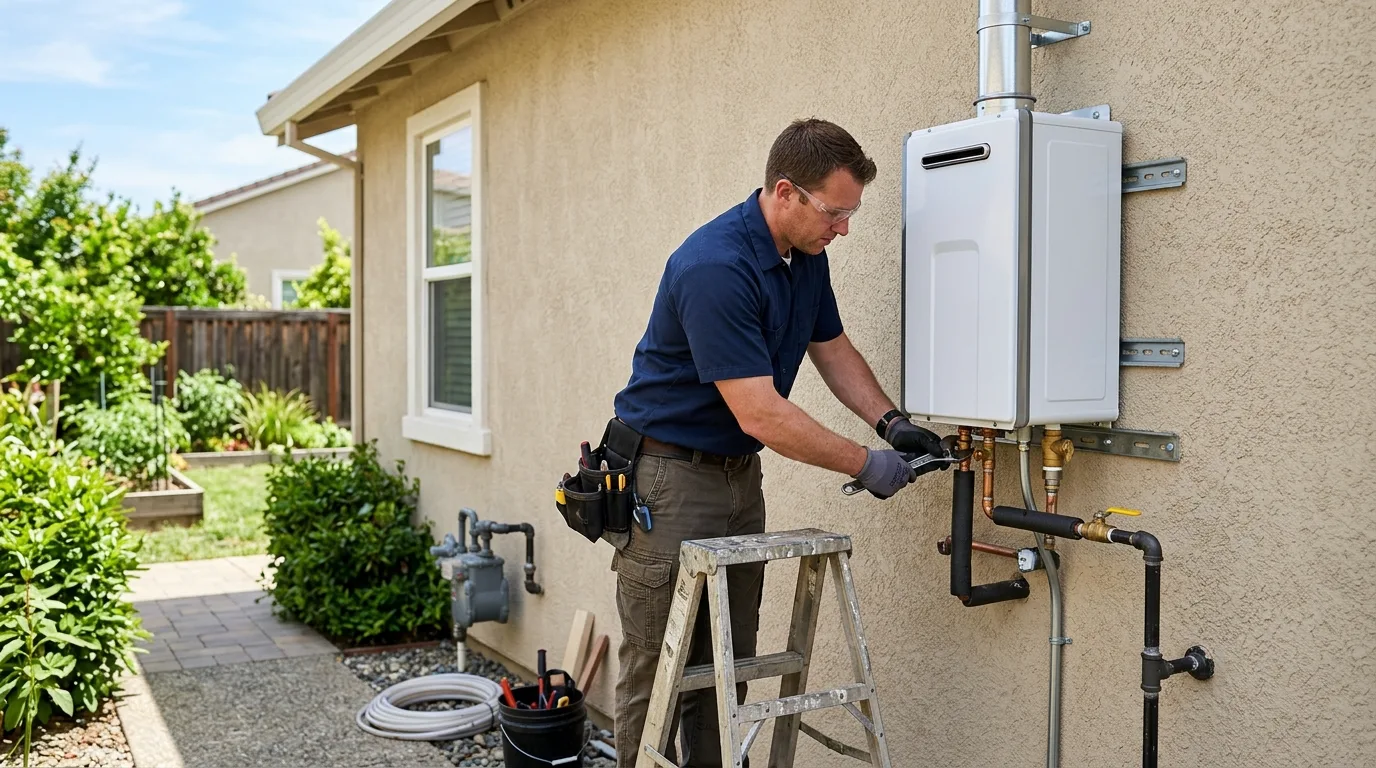
Annual service · Corona, CA
Corona’s water is hard enough to shorten a twenty-year tankless unit to eight. Descaling is the one service that decides which of those you get, and it takes an afternoon.
Answered 24/7 · error codes diagnosed · service valves added if yours lacks them
Annual
The interval Corona hardness actually requires
Half day
Typical full service visit
15–20
Grains of hardness in local supply
What scale does
A tank water heater dumps its mineral deposits on the floor of the tank, where they sit and cause slow damage. A tankless unit has nowhere to dump anything. Water passes through a compact heat exchanger with narrow passages, gets heated very rapidly, and leaves. Rapid heating is precisely what drives dissolved calcium and magnesium out of solution, and narrow passages are precisely what a mineral deposit blocks first.
The scale coats the inside of the exchanger like the inside of a kettle, but under continuous thermal load. Three things follow. Flow restricts, so the unit delivers less. The deposit insulates the water from the burner, so the unit fires harder and longer for the same output and burns more gas. And hot spots form in the exchanger, which is what eventually cracks it, and the heat exchanger is the most expensive component in the appliance.
The symptoms arrive in a predictable sequence, and most homeowners misread the early ones. First, temperature that wanders during a shower, warm, then hot, then warm again. Then output that no longer keeps up with two fixtures the way it used to. Then longer waits and audible changes in how the unit runs. Then error codes: flow faults, overheat faults, ignition faults that are really flow faults. Then the repair estimate nobody wanted.
Every one of those stages is reversible except the last. Descaling on schedule keeps the unit at the top of that list permanently.
The service
A descaling is not just running vinegar through the unit for twenty minutes, though that is what a lot of quick services amount to. The visit covers the whole appliance.
The circulated descale itself. Gas and water isolated, hoses connected to the service ports, and a descaling solution circulated through the heat exchanger by pump for the duration the deposit load requires, not a fixed timer. Then a thorough flush with clean water until the return runs clear.
The filters and screens. The cold water inlet screen collects grit and scale fragments and is a frequent hidden cause of flow faults. On units with an air intake filter, that gets cleaned too, garage installations pull in a remarkable amount of dust and lint.
Combustion and venting. Burner condition, flame quality, vent connections and terminations, condensate drain and neutralizer where fitted. A unit running rich or restricted is a safety item, not just a performance one.
The electronics. Error history read out of the controller, which tells us far more about how the unit has actually been living than any visual inspection. Flow sensor and temperature sensor readings verified, and settings confirmed.
The report. How much scale came out, what that implies about your interval, and whether anything needs attention now. If the deposit load was heavy, we will tell you that twice a year is the honest recommendation rather than pretending annual is enough.
Symptoms
These are the complaints we hear most, and in Corona the majority of them are scale rather than a failed part.
01
Hot, then a slug of cold, then hot again mid-shower. Often blamed on the unit being defective. Usually a flow and heat transfer problem caused by restriction in the exchanger.
02
The unit that used to handle a shower and the dishwasher now cannot. Nothing broke; the passages narrowed. Descaling frequently restores it fully.
03
Flow-related and overheat-related codes are the classic scale signature. We read the full error history rather than just the code on the display, because the pattern tells the story.
04
A scaled exchanger makes the burner work longer for the same delivered heat. A gas bill creeping up with no change in habits is worth a service visit.
05
Changes in the sound of ignition and operation, or the unit cycling on and off during steady demand. Both point at restricted flow through the exchanger.
06
The most common one of all. If the unit went in four years ago and has never been touched, it needs this visit before it needs a repair.
Sequence
Typically two to four hours depending on deposit load.
Error history pulled from the controller, current settings recorded, and your description of the symptoms matched against what the unit has logged.
Gas off, power off where appropriate, and the water isolated at the service valves. If your unit has no service valves, we fit them, and then every future service is simple.
Pump and hoses connected, solution circulated through the heat exchanger and monitored. Duration driven by how much deposit is actually coming out, not by a stopwatch.
Full flush with clean water until the return is clear, so no descaling solution remains in the system.
Inlet screen, air filter, burner, combustion chamber, vent terminations, and condensate path. Anything worn gets reported with a price rather than silently replaced.
Refilled, purged, fired, temperature and flow verified at fixtures, errors cleared, and your next interval set based on what came out of your unit.
1×/yr
Minimum interval in Corona water
2–4 hrs
Typical full service visit
20+
Years achievable with maintenance
Why here
Manufacturers publish descaling recommendations for typical water. They also publish a hardness threshold above which they recommend more frequent service or water treatment, and Corona is generally above it.
The city’s supply is a blend of local Temescal basin groundwater and imported State Water Project water. Hardness commonly lands in the fifteen to twenty grain range, roughly 250 to 350 milligrams per liter as calcium carbonate. For context, water is generally described as “very hard” above about ten grains. We are comfortably past that.
What that means in practice is that every gallon through your heat exchanger deposits meaningfully more mineral than the same gallon would in a soft-water region. A household using a hundred gallons of hot water a day is putting a substantial mass of dissolved mineral through a component with passages measured in millimetres.
This is why the manufacturer’s “every one to two years” becomes “annually, and sometimes twice” here. It is also why the two upstream fixes are worth serious consideration for anyone with a tankless unit in Corona:
A water softener removes the hardness minerals before they reach the appliance. It is the single most effective thing you can do for a tankless heat exchanger, and it protects your fixtures, valves, dishwasher, and washing machine at the same time. For a household that has already replaced one heat exchanger, the softener usually pays for itself.
Whole-house filtration handles sediment and chlorine rather than hardness, but sediment is what clogs inlet screens and abrades sensors, so a good sediment stage upstream reduces a different category of tankless problem.
Neither eliminates the need for periodic service. Both change the interval and the amount of damage happening between visits.
Straight answers
| Factor | What it changes |
|---|---|
| Whether you have service valves | Isolation valves with hose ports make this a routine service. Without them, the unit has to be isolated by other means or valves added; we would rather add them once than work around their absence every year. |
| Time since the last service | A unit descaled last year flushes quickly. A unit that has never been serviced in five years takes longer, needs more solution, and occasionally reveals damage the scale was masking. |
| Household hot water volume | Two people and five people put very different mineral loads through the same appliance. High-volume households often justify a six-month interval. |
| Whether there is a softener | A softened house builds scale far more slowly. We still recommend annual service, but the visit is shorter and the appliance stays near its original output. |
| Condensing versus non-condensing | Condensing units add a condensate drain and often a neutralizer cartridge to the service scope. Neutralizer media is consumable and gets checked. |
| Accessibility | A wall-mounted unit at working height in a garage is straightforward. A unit in a tight closet, in an attic, or behind storage takes longer to set up around. |
| Parts found during service | A worn inlet screen, a failing flow sensor, or a degraded gasket gets reported with a price before replacement. Nothing is swapped without telling you. |
| Multiple units | Homes with two units in parallel need both serviced. Doing them in one visit is more efficient than two separate calls. |
If a descaling does not restore your unit’s performance, that is diagnostic information in itself, and we tell you what it points to rather than repeating the service.
Never been serviced?
If your tankless unit has gone years without a flush in Corona water, this visit is the difference between maintenance and a heat exchanger.
Answered 24/7 · upfront pricing before the visit
Related work
Coverage
Fix the cause too
If you are descaling twice a year to keep up, it is worth pricing the upstream fix.
Independent local contractors · workmanship guarantee on completed work
Descaling FAQs
Annually as a baseline. High-volume households, units without a softener, and units already showing symptoms often warrant every six months.
The reason our answer is more frequent than the manual’s is hardness. Manufacturer intervals assume moderate water; Corona commonly runs fifteen to twenty grains, which is firmly in the range where the same manufacturers recommend shortened intervals or treatment.
If your unit has isolation valves with service ports, a homeowner descale with a submersible pump and the right solution is genuinely feasible, and we are not going to pretend otherwise.
What a professional visit adds is the rest of it: reading the error history, cleaning the inlet screen and air filter, checking combustion and venting, verifying sensors, and knowing what a heavy deposit return implies. The descale is maybe half the value of the visit.
That is common on installations done quickly or cheaply, and it is the single biggest obstacle to maintaining a tankless heater. Without ports there is no clean way to circulate solution.
We fit isolation valves with service ports as part of the first visit. It is a one-time cost that makes every future descaling a routine job. Any tankless unit installed without them was installed with no thought given to its second decade.
In Corona, usually yes. The cold water sandwich and mid-shower temperature swings are most often caused by restricted flow and degraded heat transfer in a scaled exchanger.
If a full descale does not resolve it, that is useful information: the next candidates are the flow sensor, a mixing valve issue at the fixture, gas supply pressure under load, or a recirculation system behaving badly. We work through those rather than just booking another flush.
White vinegar does dissolve carbonate scale and is a legitimate option for a light, regular maintenance flush. It is slow, and on heavy deposits it often does not fully clear the passages.
Purpose-made descaling solutions work faster and more completely on the deposit loads we see here, and are formulated to be safe for exchanger materials. On a unit that has gone years without service, that difference matters.
Two to four hours for a full service. The descale circulation itself is typically thirty to sixty minutes, longer on heavy deposits, and the rest is setup, filter and burner work, inspection, flushing, and recommissioning.
You have no hot water during the service and normal service immediately after. It is a half-day at most, not a project.
Sometimes it does, and we would rather find it during a scheduled service than during a January failure. Heavy scale can mask a weeping fitting, and a badly scaled exchanger occasionally turns out to be already compromised.
You get told immediately, with what it is, what it costs, and whether it needs doing now or can be planned. Nothing gets replaced without your approval.
No, but it changes the picture substantially. A softened house builds scale far more slowly, so annual service becomes genuinely light maintenance rather than remedial work, and the unit holds its original output.
There are also non-scale reasons to service annually: inlet screens collect grit, air filters clog, combustion drifts, and sensors need verification. Those apply regardless of water treatment.
Many manufacturers require documented annual maintenance as a condition of heat exchanger warranty coverage. A failed exchanger on an unmaintained unit is a common warranty denial.
We provide a service record for exactly that reason. Check your specific warranty language, but as a rule, keeping receipts for annual descaling is how you keep the coverage you paid for.
Service first, almost always. A twelve-year-old tankless unit that has never been descaled is frequently recoverable, and finding that out costs a fraction of a replacement.
If the descale does not restore performance and the exchanger is compromised, then you have a real decision, and by then you have actual information rather than a guess. We give you the repair cost and the replacement cost side by side at that point.
Corona, CA · tankless maintenance
Full descale, filters, combustion, sensors, and an honest read on your interval.
Dispatch answers 24/7 · scheduled service and emergency response