01
Copper pinhole leaks
Small weeping perforations, often inside walls or above ceilings. Detected by staining or moisture metering long before anyone hears water.

Chase Ranch · 92880
Built through the 1990s on the old Chase citrus land, these tracts are now at the age where original copper, regulators, and heaters all come due within a few years of each other.
Answered 24/7 · pinhole leaks located before drywall comes out
The neighborhood
Chase Ranch was developed through the 1990s on land that had been citrus groves for most of the previous century. The housing is consistent in a way older parts of Corona are not: slab-on-grade foundations, copper supply, ABS drains, and a single generation of builder-specified fittings and appliances throughout.
That consistency is useful. It means the failure pattern across the neighborhood is highly predictable, and it means when we see one problem at one house, we generally know what the next three calls on that street will be.
The defining issue is thin-wall copper. Copper is excellent pipe and much of it lasts far longer than the houses around it. But wall thickness was specified to cost in production housing of this era, and thinner-wall copper is meaningfully more susceptible to pinhole corrosion from the inside, small perforations that develop where water chemistry, velocity, and wall thickness combine unfavourably.
Pinholes have a specific character worth understanding. They are small, they weep rather than spray, and they frequently appear inside walls or above ceilings where nobody sees them for weeks. The first evidence is usually staining, bubbling paint, or a musty smell. And critically, they are not random. A pinhole in one location means the conditions that produced it exist throughout the same-age piping in that house.
Alongside this, everything else installed with the tract is now at end of life together: pressure regulators, water heaters, angle stops, supply lines, and fixture cartridges. This is the age at which a house transitions from occasional repairs to a cluster of them.
The decision
When we fix a pinhole, the useful part of the visit is not the repair. It is the assessment of what the rest of the system looks like.
What we look at: the number of previous failures and when they occurred, the condition of copper visible at the heater and under sinks, the static pressure the system runs at, and whether the failures cluster on hot lines, cold, or both. Hot-side clustering is common because heat accelerates the chemistry.
A first pinhole in an otherwise healthy system is genuinely a repair. Cut out the section, replace it, move on. We are not going to sell a repipe to a house that does not need one.
A second or third changes the picture. Each individual repair carries a call-out, access, and drywall cost, and three of them approach a meaningful fraction of a whole-home repipe without solving anything. At that point the honest recommendation is to plan the repipe on your schedule rather than keep buying emergencies on the pipe’s schedule.
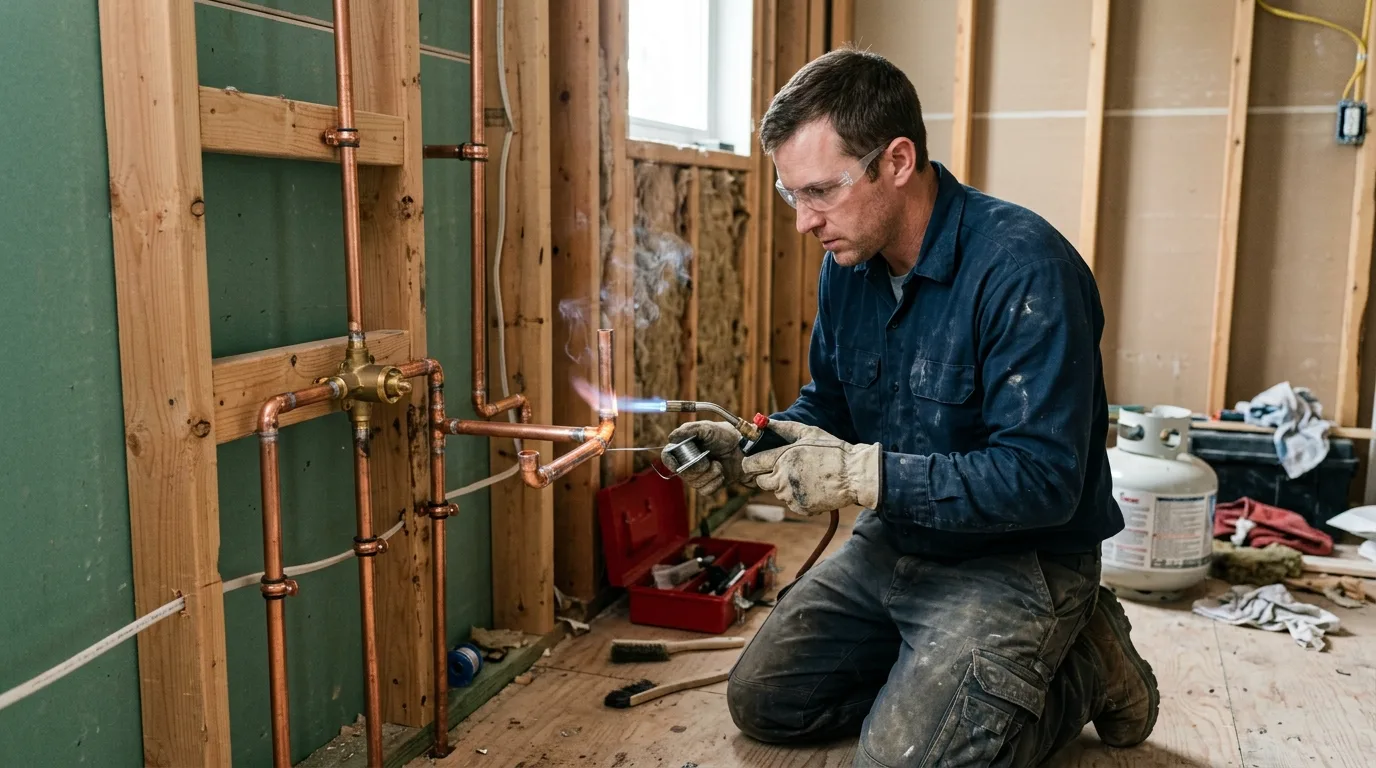
On these floor plans a repipe is relatively straightforward. Attic access is generally good, so new lines run overhead and drop down interior walls, and the slab is never touched. Two to four days, drywall patches at the drop points, and the household normally stays in place throughout.
It is also the moment to replace the original regulator, every angle stop and supply line, and add an expansion tank if the system needs one, all of which cost a fraction during a repipe compared with separate visits later.
Common calls
A tight, predictable cluster driven by build year.
01
Small weeping perforations, often inside walls or above ceilings. Detected by staining or moisture metering long before anyone hears water.
02
Slab-on-grade throughout. Warm floor spots, running water with everything off, or unexplained bills. Located acoustically before any concrete is cut.
03
Builder-grade PRVs now well past service life, scaled by hard water. Symptoms show up as fixture failures long before anyone suspects the valve.
04
Original or first-replacement tanks in garages, typically with heavy sediment and often with strapping and venting below current standards.
05
Original builder-grade components on their third decade. Cheap to replace, and a known cause of unattended flooding when they fail.
06
Established landscaping with decades of trenching and hardscape work. Outdoor leaks here run for months without visible evidence.
How we work
The repair is quick. The assessment is what you are actually paying for.
Moisture metering, acoustic detection, and pressure isolation. We do not open drywall or concrete on an estimate.
Static and flowing at the hose bib, held overnight where creep is suspected. High pressure accelerates every failure mode in the house.
At the heater, under sinks, and at the point of entry. Condition here is a reasonable proxy for what is behind the walls.
How many failures, where, and when. This is the single most important input into the repair-versus-repipe question.
The cost of this repair, the likely cost of the next two, and the cost of a repipe. Then you decide, not us.
System pressure-tested and held, area left clean, and photographs of anything you cannot see yourself.
1990s
Dominant construction era
2+
Pinholes after which repipe usually wins
2–4 days
Typical whole-home repipe
24/7
Dispatch across northwest Corona
Local conditions
Hard water. Fifteen to twenty grains from the Temescal basin and imported supply blend. It puts sediment in water heaters, scales fixture cartridges and shower valve bores, and deposits mineral on regulator seats. In a neighborhood where all the equipment is the same age, hardness is what makes them fail early and together.
Static pressure. Worth measuring at every Chase Ranch address. Above the 80 psi code limit, thin-wall copper is under more stress, fixture cartridges wear faster, and supply lines are more likely to let go unattended. A gauge on the hose bib is the cheapest diagnostic available and it frequently explains a whole history of small failures.
Water chemistry and copper. Pinhole corrosion is a chemistry problem as much as a material one, pH, dissolved oxygen, and velocity all contribute. It is why the same copper performs differently in different water systems, and why pinholes cluster in particular neighborhoods rather than spreading evenly across a city.
Former agricultural land. Development on old grove ground means graded and filled soil in places, legacy irrigation infrastructure occasionally still in the ground, and expansive soil behavior typical of the region. Ground movement stresses rigid pipe embedded in or beneath a slab, which is one of the mechanisms behind slab leaks here.
What is in your favour. ABS drains rather than cast iron, and plastic laterals rather than jointed clay. Root intrusion is a far smaller issue in Chase Ranch than in the older parts of the city, and drain problems here are usually about what went down them.
Chase Ranch
A pinhole weeps for weeks before it announces itself. Metering finds it without exploratory holes.
Answered 24/7 · upfront pricing before any work
Full service list
Chase Ranch
At that point the arithmetic changes. A repipe usually costs less than the repairs you are going to keep buying.
Independent local contractors · workmanship guarantee on completed work
Chase Ranch FAQs
A pinhole is a small perforation in copper pipe caused by corrosion from the inside. Thin-wall copper specified to cost in 1990s production housing is more susceptible, and water chemistry, velocity, and pressure all contribute.
They weep rather than spray, so they typically appear as staining, bubbling paint, or a musty smell weeks after they start.
Possibly, and the honest answer depends on how many you have had. A first pinhole in an otherwise sound system is a repair; we are not going to sell you a repipe you do not need.
A second or third means the conditions that produced them exist throughout the same-age piping. At that point planning a repipe is usually cheaper than continuing to buy individual repairs.
On these floor plans, typically two to four days. New lines run overhead through the attic and drop down interior walls, so the slab is never opened.
The cost depends on fixture count, floor plan, and whether you choose PEX or copper. We quote both, and we include the regulator, angle stops, and supply lines because doing those during a repipe costs a fraction of doing them separately.
Almost never. Water is kept on for as much of the work as possible, and we group the drywall openings sensibly rather than scattering them through the house.
There are periods each day with water off while sections are tied in. Most households find it manageable and stay in place throughout.
Warm spots on the floor, the sound of running water with everything off, an unexplained rise in the bill, or damp and a musty smell near the base of a wall.
Confirm with the meter: everything off inside, and watch the low-flow indicator. If it moves, water is escaping. We then locate acoustically before opening any concrete.
If it is original to the tract or a first replacement now past twelve years, yes. Hard water sediment will have reduced its effective capacity and efficiency considerably by this point.
Planned replacement is a scheduled expense. Unplanned replacement is that expense plus water damage plus an emergency rate.
Because they are original builder-grade components now on their third decade, and they are what stands between a fixture failure and a flooded room.
Old multi-turn stops seize, and they often start leaking the first time they are turned after years of disuse. We fit quarter-turn ball valves, which either work or do not; they do not slowly fail.
Yes. Dispatch is answered 24 hours a day across Chase Ranch and northwest Corona, with emergency response for burst lines, active leaks, and backups at any hour.
If water is running and you can reach the main shut-off safely, close it before calling. That single step limits most of the damage.
It can, and on occupied homes it is sometimes the sensible route, hot water lines first, or one wing at a time, with the old pipe left live in between. It costs more in total because the crew mobilises twice.
The case for doing it in one run is that walls are opened, patched, and painted once. Where pinholes are already appearing in more than one place, staging usually just moves the next leak somewhere you have not paid for yet.
It helps with the chemistry side. Softened water is less aggressive on the inside of copper and stops the scale deposits that create the turbulence pitting starts under.
It is not a complete answer on its own. Pressure above code and high flow velocity in undersized runs cause pinholes in soft water too. Treatment plus a regulator set properly is the combination that actually changes the outcome.
Chase Ranch · 92880
We tell you whether you are looking at a repair or the start of a pattern, and we show you what we based that on.
Dispatch answers 24/7 · same-day and emergency response available