01
Reset and breaker
The thermal overload button on the underside of the unit and the circuit breaker. A dead disposal is often neither dead nor a disposal problem.
Disposals · Corona, CA
A humming disposal is jammed. A silent one has tripped or failed. A leaking one is usually finished. The distinction takes two minutes to establish and it decides whether this is a repair or a replacement.
Answered 24/7 · jams often cleared same visit, common units carried
Three sounds
Disposals fail in a small number of ways, and each one makes a distinct noise. Working out which you have takes about two minutes and saves a lot of unnecessary expense.
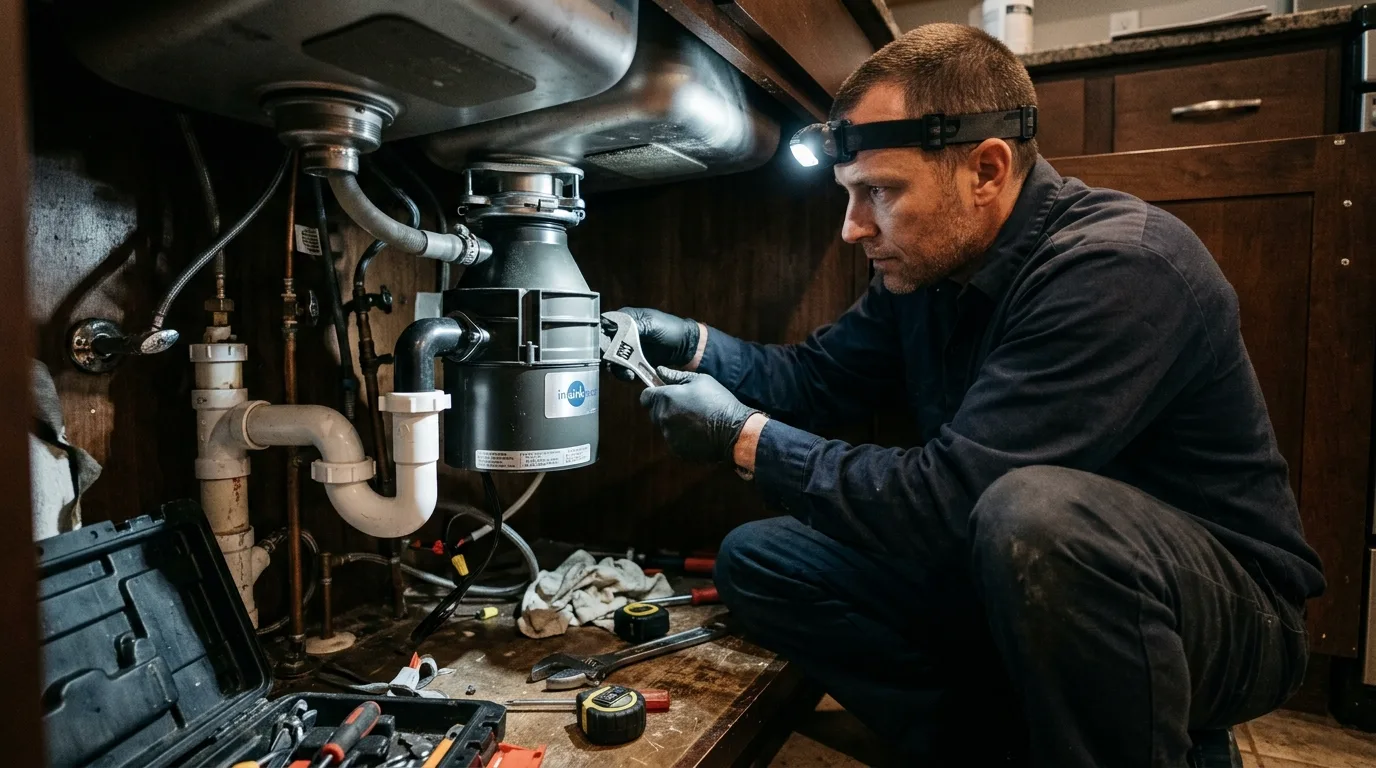
A hum with no rotation means power is reaching the motor but the flywheel cannot turn. Something is jammed between the impeller and the grind ring. Usually a bone fragment, a fruit pit, a bottle cap, a piece of glass or accumulated fibrous material. The motor is fine. Leaving it humming, however, will cook the windings, so switch it off. Most jams clear with a hex wrench in the socket underneath and a look inside with the power off at the breaker.
Silence means power is not reaching the motor. In order of likelihood: the thermal overload has tripped and the red reset button underneath needs pressing, the breaker has tripped, the switch has failed, or the motor is genuinely dead. The first two are free to check and worth doing before calling anyone.
Grinding, rattling, or a sudden clatter is usually foreign material bouncing around the chamber, often a spoon or a bottle cap. If the noise persists after the chamber is clear, the impellers or bearings are worn and the unit is at the end of its life.
And then the one that is not a sound. Water under the cabinet is the failure that ends a disposal. Leaks from the sink flange or the discharge tube are repairable. A leak from the reset button or the seam of the body means the internal seal has gone and water is inside the motor housing. That unit is finished, and continuing to run it is an electrical hazard rather than a plumbing one.
The real question
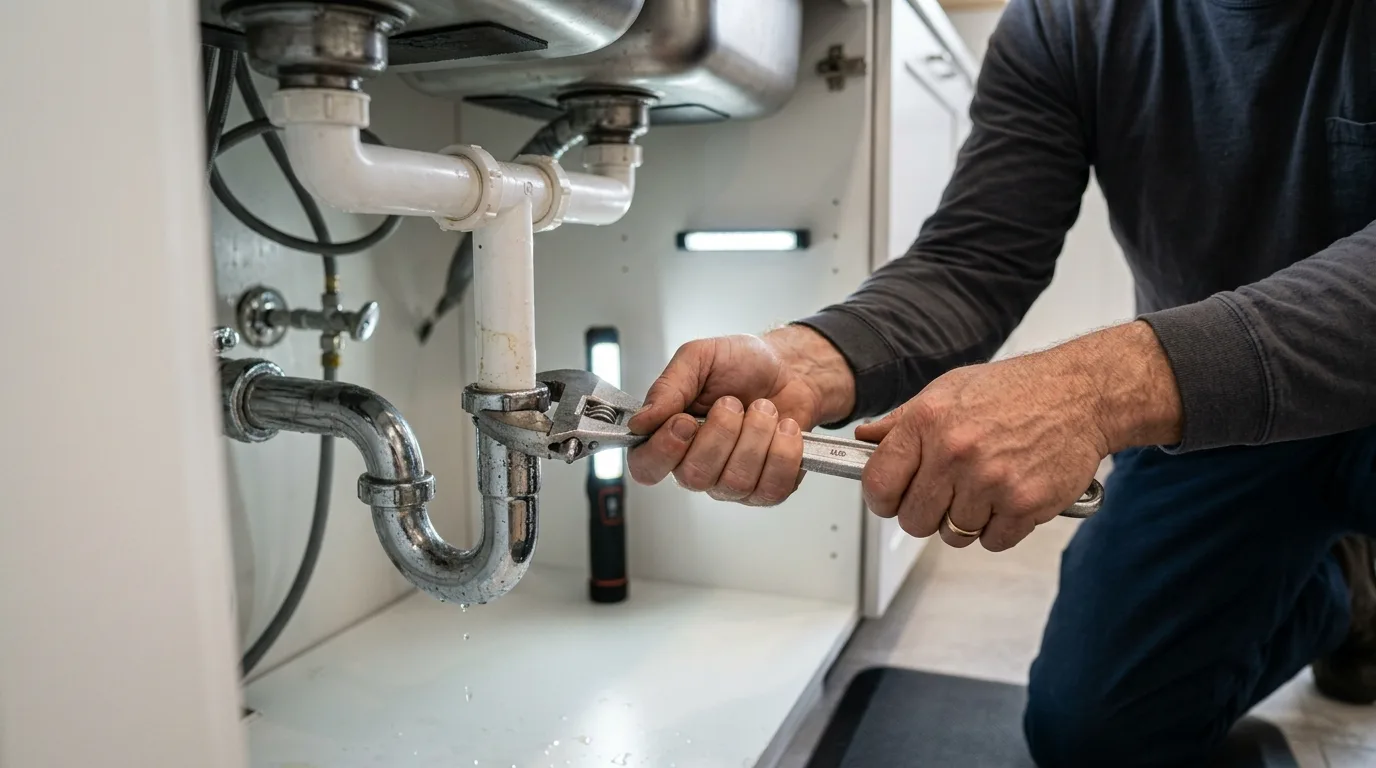
A large share of disposal calls turn out not to be about the disposal at all. The unit runs, the motor is healthy, and the sink still fills up. That is a drain problem wearing a disposal costume, and replacing the unit will not touch it.
The distinction is easy to make. If the disposal spins freely and the water still will not go, the restriction is downstream, in the trap, the branch arm, or the kitchen line where it joins the main. If both basins back up and one fills when the other drains, that is definitively a shared line problem.
Kitchen lines here fail in a specific and predictable way. Cooking fat goes down as liquid, cools in the horizontal run, and congeals on the pipe wall. Over years the effective diameter narrows until a single starchy meal finishes it. The resulting deposit is not a clog in the sense of an object; it is a hardened coating around the entire circumference.
That matters because a cable auger punches a hole through it. Water flows again, the call gets closed, and the pipe is still eighty percent coated. It backs up again within months. Hydro jetting scours the pipe wall back toward full diameter, which is why we recommend it for kitchen lines with any repeat history.
If the same line has failed more than twice, a camera is worth the hour. Repeat kitchen backups sometimes reveal a belly in the line, a bad transition, or cast iron that has scaled internally, and none of those are fixed by cleaning.
Diagnosis
The cheap possibilities are eliminated first, because sometimes the answer is a button.
01
The thermal overload button on the underside of the unit and the circuit breaker. A dead disposal is often neither dead nor a disposal problem.
02
Hex wrench in the socket underneath, chamber inspected with power isolated at the breaker, foreign material removed by hand rather than by running the motor against it.
03
Wall switch, air switch, and the electrical connection at the unit. A failed air switch presents exactly like a failed motor and costs a great deal less to fix.
04
If the flywheel turns freely and power is confirmed at the unit but nothing happens, the motor has failed and replacement is the only honest answer.
05
Sink flange, discharge tube gasket, dishwasher inlet, and body seam each mean something different. Only one of them ends the unit.
06
Trap, branch arm, and kitchen line tested independently of the disposal, so a drain problem does not get sold as a new appliance.
Sequence
Jams are frequently cleared within the hour. Replacements are a morning job.
Breaker off before anything goes into the chamber. This is not optional and it is the first thing we do.
Hum, silence, rattle, or leak, and from that, whether we are looking at a jam, an electrical fault, worn internals, or a finished unit.
Jam freed and the chamber cleared by hand, or power verified at the unit to confirm whether the motor is the fault.
Water run with the disposal off to see whether the line takes it. This is the step that stops a drain problem being sold as an appliance problem.
Repair, replacement, or drain work, with the reasoning. If a working unit needs nothing and the line needs jetting, that is what we will tell you.
New unit mounted with a fresh sink flange and plumber’s putty, discharge and dishwasher connections made up, alignment checked, and everything run and watched dry.
10–12 yr
Typical disposal service life
½ hp
Practical minimum for a family kitchen
Same day
Availability for most jams
Free
Cost of checking the reset button yourself
Why here
Two local conditions shape what goes wrong in Corona kitchens, and neither is about the disposal.
The first is hard water. At fifteen to twenty grains, mineral combines with fats and soap residue to form a deposit considerably tougher than grease alone. The technical term is soap scum; the practical reality is a hardened, adherent layer that coats the inside of a kitchen line and does not respond well to enzymes, hot water, or good intentions. It is one of the reasons kitchen drains here need jetting more often than in soft-water regions.
The second is housing age and pipe material. Homes around downtown Corona and the Circle City district often still run cast iron drain lines, and cast iron scales internally with a rough tuberculated surface that catches everything passing over it. A cast iron kitchen line thirty years into its life has an effective diameter well below its nominal size and a surface that grease grips.
Newer tracts have ABS, which is smooth and much more forgiving, but newer kitchens also tend to have longer horizontal runs to reach the stack, and long horizontals with minimal fall are exactly where cooling fat settles.
There is a third factor that is not local but is worth stating: disposals do not make waste disappear. They make it smaller. Everything ground still travels the same pipe, and fibrous material, starches, coffee grounds, and eggshell fragments all contribute to the deposit. A disposal used as a bin is a drain problem being manufactured daily.
The single most effective habit, in any water: pour cooking fat into a container and bin it. Never down the sink, and not chased with hot water, hot water only moves the fat further along before it cools and settles somewhere less accessible.
Straight answers
| Factor | Why it changes the number |
|---|---|
| Jam versus replacement | Clearing a jam is the least expensive kitchen visit we make. A replacement adds the unit, the removal, and new connections. |
| Unit size and grade | Half, three-quarter, and one horsepower units differ in cost, as do continuous-feed and batch-feed designs. More power means less jamming and quieter running. |
| Mounting compatibility | Like-for-like on a matching mount is quick. Changing brand or mount type may mean a new sink flange assembly and a little more time. |
| Electrical condition | A hardwired unit with sound wiring or a working cord and outlet is straightforward. Failed switches, damaged cords, or no dedicated outlet add work. |
| Dishwasher connection | The knockout plug in a new unit must be removed before the dishwasher drain is connected, a small step that causes a large number of callbacks when missed. |
| Drain work | If the line is the real problem, cleaning or jetting is quoted separately. We are explicit about which part of the bill is the appliance and which is the pipe. |
| Cabinet access | Deep cabinets, water filters, reverse osmosis tanks, and stone countertop overhangs all restrict working room and add time. |
| Emergency versus scheduled | A leaking unit soaking a cabinet at night is dispatched at night. Planned replacement in normal hours costs less. |
Disposal humming?
A humming unit is jammed, not dying, but running it while jammed is how it dies.
Answered 24/7 · upfront pricing before any work
Related work
Coverage
Kitchen sink backing up?
If both basins fill and the disposal runs fine, the fault is downstream. Jetting clears what an auger only tunnels through.
Independent local contractors · workmanship guarantee on completed work
Disposal FAQs
That is a jam. Power is reaching the motor but the flywheel is blocked, usually by a bone fragment, fruit pit, bottle cap, or glass. Switch it off immediately, a humming motor under load overheats quickly.
Turn the power off at the breaker, use the hex wrench in the socket on the underside to rock the flywheel free, then remove the obstruction by hand or with tongs. Never put your hand in the chamber without the breaker off.
Not necessarily. Check the reset button on the underside of the unit first; it is a thermal overload and it trips routinely. Then check the circuit breaker.
If both are fine and the flywheel turns freely with a wrench, the fault is the switch, the wiring, or the motor. A failed air switch is common and far cheaper than a new unit.
It depends on where it is coming from. A leak at the sink flange usually means the putty seal or mounting has failed and can be resealed. A leak at the discharge tube is a gasket or a loose connection.
A leak from the reset button area or the body seam means the internal seal has failed and water is inside the motor housing. That unit needs replacing; it is an electrical hazard, not just a plumbing one.
Ten to twelve years is typical for a decent mid-range unit in normal household use. Cheap builder-grade units with galvanised grinding components often fail well before that.
Stainless grinding components resist corrosion better, which matters more here than in soft-water areas. Frequency of use matters too, a unit fed heavily every day ages faster.
Cooking fat and oil above all; they go down liquid and set solid in the line. Then fibrous material like celery, artichoke, corn husks, and onion skins, which wrap the impellers rather than grinding.
Also avoid coffee grounds and eggshells in quantity, starchy items like pasta, rice, and potato peel that swell and paste, and bones and fruit pits, which are the classic jam. Anything non-food is obvious but still the leading cause of the calls we get.
Cold, and keep it running for fifteen to twenty seconds after the grinding stops. Cold water keeps any fat present solid so it gets ground and flushed rather than melted and redeposited further down the line.
Hot water does the opposite: it liquefies fat, which then travels along the pipe and congeals somewhere you cannot reach.
Almost certainly not. If one basin fills when the other drains, the restriction is in the shared line downstream of both, and the disposal is irrelevant to it.
That needs the drain cleared, and if there is any history of repeat backups, jetted rather than augered. A cable punches a hole through a greased line; jetting scours the pipe wall back toward its full diameter.
Half horsepower handles a light-use household. Three-quarter is the sensible default for a family kitchen and jams noticeably less. One horsepower suits heavy cooking, larger households, or anyone who has jammed a smaller unit repeatedly.
More power also generally means better sound insulation and a longer warranty, so the step up buys more than grinding force.
A like-for-like swap on an existing matching mount is within reach of a confident homeowner. The parts that catch people out are the electrical connection, sealing the sink flange properly, and remembering to knock out the dishwasher inlet plug before connecting the dishwasher drain.
That last one is the single most common self-install callback: the dishwasher will not drain because the plug is still in place.
Not by themselves, but they make it easy to put things into the drain that should never go there. Ground waste is smaller, not gone, and it still has to travel the same pipe.
In hard water, ground food combines with fat and mineral into a deposit that coats the line. Used sensibly, a disposal is fine. Used as a bin, it manufactures a drain problem on a schedule.
Corona, CA · kitchen drain specialists
Diagnosed before anything is quoted, and if the real problem is the drain line rather than the unit, we will say so.
Dispatch answers 24/7 · same-day and emergency response available