01
Attached-unit leak location
Moisture metering and acoustic detection to establish which unit and which line before any drywall is opened across a party wall.
Dos Lagos · 92883
A mix of attached residential and active commercial in one district. Shared walls and stacked units change how a leak is diagnosed, and trading hours change when the work happens.
Answered 24/7 · after-hours and before-open scheduling for commercial
The district
Dos Lagos combines an active commercial and retail district with attached and multi-family residential, all built from the mid-2000s onward. That mix means we are doing two quite different kinds of work within the same few blocks, and the considerations barely overlap.
On the residential side, the defining feature is shared construction. Condos, townhomes, and stacked units mean plumbing that passes through party walls and between floors, which changes leak diagnosis fundamentally. Water appearing in your unit may originate in a neighbor’s, or in a common-area line, or in a stack serving several units. Opening drywall on the wrong side of a party wall is both expensive and awkward.
It also means there is usually a third party involved. HOAs and management companies typically own the common-area plumbing and the stacks, while the owner is responsible from a certain point inward, and where that line falls is defined by the governing documents rather than by plumbing logic. Knowing which side of it a problem sits on before work starts avoids a dispute afterwards.
On the commercial side, the defining feature is trading hours. A restaurant, cafe, or retail unit cannot have its water off during service, and a plumbing failure during business hours is lost revenue rather than inconvenience. Scheduling work before open, after close, or overnight is standard practice for us, not a special accommodation.
The build era means modern materials throughout, PEX or copper supply, ABS or cast iron waste depending on the building, and current venting. Age-related failures are not the story here. Usage patterns and shared infrastructure are.
Commercial
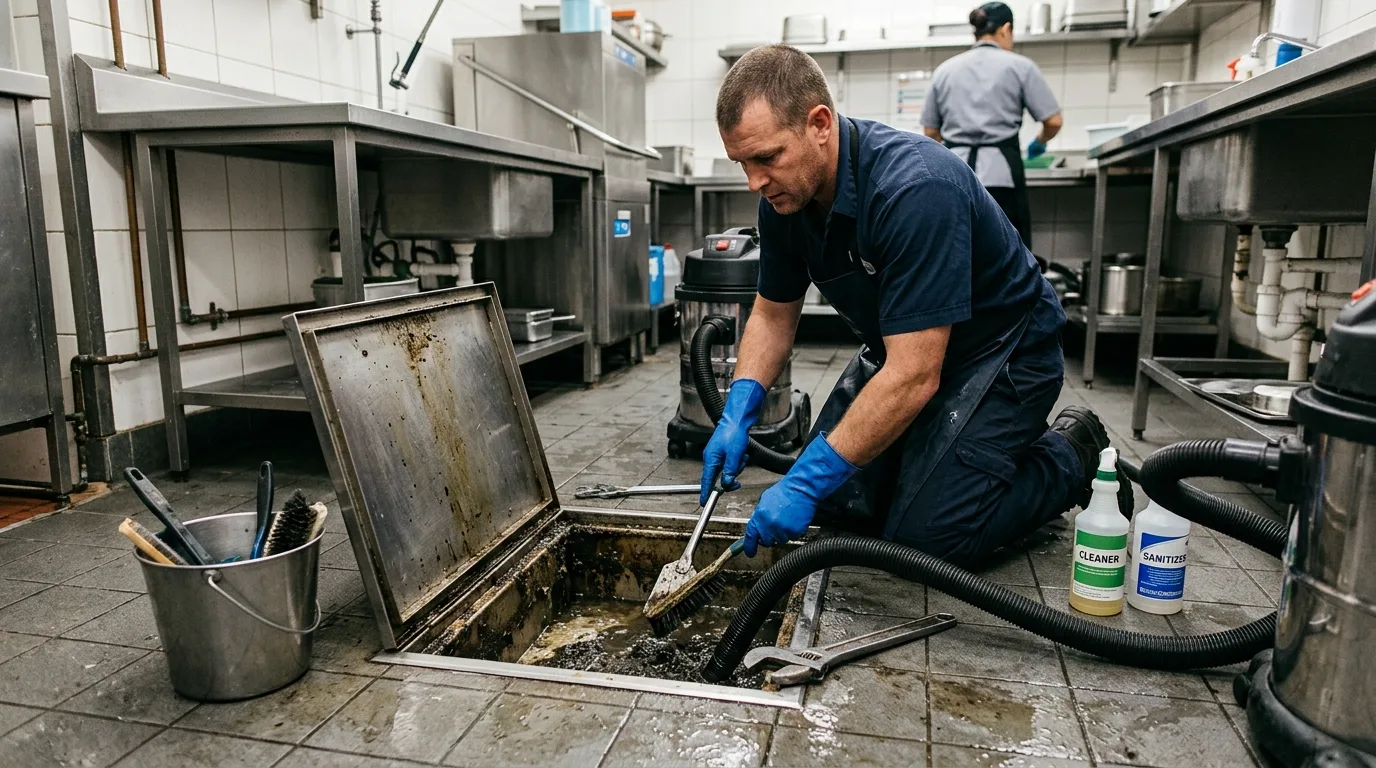
In any district with food service, one problem dominates emergency calls: the kitchen grease line. Understanding why it fails explains why the standard response to it is the wrong one.
Fats and oils leave the kitchen warm and liquid, cool in the horizontal run, and deposit on the pipe wall. Each layer gives the next something to hold. The build is circumferential and progressive, so the pipe does not block at a point; it narrows everywhere until an ordinary day’s volume no longer fits.
Which is why cabling a grease line is a deferral, not a repair. A cable punches a channel through the deposit. Water flows, the call closes, and most of the coating is still on the wall. Operators who have been cabled three times in a year are not unlucky; they are on a treadmill.
Jetting scours the wall back toward full diameter. It costs more per visit and it is the only approach that resets the clock. Paired with a camera, it also tells you the actual condition of the line, which is what sets a sensible service interval.
The model that works is a scheduled program at an interval set by the footage rather than by a default, quarterly for a busy kitchen, annually for light food service. The work happens overnight on a date you chose instead of at seven on a Friday with a full book. That is the entire business case, and it is a strong one.
Where a line keeps failing on a reasonable interval, the grease interceptor is the next place to look: undersized, overdue, or bypassed, it sends everything it was meant to capture straight into the pipe.
Scope
Two distinct sets of work in one district.
01
Moisture metering and acoustic detection to establish which unit and which line before any drywall is opened across a party wall.
02
Establishing responsibility boundaries from the governing documents before work starts, and documenting findings for both sides.
03
Reactive clearing and scheduled jetting programmes with camera verification, worked around trading hours.
04
Flushometer valves, floor drains, mop and prep sinks, hand-wash stations, and commercial gas connections for kitchen equipment.
05
Installation, repair, and replacement, plus coordination of the annual backflow test the water purveyor requires.
06
Standard work in condos and townhomes, heaters, fixtures, disposals, toilets, with access and noise considerations for attached construction.
How we work
Residential and commercial follow different paths from the first question.
Owner-occupied unit, rental, HOA common area, or commercial tenancy. This determines who authorises work and who pays for it.
On attached construction, moisture metering and acoustic detection to identify the source unit and line. Party walls are not opened speculatively.
Where an HOA or management company is involved, we establish which side of the boundary the fault sits on and document it.
For commercial, work planned before open, after close, or overnight. We quote both in-hours and after-hours so the comparison is explicit.
Noise, access, water shut-off scope, and shared-stack implications communicated in advance rather than discovered.
Camera footage on drain work, written records for compliance and HOA files, and a recommended service interval where one applies.
Mid-2000s
Construction era across the district
Quarterly
Common jetting interval for a busy kitchen
Annual
Backflow assembly testing requirement
24/7
Dispatch, including overnight
Local conditions
Hard water at commercial volume. Temescal Valley hardness of fifteen to twenty grains or more running through a dish machine, an espresso machine, an ice maker, or a high-throughput water heater produces scale at a rate residential experience does not prepare anyone for. Commercial heaters here fail early without treatment, and equipment warranties frequently require it.
Shared stacks. In stacked residential, a drain problem in one unit can present in another, and a blockage low in a stack affects everything above it. Diagnosis has to consider the whole stack rather than the fixture in front of you, which is the most common reason attached-unit problems get misdiagnosed.
Usage intensity. Commercial fixtures see more cycles in a month than residential ones see in a year. Flushometers, floor drains, and prep sinks wear on a schedule that makes planned maintenance genuinely cheaper than reactive repair.
Pressure. Worth measuring here as everywhere in the valley. Commercial flushometers, mixing valves, and equipment solenoids are sensitive to it, and a business replacing the same component repeatedly is usually looking at a pressure problem nobody has measured.
Access windows. Center management rules and shared parking and loading areas constrain when work can happen and where equipment can go. We plan around those rather than discovering them on arrival, which is a practical difference that matters more than it sounds.
Dos Lagos
Metering and acoustic detection identify the source before anyone opens a party wall.
Answered 24/7 · upfront pricing before any work
Full service list
Dos Lagos commercial
Cleared tonight, then jetted and cameraed so next Friday is not the same Friday.
Independent local contractors · after-hours scheduling available
Dos Lagos FAQs
It depends where it originates and what your governing documents say. HOAs typically own common-area lines and stacks while the owner is responsible from a defined point inward, and that boundary is set by the documents rather than by plumbing logic.
We locate the source first with metering and acoustic detection, then establish which side of the line it falls on and document it. That order avoids a dispute after the work.
Possibly, if that is where the source is, but not speculatively. On attached construction we locate before opening anything, because opening the wrong side of a party wall is expensive and awkward.
Where access to a neighboring unit or common area is needed, that gets arranged through the HOA or management company rather than negotiated at the door.
Yes, and for most commercial clients that is the preferred arrangement. Work is routinely scheduled before open, after close, or overnight.
After-hours labor carries a premium and it is almost always cheaper than losing trading hours. We quote both so the comparison is explicit rather than assumed.
In a center, the interval is set by the busiest tenant on the shared lateral rather than by your own kitchen. A patio-heavy summer can load a line faster than whatever default interval was assumed when the space was fitted out.
We camera the lateral after the first clean, note where grease is actually accumulating and how far down it starts, and set the interval from that. Where the build is past your cleanout we put it in writing for the property manager, because that segment is usually theirs.
A cable opens a channel through a deposit that still coats the whole pipe wall. Flow returns, the call closes, and the build is all still there.
On a shared retail lateral that matters more than it does in a house, because the next tenant’s peak refills the channel and the next blockage arrives mid-service. Jetting cuts the wall back toward full diameter, which is the only version of this that resets the clock instead of moving it a few weeks.
Your lease decides that, and it is worth reading before there is a problem rather than during one. On the plumbing side we work on the lines in and out, the connections, and the diagnosis when an interceptor is undersized, bypassed or long overdue in a way that is causing the line to fail.
Pumping and hauling is a separate licensed function. What we can add is documentation: what we found, where, and on which side of your cleanout, so the conversation with the landlord starts from evidence.
In this valley, scale. Temescal Valley hardness through a high-throughput heater deposits on the tank bottom or heat exchanger, insulating the burner from the water and driving both fuel use and failure rate.
Undersizing is the other common cause. We size to actual fixture load and recommend treatment where the equipment warranty requires it anyway.
Often, yes. Where a job can be staged we isolate sections so part of the premises keeps operating, and the disruptive stages go into closed hours.
Some work genuinely needs the water off or a floor open. In those cases we give you the honest duration up front so you can plan rather than discover it mid-shift.
By elimination rather than exploration. Isolating one riser at a time and watching pressure, then thermal imaging and moisture meters across the suspected area, narrows it to a small target before anything is cut.
Water tracks along joists and steel, so the wet spot is often nowhere near the failure. That is exactly why cutting first is the expensive route in attached buildings.
Most often a trap that has dried out in a fixture nobody uses, or a floor drain in a back-of-house area that has evaporated. The seal is water, and water leaves.
The other causes are a blocked or badly terminated vent pulling odor into the room, and an interceptor that is overdue. A camera on the vent and a check on the interceptor schedule usually finds it quickly.
Dos Lagos · 92883
Leaks located before drywall opens, and commercial work scheduled around your trading hours rather than ours.
Dispatch answers 24/7 · same-day and emergency response available