01
A long concrete driveway over the run
Common in older Corona properties with a detached garage at the back. Replacing that driveway can cost more than the entire sewer job.
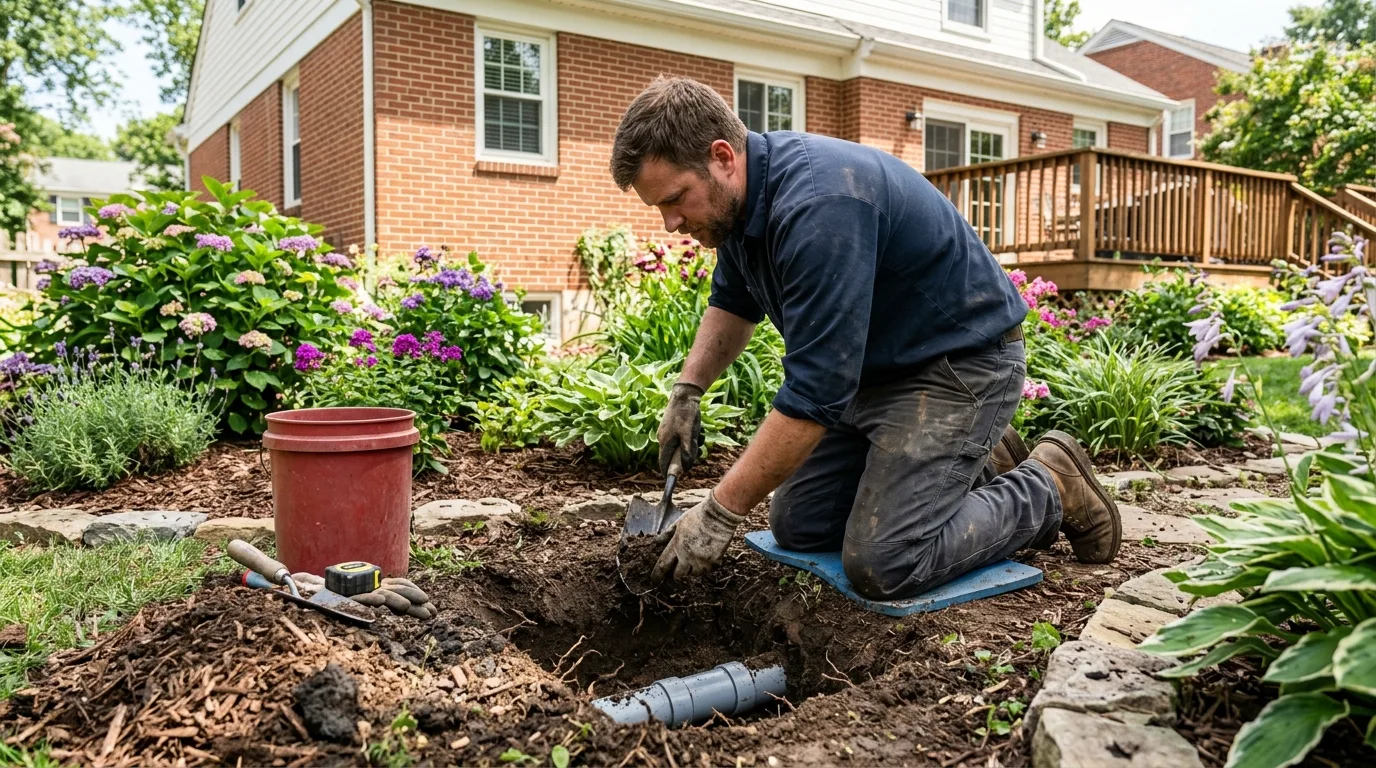
No trench across the yard · Corona, CA
Two access pits instead of a hundred-foot trench. When the driveway, the patio, the pool deck or a forty-year-old tree sits over your lateral, trenchless is usually the cheaper job once restoration is counted honestly.
Trenchless is not always right. We will tell you when open-trench is cheaper or when the pipe cannot be lined.
Hardscape stays put
Driveways, pavers, pool decks and mature planting are not excavated.
Two methods
CIPP lining creates a new pipe inside the old one. Pipe bursting replaces it outright.
Compared honestly
Both trenchless routes priced against open-trench, restoration included in the comparison.
The two methods
Trenchless is a category, not a product. Two quite different techniques sit inside it, they suit different problems, and knowing which one you are being sold matters.
A resin-saturated flexible liner is pulled or inverted into the existing pipe, inflated against the inner wall, and cured, with hot water, steam or UV light, into a hard, jointless pipe inside the old one. The host pipe becomes a mold. What you end up with is a continuous, seamless conduit with no joints for roots to enter, at a marginally reduced internal diameter that the smoother bore more than compensates for in flow terms.
Lining requires a host pipe that still holds its shape. Cracked clay, corroded-but-intact cast iron and old plastic all line well. A collapsed section, a badly deformed pipe, or Orangeburg that has lost its round does not; there is nothing to line against.
A bursting head is pulled through the old pipe on a cable or rod. It fractures the host pipe outward into the surrounding soil while simultaneously drawing new HDPE pipe in behind it. You get a genuinely new pipe, at full diameter or larger, and the old one becomes part of the backfill.
Bursting handles pipe that is too far gone to line and can upsize a lateral that was undersized to begin with. It needs enough soil around the pipe to accept the fractured material, and it needs the route to be reasonably straight, so it is less suited to lines with sharp bends or with other utilities crowded alongside.
Slope. If your line has a belly, a sagging section where fill settled and water now stands, lining it produces a smooth, lined, still-bellied pipe, and bursting follows the same path the old pipe took. Correcting fall means excavating that section and re-bedding it. Anyone who offers to line away a belly is selling you a repeat visit, and the camera footage will show which situation you have.
When it wins
The case is almost never about the pipe. It is about what sits on top of it.
01
Common in older Corona properties with a detached garage at the back. Replacing that driveway can cost more than the entire sewer job.
02
Standard in the newer tracts south of Ontario Avenue. Matching stamped concrete or discontinued pavers is often impossible, not just expensive.
03
Open-trench work through a root plate frequently kills the tree eventually. Two access pits away from the canopy usually does not.
04
A jointless liner removes every entry point along the run at once, rather than spot-repairing joints one at a time and waiting for the next.
05
Excavation cost climbs steeply with depth, and shoring requirements arrive. Trenchless cost is far less depth-sensitive.
06
A run passing beneath a slab addition, a converted garage or an enclosed porch is a serious excavation and a comparatively ordinary lining job.
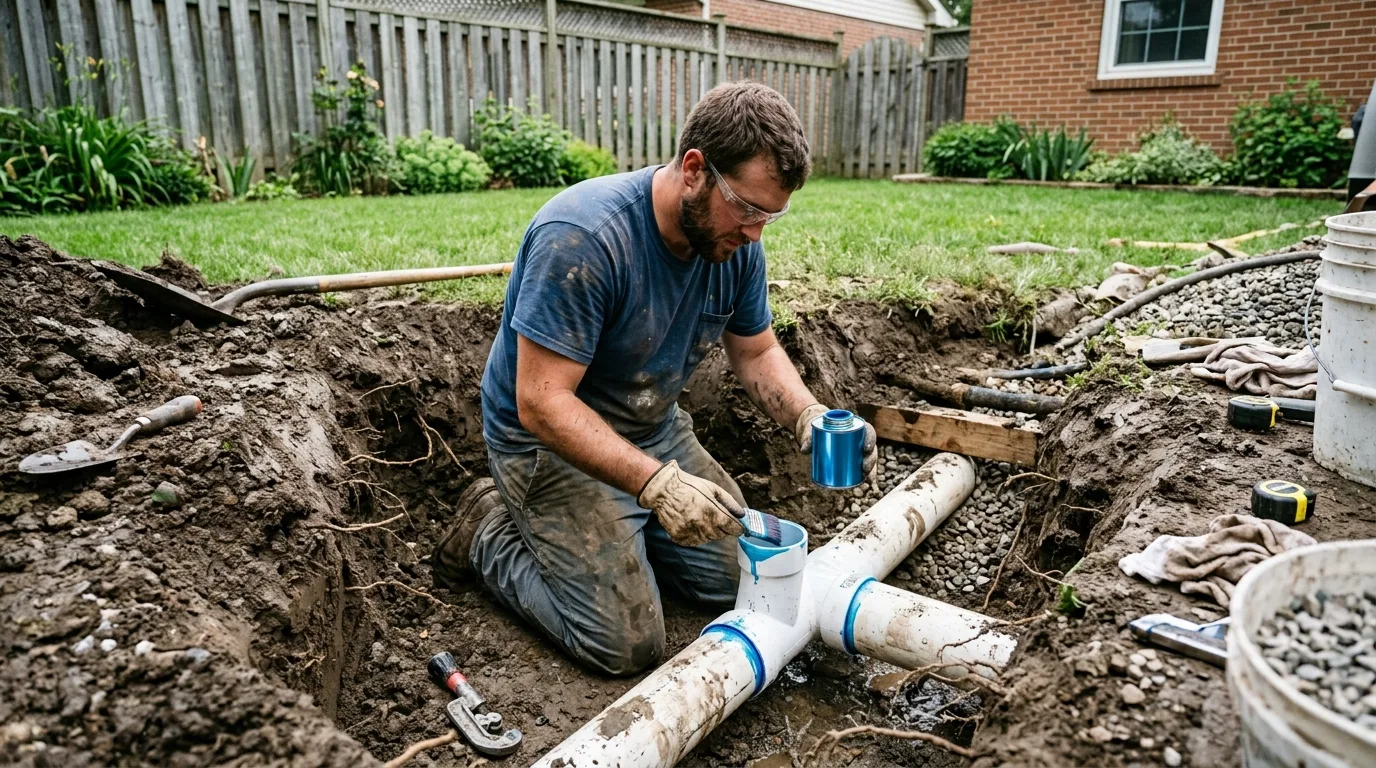
When it does not
Trenchless gets marketed as universally superior. It is not, and we would rather lose the bigger job than sell you the wrong one.
The reason to price both is that the comparison is genuinely non-obvious. Trenchless usually costs more per foot for the pipe work and frequently costs less in total once you count concrete, pavers, planting, irrigation and the days your yard is a construction site. Sometimes it is the other way round. You should see both numbers, with restoration explicitly included in each, and make the call yourself.
Sequence
Two access pits, one or two days, and a camera pass you get to watch at the end.
Full run from cleanout to main, with distance and depth for every defect, plus every branch connection recorded so nothing gets covered over.
Lining, bursting and open-trench, each with restoration counted honestly. If open-trench is cheaper for your yard, that is what gets recommended.
City permit where required, and every buried utility marked before a shovel moves. Non-negotiable on any excavation, however small.
The host pipe is scoured back to clean wall. Liners bond to clean pipe, and this step is where a cheap job cuts corners.
Two small excavations rather than a trench. Liner inverted and cured, or bursting head pulled through drawing new HDPE behind it.
Any branch connections re-cut and confirmed on camera, final end-to-end footage, pits backfilled and compacted. Keep the footage for your records.
2
Access pits instead of a full-length open trench
0
Joints in a cured liner, nothing for roots to enter
50
Typical design life claimed for a properly installed CIPP liner
3
Options priced: lining, bursting, open-trench
Local detail
The economics of trenchless are decided by what is above the pipe, and Corona’s two dominant housing patterns both tend to put something expensive there.
Downtown, the Circle City Historic District and Central Corona have deep lots, detached garages at the rear, and long concrete driveways running the length of the property, frequently directly over the sewer lateral. They also have the mature pepper, ficus and eucalyptus trees that make those streets worth living on, with root plates that an open trench would cut straight through. These are the properties where lining is often dramatically cheaper in total, because the pipe work is a fraction of what the driveway and the tree are worth. It is also where the underlying defect, root intrusion at clay joints, is exactly what a jointless liner is best at eliminating permanently.
South Corona, Eagle Glen, Chase Ranch, Sycamore Creek, Dos Lagos and Temescal Valley homes from the late 1990s onward tend to have heavily improved yards: stamped concrete, paver patios, pool decks, built-in outdoor kitchens, specimen planting on drip. Matching stamped concrete color and pattern after a trench is genuinely difficult, and discontinued pavers cannot be matched at all. The pipe here is usually ABS or PVC in reasonable condition, which lines well, so the common finding is a good host pipe with one or two defects under something irreplaceable, which is close to the ideal trenchless case.
Corona climbs from roughly 500 feet at the freeway junction to well over 1,000 feet against the Santa Ana Mountains, and lots on the slopes frequently have deeper laterals with more fall to the street. Excavation cost rises sharply with depth once shoring comes into it, while trenchless cost is comparatively flat. On the hillside properties in Corona Hills, Orange Heights, Eagle Glen and up toward Temescal Valley, that difference alone often decides it.
The seasonal swell and shrink in western Riverside County soils is what pulls clay joints apart in the first place. A jointless liner is immune to that mechanism, which is a real long-term advantage here rather than a brochure claim. The same soil movement is also why proper bedding and compaction matter so much on the open-trench alternative, a poorly backfilled trench in expansive soil develops its own belly within a few years.
Work in the public parkway or a new connection at the city main brings in permits, inspection and sometimes traffic control on the busier streets. Trenchless reduces how much of the work sits in the right of way, which can simplify that side of the job considerably, but it does not eliminate it, and any quote that shows no permit line for work at the main deserves a question.
Straight answers
| Consideration | Trenchless (lining or bursting) | Open-trench replacement |
|---|---|---|
| Cost of pipe work | Higher per foot, with fixed setup costs | Lower per foot on short, shallow, accessible runs |
| Surface restoration | Two small pits only | Full length of trench, plus whatever is over it |
| Total cost with hardscape above | Usually lower | Usually higher, sometimes dramatically |
| Time on site | Typically one to two days | Typically two to four days |
| Fixes slope or belly | No | Yes; this is the reason to dig |
| Changes diameter or route | Bursting can upsize; lining cannot | Yes, freely |
| Works on collapsed pipe | Lining no; bursting sometimes | Yes |
| Eliminates root entry joints | Yes, a cured liner is jointless | Yes, with new jointed or fused pipe |
Ask for both numbers on the same sheet, with restoration stated explicitly in each. That single comparison is where the real decision lives.
Driveway over the line?
The comparison is not obvious, and it is your money. We will show you both, with restoration counted.
Camera survey, both methods assessed, and an honest answer if digging is cheaper for your yard.
Related work
Coverage
Trenchless FAQs
Per foot of pipe, usually not. In total, frequently yes, because most of the cost of open-trench sewer work is not the pipe, it is putting the surface back.
On a short lateral under plain lawn, digging generally wins. Under a long driveway, a paver patio, a pool deck or a mature tree, trenchless usually wins by a wide margin. Get both priced with restoration included and the answer for your property becomes obvious.
A properly installed cured-in-place liner is generally rated for a design life of around fifty years, comparable to new pipe. The material is a resin composite and it does not corrode.
The variables that matter are installation quality: whether the host pipe was properly cleaned first, whether the cure was managed correctly, and whether branch connections were reinstated accurately. Ask to see the final camera footage, a good liner looks smooth and continuous with cleanly cut branch openings.
Marginally, yes, the liner has a wall thickness, so internal diameter reduces slightly. In practice flow usually improves rather than worsens.
That is because the new surface is smooth, jointless and free of the roughness, scale and root hair that were restricting the old pipe. A slightly smaller smooth pipe carries more than a nominally larger rough one.
No. Lining needs a host pipe that still holds its shape. Cracked clay, corroded but intact cast iron and older plastic all line well.
Collapsed sections, badly deformed pipe and Orangeburg that has lost its round give a liner nothing to cure against. Pipe bursting can handle some of those cases; sometimes the honest answer is an open trench.
A liner passes over them, so each one has to be reinstated, cut open from inside with a robotic cutter and confirmed on camera.
This is a step where corners get cut, and a missed or partially opened branch causes a backup in whatever it serves. Insist on seeing every reinstated connection on the final footage.
Yes, but far less. Trenchless needs access pits, typically one near the house and one near the property line or the connection at the main.
So expect two modest excavations rather than a trench along the whole run. Where those pits land is worth discussing in advance, since you get to choose the least painful spots.
A run passing beneath a slab, an addition or a converted garage is one of the strongest cases for trenchless, because the alternative is breaking concrete inside or under the building.
It depends on access at both ends and on the condition and geometry of the pipe. The camera survey answers it, and this is exactly the situation where paying for a proper survey saves the most money.
Usually yes, particularly for anything involving the connection at the public main or work in the parkway. Requirements vary by jurisdiction and scope.
Have it pulled. Unpermitted sewer work resurfaces at resale or refinance, and resolving it retroactively costs more than doing it correctly now.
Less than open-trench, but it is still construction. Expect equipment on the street or driveway, water use interrupted for periods, and no sewer use while the liner cures.
Most residential jobs are one to two days. You will be told when the house cannot drain, and it is worth planning around that rather than discovering it.
Sometimes it is genuine judgment about your pipe. Sometimes it is which equipment the contractor owns.
The way to tell them apart is the footage. Ask each to point at the specific defect, give its distance from the cleanout and its depth, and explain why their method suits that finding. A contractor working from evidence can do that immediately; one working from preference cannot.
Corona, CA · 24/7
Camera survey, lining and bursting both assessed, open-trench priced alongside them, and restoration counted in every number.
Permits handled. Final camera pass on every job. Upfront pricing before work begins.