01
Running or phantom-flushing
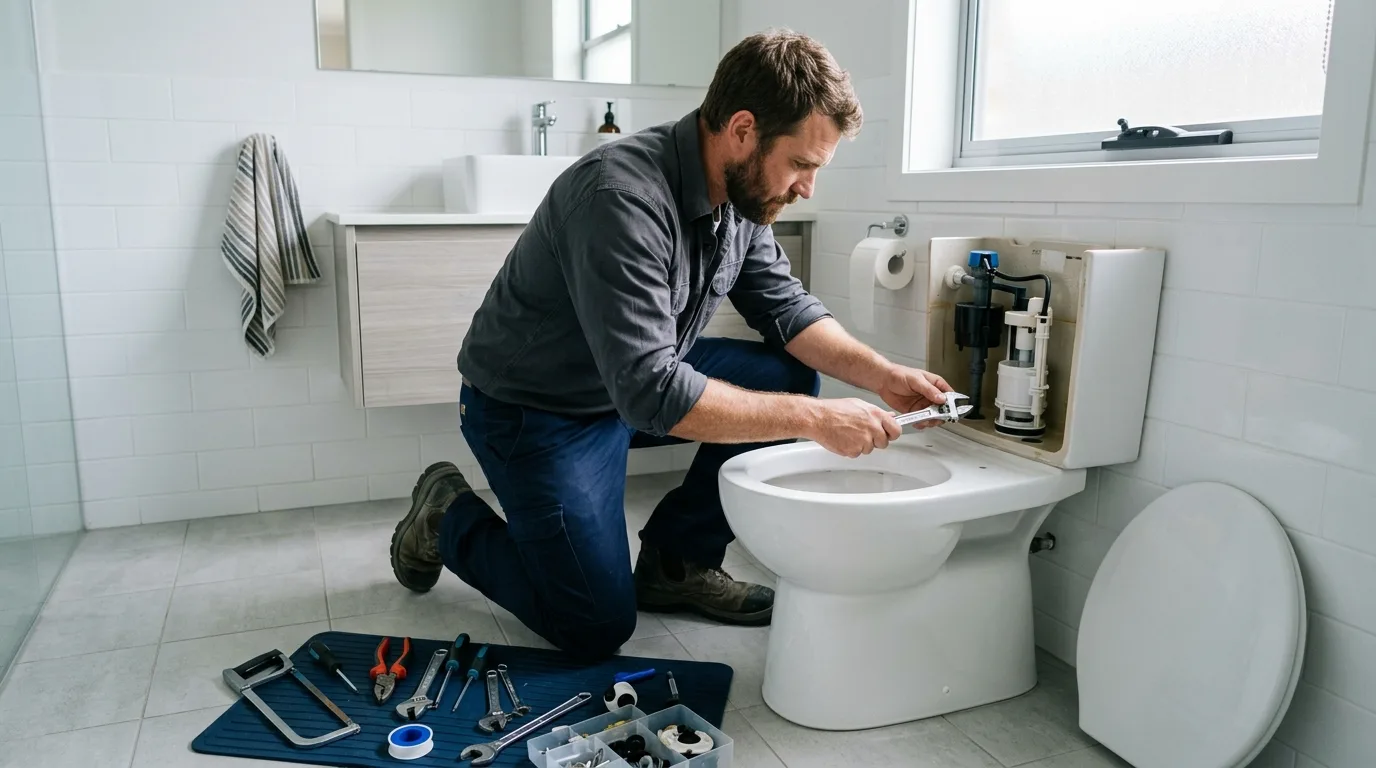
Flapper, seal, or fill valve. The tank refills on its own without anyone touching it. Cheap to fix, expensive to ignore on a water bill.
Toilets · Corona, CA
A running toilet is the most expensive small leak in most houses, and a rocking one is a flange problem waiting to reach the subfloor. Both are usually fixed in a single visit.
Answered 24/7 · common fill valves, flappers, and wax kits carried on the truck
The quiet expense
Of everything that goes wrong in a house, a running toilet is the failure people tolerate longest. It is not dramatic. Nothing floods. The jiggle-the-handle workaround takes two seconds. And in the meantime a worn flapper can pass a startling volume of water, enough to show up clearly on a bimonthly bill, and enough that in a summer of tiered water rates it becomes a genuinely expensive habit.
The mechanism is unglamorous. A flapper or seal at the bottom of the tank is supposed to close watertight after each flush. Rubber hardens with age, mineral deposits build on the seat it lands against, and eventually it stops sealing. Water trickles into the bowl, the tank level drops, and the fill valve cycles to top it up, sometimes audibly every few minutes, sometimes silently and continuously.
The test is simple enough to do yourself: put a few drops of food colouring in the tank, do not flush, and come back in fifteen minutes. Color in the bowl means the flapper is passing. It is the single most useful five-minute diagnostic in household plumbing.
The other half of the tank, the fill valve, fails differently. It hisses, refills slowly, refuses to shut off, or overfills until water runs down the overflow tube in a permanent silent leak. Both parts are inexpensive. Both are routinely replaced together, because if one has reached the end of its life in this water the other is usually close behind.
And there is a cause upstream worth naming. If a house is running above 80 psi, fill valves and flappers get destroyed on a cycle no part can survive. When we see a toilet that has eaten three fill valves in four years, the first thing we do is put a gauge on the hose bib.
Below the bowl
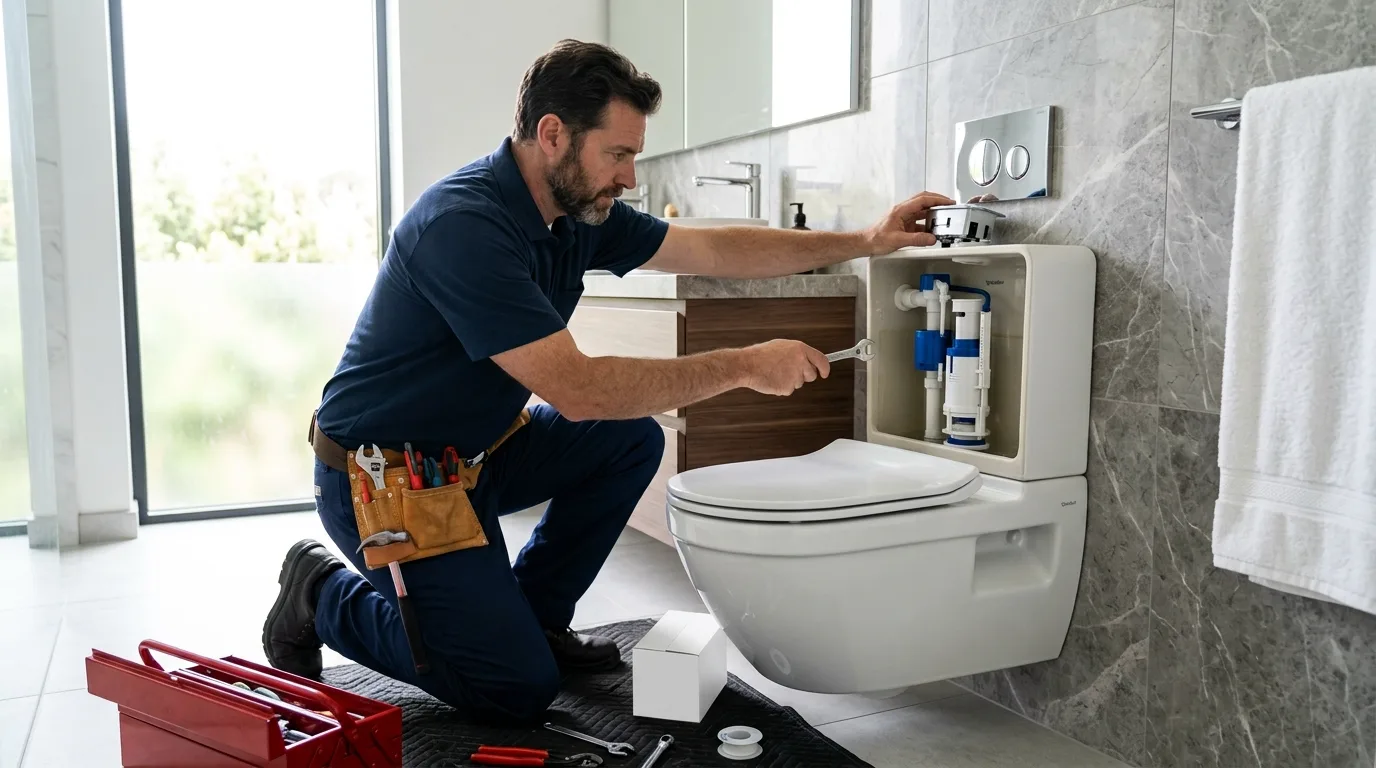
A toilet that moves when you sit on it is not a nuisance to live with. Every rock breaks the seal between the bowl horn and the closet flange, and once that seal is broken, a little waste water goes into the floor with every flush instead of down the drain.
It is slow, it is invisible, and the first visible sign is often staining on a ceiling below or a soft patch of subfloor around the base. By that point the repair is no longer a wax ring; it is a wax ring plus whatever the water has been doing underneath for a year.
The usual root cause is the closet flange: the ring that anchors the toilet to the drain. Older cast iron flanges corrode, plastic ones crack, and flanges that sit below the finished floor after a tile job cannot hold a proper seal no matter how many wax rings get stacked on them. That last one is extremely common in remodeled Corona bathrooms, where tile was laid over the original floor and the flange stayed where it was.
The fix depends on what we find. Sometimes it is a repair ring and new bolts. Sometimes it is a flange extender to bring the height right. Sometimes the flange has to be cut out and replaced, which on a slab foundation means opening a small amount of concrete, work we would rather quote honestly up front than discover halfway through.
We also use the opportunity to look at the closet bend and the branch drain while the fixture is off. It is the only time that view is free, and on a house with a history of backups it is worth taking.
Common calls
Most are same-visit repairs. A couple of them are symptoms of something further down the drain.
01
Flapper, seal, or fill valve. The tank refills on its own without anyone touching it. Cheap to fix, expensive to ignore on a water bill.
02
Often mineral blockage in the rim jets and siphon jet rather than a failing fixture. On hard water these scale closed gradually, and a proper descale restores the flush.
03
A single blockage is a plunger job. The same toilet backing up week after week points at the branch line or the main, and that needs a camera, not another auger.
04
Bolts, shims, and levelling if the flange is sound. If it is not, the flange gets repaired or replaced, putting a bowl back on a bad flange just repeats the failure.
05
Water appearing around the base after a flush is a failed seal. It needs the fixture pulled, not caulk around the outside, which only traps the water where you cannot see it.
06
The gasket and bolts between tank and bowl are a wear item, and the drip runs down the back where nobody looks until the floor is damaged.
Sequence
Repairs are usually within the hour. Replacements are a half-day at most.
Dye test for a passing flapper, listen and watch a full fill cycle, check the shut-off, and look at the base and floor. Guessing at a toilet wastes a trip.
If this fixture has a history of eating fill valves, a gauge goes on the hose bib before anything is replaced.
Rebuild, part replacement, flange work, or full fixture replacement, with the number given first. No work starts on an assumption.
Tank parts swapped, or the fixture drained and lifted with the floor protected. Once it is off, the flange, bolts, and drain get inspected.
New wax or a modern seal, new bolts, correct flange height, and the bowl set level and shimmed where the floor demands it, not over-tightened, which is how porcelain cracks.
Multiple full flush cycles, base checked dry, supply connection checked, and the old fixture and packaging taken away.
1.28 gpf
California maximum for new toilets
17–19 in
Comfort height range we usually recommend
½ day
Typical full replacement
24/7
Dispatch for an overflowing fixture
Why here
Fifteen to twenty grains of hardness has three distinct effects on a toilet, and each one gets misdiagnosed as something else.
First, the flapper seat. Mineral deposits build up on the seat the flapper lands against, and a microscopically rough seat will not hold a seal against soft rubber. This is why a brand new flapper sometimes still leaks, the part is fine, the surface it closes against is not. A proper repair cleans or replaces the seat, not just the flapper.
Second, the rim jets. Water enters the bowl through small holes under the rim and one larger siphon jet at the bottom. Those scale closed slowly over years, and the flush weakens so gradually that nobody notices until it needs two flushes routinely. Homeowners replace a perfectly good toilet over this. A descale often fixes it.
Third, fill valve internals. The small diaphragms and seals inside a fill valve are exactly the kind of surface mineral loves. Valves that would last a decade elsewhere have a considerably shorter life here.
All three are arguments for a softener that never make it into the sales pitch, which usually focuses on soap and laundry. The plumbing lifespan argument is the stronger one.
There is also a housing-stock pattern worth knowing. Corona has a large inventory of homes built on slab, and a slab foundation changes what a flange repair means: there is no crawlspace to work from, so a genuinely failed flange sometimes requires opening a small area of concrete. It is not a disaster, but it is a different quote to a wax ring, and it is one of the reasons we look before we promise.
Finally, older properties around downtown and the Circle City district often still have original cast iron closet flanges and, in some cases, cast iron branch drains. Both change the job. We would rather find that on inspection than in the middle of it.
Straight answers
| Factor | Why it changes the number |
|---|---|
| Repair or replace | Tank internals are the least expensive visit we make. A full fixture replacement involves the toilet itself, the removal, and the disposal. |
| Flange condition | A sound flange means a wax ring and bolts. A corroded, cracked, or below-floor-height flange means repair rings, extenders, or in the worst case cutting concrete on a slab. |
| Floor damage already present | Soft subfloor or a damaged slab area around the base has to be addressed before a fixture goes back on it. We will show you what we find. |
| Fixture choice | Standard height versus comfort height, round versus elongated, one-piece versus two-piece, and pressure-assist versus gravity all sit at different price points. |
| Shut-off and supply line | Old angle stops seize and old supply lines are a known failure point. Replacing both while the fixture is off is cheap insurance and we usually recommend it. |
| Recurring clogs | If the real fault is the branch drain or main line, a camera inspection is the honest next step rather than repeated augering of one fixture. |
| Access and stairs | Upstairs bathrooms, tight powder rooms, and carrying a one-piece fixture up a flight all add labor time. |
| Emergency versus scheduled | An overflowing toilet at midnight is dispatched at midnight. A planned replacement in normal hours costs less. |
Toilet running?
Food colouring in the tank, no flush, check the bowl. If there is color, call us.
Answered 24/7 · upfront pricing before any work
Related work
Repeat clogs?
When one fixture backs up over and over, the answer is often further down the line. A camera settles it in an hour.
Independent local contractors · workmanship guarantee on completed work
Toilet FAQs
Almost always the flapper or the fill valve. A hardened flapper, or a mineral-roughened seat that a new flapper cannot seal against, lets water trickle into the bowl until the fill valve cycles to top the tank back up.
Confirm it with a dye test: a few drops of food colouring in the tank, no flushing, and check the bowl in fifteen minutes. Color in the bowl means the flapper is passing.
Enough to be obvious on a bill. A steadily leaking flapper can pass hundreds of gallons a day in a bad case, and even a slow one adds up over a billing period.
Because water here is billed in tiers, a running toilet can push a household into a higher rate band and cost noticeably more than the leak volume alone suggests.
Usually not. Weak flush in Corona is most often mineral scale closing off the small rim jets under the bowl lip and the siphon jet at the bottom. It happens so gradually that people adapt to double-flushing without noticing.
A descale of the jets frequently restores the original flush. It is worth trying that before replacing a functional fixture.
Yes. Every rock works the seal between the bowl and the closet flange, and once that seal breaks, a little waste water goes into the floor with each flush instead of down the drain.
It is invisible until the subfloor is soft or a ceiling below is staining. Fixing a rock early is a wax ring. Fixing it late is a wax ring plus a floor repair.
No; that treats the symptom in the worst possible way. Caulk around the outside traps the water under the fixture where you cannot see it, and the subfloor damage continues out of sight.
A leak at the base means the fixture comes up and the seal and flange get addressed. Caulk has a legitimate role afterwards, for stability and hygiene, with a deliberate gap left at the back so any future leak still shows itself.
It is the ring that anchors the toilet to the drain pipe and gives the wax ring something to seal against. If it is corroded, cracked, or sitting below the finished floor level, no amount of wax will produce a reliable seal.
Below-floor-height flanges are very common in remodeled bathrooms where tile was laid over the original floor. The fix is a flange extender or a proper replacement, not stacked wax rings.
On a raised foundation there is access from below and it is straightforward. On a slab, the flange is set into concrete, so a genuine replacement can mean opening a small area of the slab around the drain.
It is routine work, but it is a different job to a wax ring and we quote it as such. We always look at the flange before promising a price on a leaking base.
For most adults, yes. Comfort height bowls sit around 17 to 19 inches to the seat, against roughly 15 inches for a standard bowl, and the difference matters a great deal for anyone with knee, hip, or mobility issues.
Standard height still suits households with young children. It is genuinely a preference call, and worth sitting on one in a showroom before deciding.
Not anymore. Early 1.6 gallon models earned a poor reputation, but bowl and trapway design has moved on considerably, and current 1.28 gallon fixtures from decent manufacturers clear reliably on one flush.
California requires new toilets to be 1.28 gallons per flush or lower, so this is what is available. The variable that matters is fixture quality, not the flush volume rating.
Sometimes, if it is an early low-flow model with a narrow trapway or the jets are scaled. But when one toilet backs up repeatedly, the more common cause is downstream, a partially blocked branch drain or a main line with roots or a belly in it.
A camera inspection settles the question in about an hour, and it is a far better use of money than replacing a fixture that was never the fault.
Corona, CA · same-day toilet service
Diagnosed properly, repaired with parts that survive hard water, and left tested rather than assumed.
Dispatch answers 24/7 · same-day and emergency response available