01
Standard atmospheric gas tank
The workhorse and the value choice. Simple, reliable, inexpensive to service, and a direct replacement in most Corona garages. Requires an adequate existing vent, which is the first thing we check.
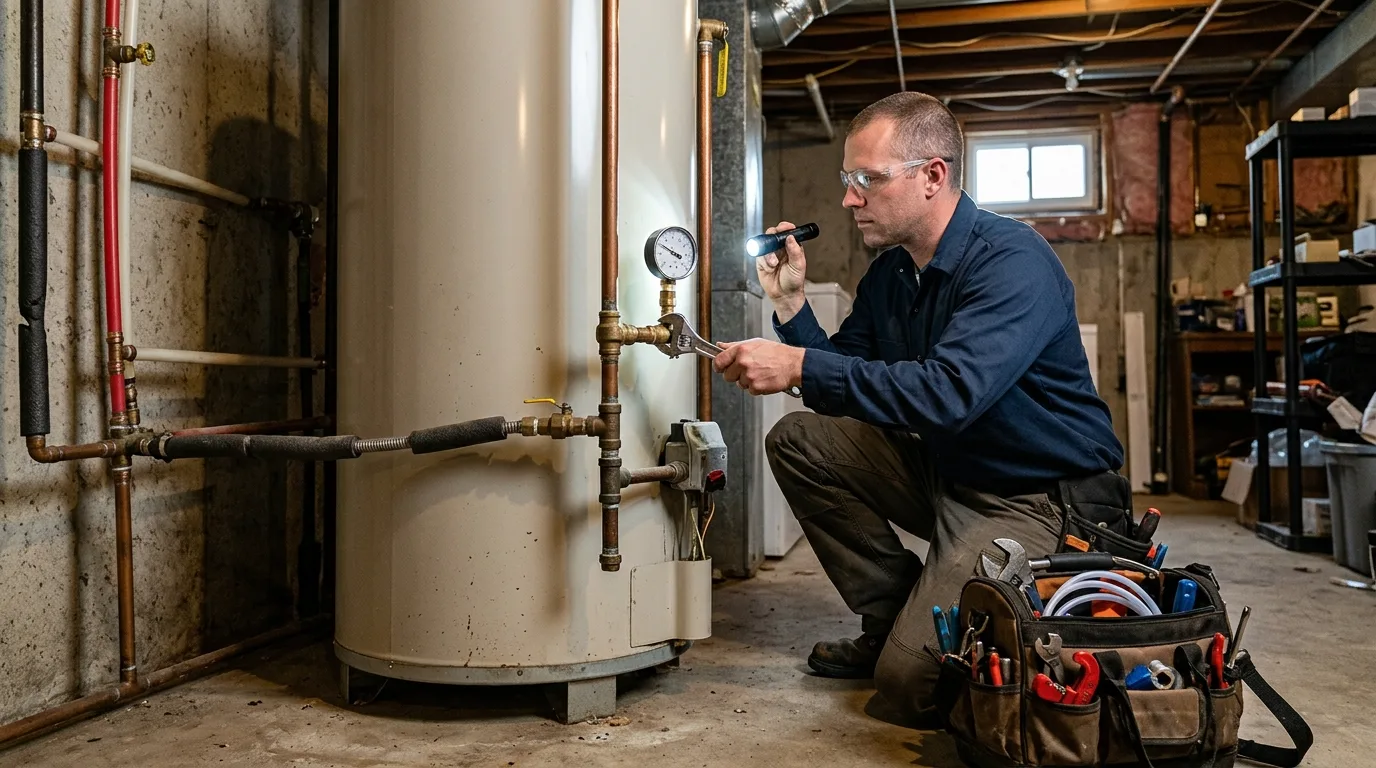
Replacement · Corona, CA
A replacement is not just swapping a cylinder. It is sizing the unit to the household, bringing venting and strapping up to current code, and adding the expansion protection Corona’s pressure demands. We do all of it, and we quote all of it.
Answered 24/7 · same-day replacement often available · old unit hauled away
Same day
Standard replacements, when stocked
To code
Strapping, venting, drip pan, TPR line
Hauled
Old unit removed and disposed
The real scope
The cheapest water heater installation is a new tank set on the old pedestal, connected with the old flex lines, vented into whatever was there before, and left with no expansion tank. It happens constantly, it passes a glance, and it fails inspection or fails early.
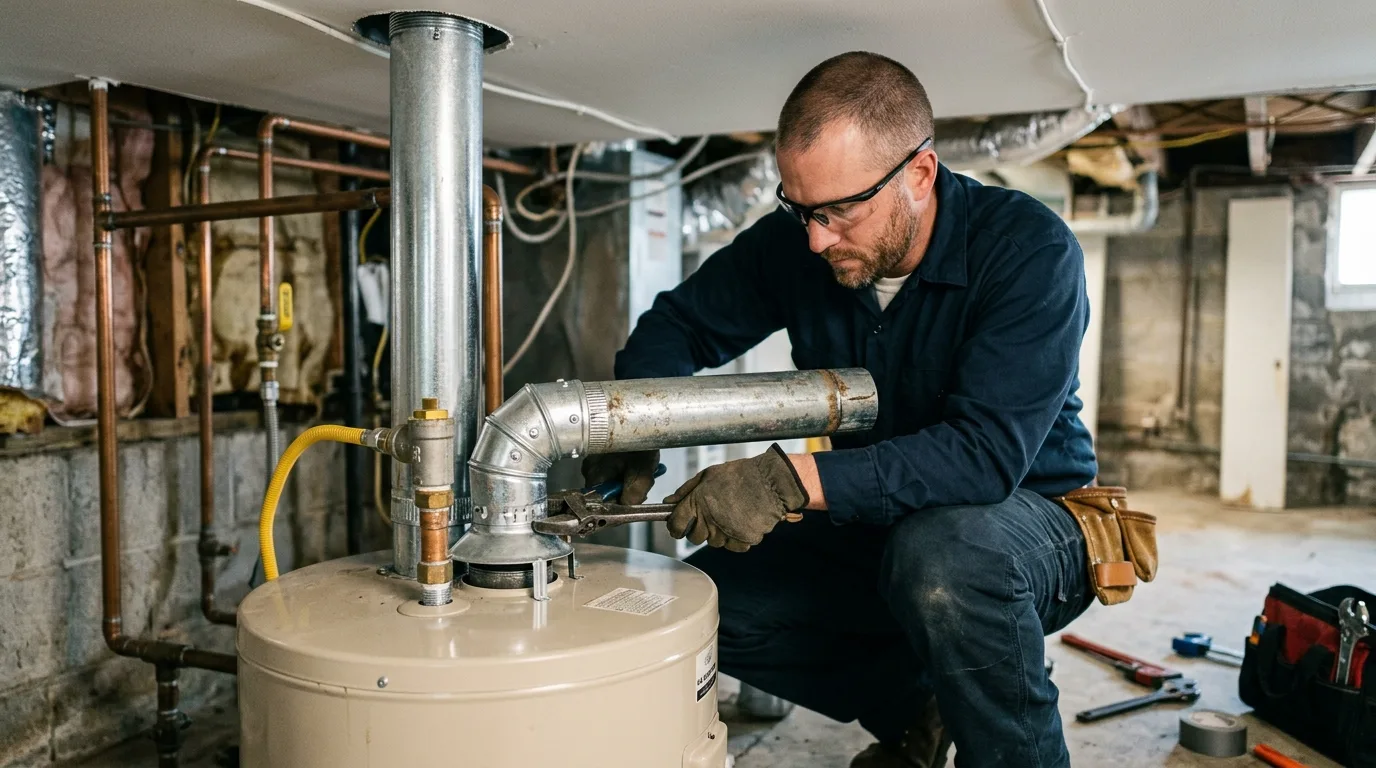
A correct installation in Corona covers a specific list. The unit is sized to the household’s actual peak demand, not to whatever gallon number was on the old label. Gas supply is verified for adequate capacity, particularly if the new unit has a higher input rating. Venting is inspected and corrected, atmospheric vents get checked for proper rise, connector condition, and draft, and the flue is verified after startup rather than assumed. Seismic strapping is installed at the upper and lower thirds of the tank, which is code in California and routinely missing on older installations.
A drip pan with a routed drain goes under any heater installed where a leak would cause damage. The TPR discharge line is run in approved material, downward, to an approved termination point, not capped, not threaded into something clever, not aimed at an electrical panel. New shutoff and connectors replace whatever the old install left behind. And a thermal expansion tank is added where a closed system requires it, which in Corona is most of the time.
Then the old unit is drained, removed, and hauled away, and the permit and inspection are handled. That is the whole job, and every part of it appears on your estimate before you agree to anything.
Sizing
The most common sizing mistake is replacing like for like. The forty-gallon heater in your garage was sized for the household the builder imagined in 1994, and your household may look nothing like it.
What actually matters is first-hour rating, how much hot water the unit can deliver in the first hour of heavy use, which combines storage volume with recovery rate. A high-recovery forty-gallon gas unit can outperform a slow fifty-gallon one for a family with back-to-back morning showers.
So we count the real demand: number of bathrooms and how they get used, whether showers overlap, whether there is a soaking tub or a multi-head shower (these change the math dramatically), laundry and dishwasher habits, and the distance from the heater to the furthest fixture. On the newer two-story tracts in Eagle Glen, Sycamore Creek, and Dos Lagos, that last one matters, a long run to a far master bath wastes both water and patience, and a recirculation loop may serve you better than a bigger tank.
Oversizing is not free either. A tank larger than the household needs stands there losing heat around the clock, and in hard water it means more surface area accumulating more scale. Right-sized beats big.
Options
There is no single best water heater. There is a best water heater for your household, your gas supply, and your budget.
01
The workhorse and the value choice. Simple, reliable, inexpensive to service, and a direct replacement in most Corona garages. Requires an adequate existing vent, which is the first thing we check.
02
Uses a blower to vent horizontally through a wall. The right answer when the existing chimney or vent is unusable, when the heater is moving to an interior location, or when draft has been a chronic problem.
03
Straightforward where no gas is available or where the garage layout makes venting impractical. Slower recovery than gas, so sizing matters more, and it needs adequate circuit capacity.
04
Substantially more efficient than a standard electric unit and eligible for incentives in some cases. Needs air volume around it and produces cool exhaust air, a garage in Corona is often an ideal location for exactly that reason.
05
A higher burner input on the same or smaller storage volume. Good for households whose problem is running out during a morning rush rather than needing more total capacity.
06
Endless hot water and a smaller footprint, but a bigger project, gas line capacity, venting, and Corona’s hard water all factor in. Worth doing properly, so we treat it as its own conversation.
Sequence
A standard tank swap is usually a half-day. Here is where the time goes.
Existing unit, vent, gas or electrical supply, clearances, and household demand. This is also where we catch the code items the old install was missing so they are in the quote, not a surprise.
Unit, labor, code items, expansion tank, permit, haul-away, and disposal. One number, itemized, before anything is ordered.
Water and gas or power isolated, tank drained, disconnected, and carried out. Floors protected on the path.
New unit positioned, strapped at the upper and lower thirds, drip pan and drain in place, new shutoff and connectors, dielectric protection where dissimilar metals meet.
Vent connector fitted and draft verified after startup. TPR discharge run correctly to an approved termination. Expansion tank installed and pre-charged to match measured system pressure.
Filled, purged, fired, temperature set, combustion and draft verified, connections leak-checked. Old unit hauled away, inspection scheduled, and warranty registered.
Half day
Typical standard tank replacement
100%
Code items quoted, never billed as extras
0
Old units left in your garage
Why here
Hard water. Corona’s blend of Temescal basin groundwater and imported State Water Project supply commonly runs fifteen to twenty grains of hardness. Every gallon that passes through your new heater deposits calcium and magnesium on the tank bottom, which insulates the burner from the water, drives up gas consumption, thermally stresses the glass lining, and shortens the tank’s life. A new heater installed here without a maintenance plan is on the same eight-to-ten year trajectory as the one it replaced.
There are three practical responses, and we will lay all three out rather than pushing one. Annual flushing, which is cheap and effective and can be scheduled. Replacing the anode rod on a schedule instead of after the tank starts corroding. Or treating the water with a softener, which protects not just the heater but every fixture, valve, and appliance downstream. For a household on its second heater in twelve years, the softener is usually the cheapest of the three over the life of the equipment.
Pressure and thermal expansion. Corona spans a wide elevation range, and neighborhoods low in a pressure zone can see static pressure well above what residential equipment is designed around. When a house has a functioning pressure regulator, the plumbing becomes a closed system, water cannot push back into the city main. That is correct and desirable, but it means every time the heater fires and the water expands, the pressure has nowhere to go except into the pipe, the fittings, and the tank itself.
The device that solves this is a thermal expansion tank: a small vessel with an air bladder that absorbs the expansion. It is inexpensive, it is required by code on closed systems, and it is missing on a genuinely startling number of existing Corona installations. Its absence shows up as a TPR valve that weeps, fixtures that develop drips, and a heater that dies early. We check for it, we measure the static pressure to charge it correctly, and we install it as part of the job rather than as an upsell.
Straight answers
| Factor | Why it changes the number |
|---|---|
| Unit type and capacity | A standard forty-gallon atmospheric gas tank and a hybrid heat pump unit are different pieces of equipment at very different price points. Capacity and recovery rate both move the figure. |
| Straight swap or modification | Same location, same fuel, adequate existing vent is the fastest job. Relocating the heater, converting fuel type, or changing vent strategy adds labor and materials. |
| Code corrections | Missing strapping, an unusable vent, a wrong TPR line, no drip pan, or no expansion tank all get corrected. On an older installation this can be several items, and every one is itemized in advance. |
| Access | A garage with a wide door is easy. A tight interior closet, an attic platform, or a unit behind a water softener and shelving takes longer to get out and in. |
| Gas or electrical capacity | A higher-input gas unit may need a supply line evaluated or upsized. An electric or hybrid unit may need circuit capacity confirmed. Both are checked before the quote, not discovered afterward. |
| Expansion tank and regulator | If the house has no expansion tank, or a regulator that has failed, those go in as part of doing the job properly. They are small costs that protect a large one. |
| Permit and inspection | Included and stated. A permitted heater is a documented heater, which matters at resale. |
| Timing | A scheduled weekday replacement costs less than an after-hours emergency swap when a tank has failed at nine at night. You hear which one you are getting on the phone. |
Haul-away and disposal of the old unit are included in every quote we give. If someone quotes lower and leaves the old tank in your garage, that is why.
Tank failed?
Standard sizes are stocked. Tell dispatch the fuel type, the capacity on the label, and where it sits, and we can usually have hot water back today.
Answered 24/7 · upfront pricing including haul-away
Related work
Coverage
Planning, not panicking
If your heater is past ten years, a scheduled replacement beats an emergency one on price, timing, and the state of your garage floor.
Independent local contractors · workmanship guarantee on completed work
Installation FAQs
A standard tank-for-tank swap in an accessible garage is typically three to five hours, including drain-down, removal, setting the new unit, code corrections, startup, and testing. You usually have hot water the same afternoon.
Longer jobs are the ones with changes: relocating the unit, converting to power-vent, upgrading gas or electrical supply, or a tankless conversion. Those are commonly a full day and occasionally two, and you are told which category your job is in before it starts.
Yes. Water heater replacement is permitted work in the City of Corona, and it exists for good reason, venting, gas connections, seismic strapping, and relief valve discharge are all life-safety items.
The contractor handles the permit and the inspection as part of the scope, and the cost is in your written estimate. An unpermitted heater is a disclosure item at resale and a potential insurance argument after a loss.
Not necessarily the size you have. What matters is first-hour rating, storage volume combined with how fast the unit reheats, measured against your household’s actual peak demand.
A family of four with two overlapping morning showers has a different profile than a couple who shower at night. Soaking tubs and multi-head showers change the answer significantly. We count fixtures and ask about usage patterns rather than guessing from square footage.
It can be, with clear eyes about the tradeoffs. Endless hot water, a much smaller footprint, and better efficiency are real benefits, and a well-maintained tankless unit outlives a tank by a wide margin.
The caveats are local. Corona’s hardness means a tankless heat exchanger scales up and needs annual descaling to hold performance. Conversion often needs a larger gas line and new venting, which is where the cost sits. We price both options honestly so the comparison is real rather than rhetorical.
When water is heated it expands. If your house has a functioning pressure regulator, that expanding water cannot push back into the city main, so the pressure spikes inside your plumbing instead.
An expansion tank gives it somewhere to go. It is code-required on closed systems, it is inexpensive, and its absence is a leading cause of weeping TPR valves, premature fixture drips, and early heater failure in Corona. Yes, you really need one.
Sometimes, and we will be straight about the drawbacks. Warranty handling gets complicated, manufacturer coverage on a homeowner-purchased unit typically excludes labor, and if the unit is defective out of the box you are managing the return, not us.
We also cannot vouch for a unit we did not source, and big-box models sometimes differ from trade equivalents in ways that matter for connections and venting. If you have already bought it, tell us the model and we will tell you honestly whether installing it is a good idea.
Yes, always, and it is included in our quote rather than an add-on line. The old unit is drained, removed, and disposed of or recycled properly.
It is worth asking any contractor this directly. A quote that looks lower sometimes stops at disconnecting the old heater and leaving it standing next to the new one.
Usually the same place, which is simplest and cheapest. Corona homes most often have garage installations, which is fortunate: garages give good clearance, easy access, and a sensible place for a drain pan.
Relocation is possible, to a different garage wall, an exterior enclosure, or an interior closet, but it introduces venting, combustion air, drainage, and clearance requirements that drive cost. If your motivation is reclaiming space, a tankless unit mounted on a wall is often the better route.
In Corona, realistically eight to ten years on a tank unit with no water treatment and no maintenance. Twelve to fifteen is achievable with annual flushing and timely anode replacement. Longer than that generally means the house has a softener.
This is why we bring up water chemistry at installation rather than at the first repair. The single largest factor in how long your new heater lasts is not the brand or the warranty; it is what the water does to it.
Dispatch answers around the clock, and emergency replacement is possible when a standard size is available. What we will tell you honestly is that after-hours replacement costs more than a scheduled morning.
Often the better move is stabilizing tonight, shutting the cold inlet and the gas or breaker, stopping the water, and containing the mess, then replacing first thing the next morning at normal rates. We will lay out both options with the prices attached and let you choose.
Corona, CA · installation done to code
Correct sizing, code items included, expansion protection, permit handled, old unit gone.
Dispatch answers 24/7 · same-day replacement often available