01
Kitchen faucets
Single-lever, bridge, and pull-down installations, including deck plate and sprayer configurations, soap dispensers, and matching the mounting to the sink hole count.
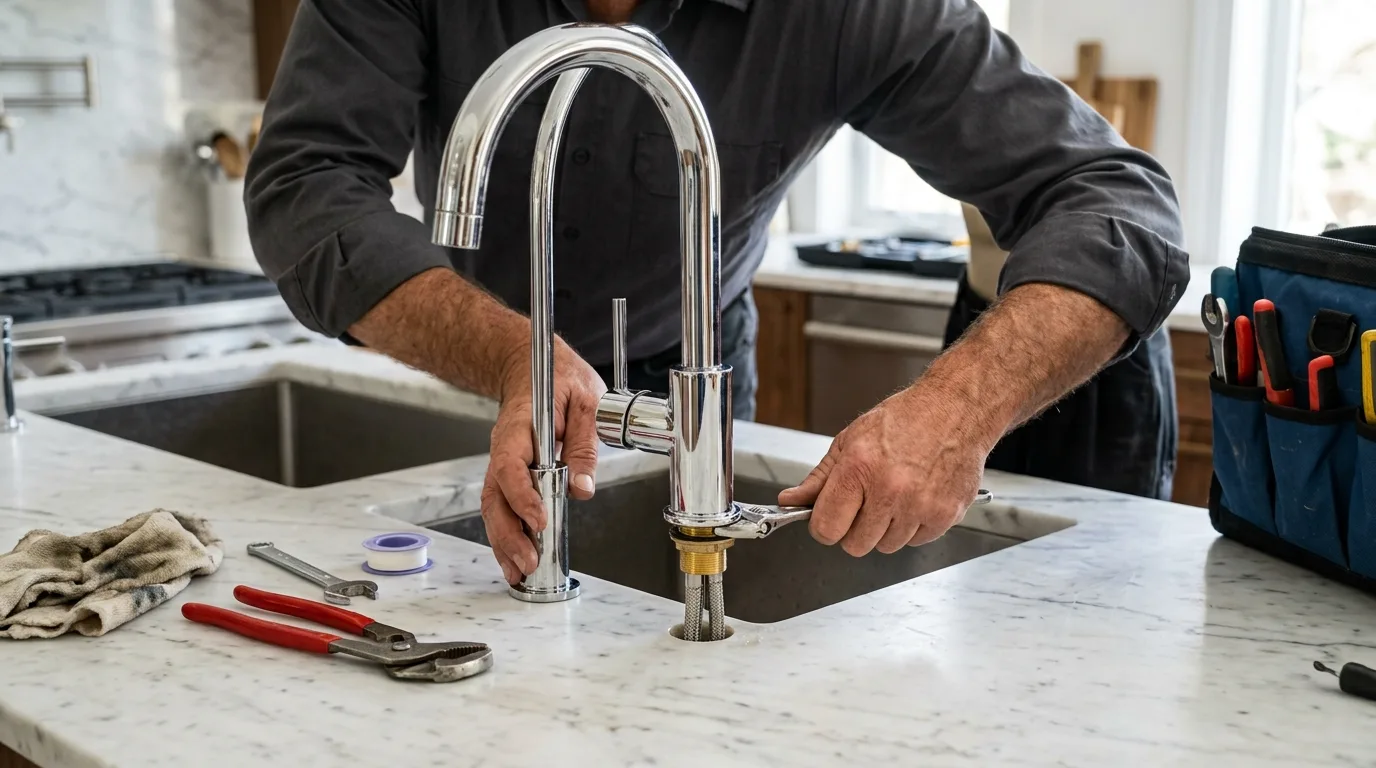
Faucets & fixtures · Corona, CA
A dripping faucet is rarely a bad faucet. It is a worn cartridge, a scaled seat, or pressure the fixture was never designed to hold, and which one it is changes the repair entirely.
Answered 24/7 · angle stops and supply lines replaced as standard practice
The real fault
The instinct when a faucet drips is to replace the faucet. Frequently that is the most expensive way to solve the problem. Inside almost every modern fixture is a replaceable cartridge or valve assembly, and in the overwhelming majority of drips that cartridge is what has failed, not the body, not the spout, not the finish.
Cartridges are a wear item with a genuine service life. Ceramic disc types are the most durable, compression types the oldest and most repairable, and ball and sleeve designs sit somewhere between. Every one of them has rubber seals and a sealing surface, and in hard water both degrade faster than the manufacturer’s literature assumes.
What makes cartridge work worth handing to a plumber is that the part has to match the valve body exactly. Manufacturers produce dozens of variants that look nearly identical and are not interchangeable, and a close-enough cartridge either will not seat or will leak within weeks. Identifying the body correctly is most of the job.
There is also a category of drip that no cartridge fixes: the fixture that keeps failing. If a faucet has eaten three cartridges in five years, the fixture is not the problem. Static pressure above 80 psi destroys seals on a cycle, and until the pressure is measured and controlled, every replacement part is on a countdown.
And a drip is not free. A steady drip from one faucet wastes a meaningful volume over a year, and on tiered water rates the arithmetic is worse than it looks. It is a small repair with an unusually good return.
Underneath
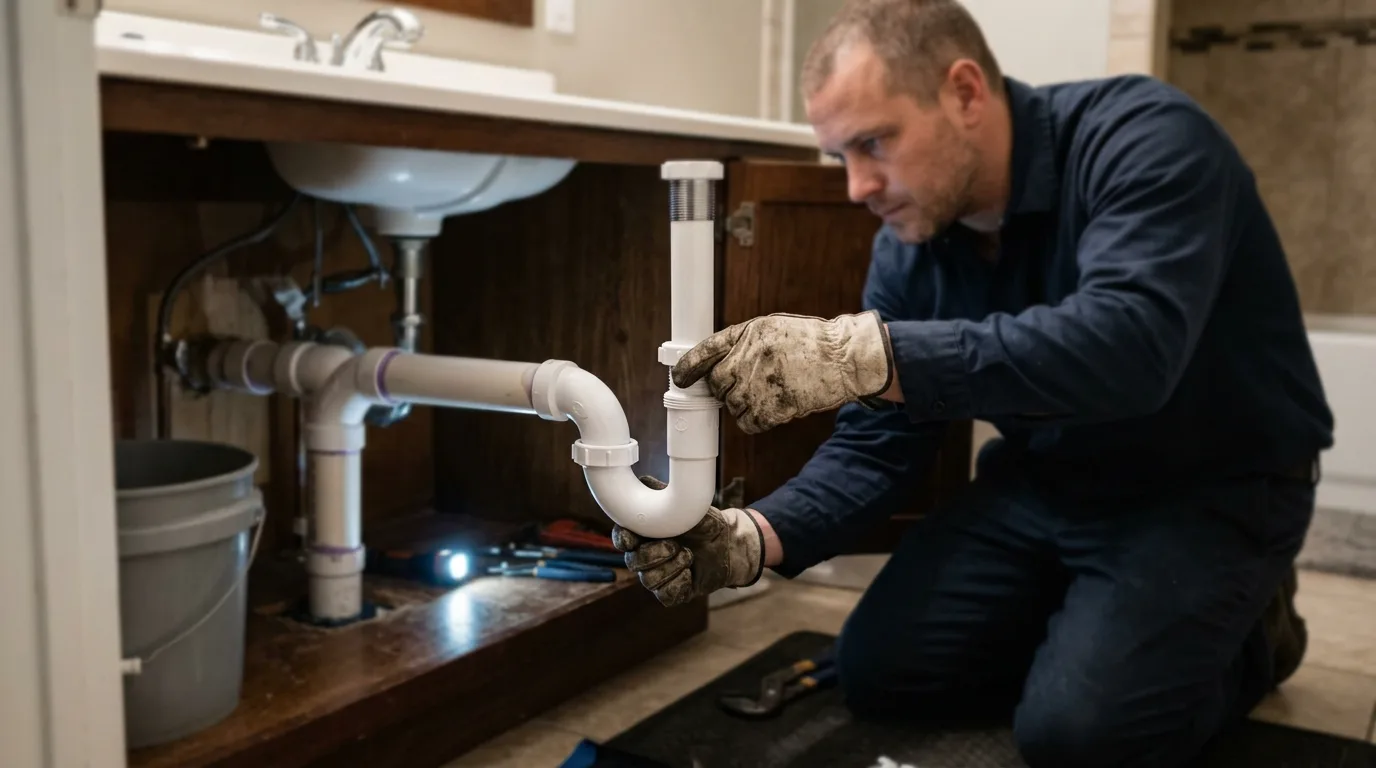
Every fixture in the house is fed through an angle stop, the small shut-off valve under the sink or behind the toilet. They are the most ignored components in residential plumbing and among the most consequential, because they are what stands between a fixture failure and a flooded room.
Old multi-turn angle stops seize. The packing dries out, the stem corrodes, and the valve that was installed to give you control in an emergency becomes the reason you cannot shut the water off when you need to. Worse, turning a seized stop after fifteen years of disuse is itself a common way to start a leak.
We replace them as a matter of course during fixture work, and we fit quarter-turn ball stops in place of the old multi-turn design. A quarter-turn valve either works or it does not; it does not slowly seize, and it closes in one motion when you are standing in water.
The same logic applies to supply lines. The flexible connectors between the stop and the fixture are consumables, and the old chrome-plated or thin plastic versions are a known failure mode. Braided stainless with a good ferrule is inexpensive and dramatically less likely to let go unattended.
None of this is glamorous and none of it is expensive. It is simply the part of a fixture installation that separates a job done properly from a fixture screwed onto whatever was already there.
Scope
Repair where repair is honest, replacement where it is not.
01
Single-lever, bridge, and pull-down installations, including deck plate and sprayer configurations, soap dispensers, and matching the mounting to the sink hole count.
02
Centerset, widespread, and single-hole installations, with drain assembly and pop-up linkage fitted and adjusted rather than left approximate.
03
The right part for the specific valve body, with the seat and springs cleaned or replaced and the aerator descaled while we are there.
04
Seized multi-turn stops replaced with quarter-turn ball valves, and braided stainless supply lines fitted in place of failure-prone older connectors.
05
Laundry sinks, bar sinks, prep sinks, and pot fillers, including running new supply and drain where the location is new rather than a like-for-like swap.
06
Dedicated drinking water taps, under-sink filtration connections, and instant-hot units, tied into the existing supply properly and vented where required.
Sequence
Most repairs are under an hour. A straightforward replacement is a morning.
Manufacturer and valve body determined so the correct cartridge or trim is used. This is the step that decides whether the repair lasts.
If parts have been failing repeatedly, a gauge goes on the hose bib. There is no point fitting a new cartridge into an uncontrolled system.
Angle stops tested for a clean shut-off. If one is seized or weeping, replacing it is part of the quote rather than a surprise mid-job.
Repair versus replacement explained with the reasoning and the number, including whether the fixture you have is worth keeping.
Old fixture removed, mounting surface cleaned, new fixture seated and secured, supplies and drain connected with new components rather than reused ones.
Water restored slowly, every joint checked dry under pressure, aerator flushed of debris, drain run, and the cabinet left dry and clean.
1.8 gpm
California maximum for kitchen faucets
1.2 gpm
Maximum for lavatory faucets
¼ turn
The stop valve we fit as standard
Same day
Availability for most fixture calls
Why here
Corona’s water runs fifteen to twenty grains of hardness, blended from local Temescal basin groundwater and imported State Water Project supply. For fixtures, that number has consequences that go well beyond spotting on chrome.
Aerators scale closed. The screen at the end of a spout catches mineral and slowly restricts flow. Homeowners read this as failing water pressure and start looking at the house. Very often the fix is unscrewing the aerator and soaking it, and we check this before entertaining any larger diagnosis.
Cartridge seats roughen. Mineral deposits on the sealing surface prevent a clean close, which is why a new cartridge sometimes still weeps. The seat needs cleaning or replacing too, and a repair that skips this comes back.
Finishes suffer. Hard water is unkind to living finishes and to some coated surfaces, particularly where a fixture is regularly wetted and left to dry. It is worth factoring into a purchase decision here rather than assuming a finish will behave the way it does elsewhere.
Pull-down sprayers stick. The diverter valve inside a pull-down kitchen faucet is a small mechanism with small passages, and scale is exactly what it cannot tolerate.
Pressure is the second local factor. Corona spreads across a substantial elevation range, and houses at the bottom of a municipal pressure zone can sit well above the 80 psi that California code allows to fixtures. Faucet cartridges, in particular, are not built for it. When we see a household replacing fixture parts on a repeating cycle, an uncontrolled PRV is the first suspect and the cheapest thing to rule out.
The third is the housing stock. Homes around downtown Corona may still have galvanised supply stubs at the fixture, which corrode internally and will not thread reliably. Late-eighties tracts can have polybutylene, which requires specific fittings. Neither means a fixture cannot be installed; it means the person installing it should recognize what they are looking at before they put a wrench on it.
Straight answers
| Factor | Why it changes the number |
|---|---|
| Repair versus replacement | A cartridge swap is the least expensive visit we make. Replacement adds the fixture, the removal, and the new connections. |
| Cartridge availability | Common valve bodies have parts on the truck. Discontinued or obscure fixtures may need a sourced part and a second visit, and sometimes replacement is genuinely the better value. |
| Angle stop condition | Sound stops mean a straightforward connection. Seized or weeping stops get replaced, which is a small line item and one we strongly recommend rather than working around. |
| Pipe material at the stub | Copper is routine. Galvanised stubs corroded at the thread, or polybutylene requiring specific fittings, both add time and materials. |
| Hole count and configuration | Fitting a single-hole faucet to a three-hole sink needs a deck plate. Going the other way may not be possible without changing the sink. |
| Drain and pop-up work | A new fixture often means a new drain assembly and linkage, and older tailpieces and traps may not mate cleanly to modern components. |
| New location versus swap | A like-for-like replacement is quick. A pot filler, prep sink, or bar sink where none existed means running supply and, for a sink, drain and vent. |
| Access | Deep cabinets, tight corners, garbage disposals in the way, and stone countertops with limited clearance all add labor time to what looks like a simple job. |
Faucet dripping?
We will tell you plainly whether your fixture is worth repairing, and we do not upsell a replacement that a cartridge would fix.
Answered 24/7 · upfront pricing before any work
Related work
Coverage
Planning a remodel?
Rough-in spacing, valve compatibility, and flow ratings decide what will actually fit. It is a five-minute conversation that avoids a return.
Independent local contractors · workmanship guarantee on completed work
Fixture FAQs
If the body is sound and the finish is acceptable to you, repair is almost always better value. Most drips are a worn cartridge, and a cartridge is a fraction of the cost of a fixture plus installation.
Replacement makes more sense when the body is corroded or cracked, when the fixture is a discontinued model with no available parts, or when you want a different configuration anyway. We will tell you which situation you are in.
Usually because the seat it closes against is damaged or scaled. Hard water roughens the sealing surface, and a perfect new cartridge cannot seal against an imperfect seat.
A proper repair cleans or replaces the seat and springs, not just the cartridge. The other possibility is a mismatched part, manufacturers make many near-identical variants that are not interchangeable.
Check the aerator first. The small screen at the end of the spout catches mineral and debris and scales closed gradually, and in Corona this is by far the most common cause of one weak fixture.
Unscrew it, soak it in vinegar, rinse, and refit. If flow is still poor after that, the next suspects are a partially closed angle stop, a clogged cartridge, or a restricted supply line.
It is the small shut-off valve under the sink or behind the toilet that isolates that one fixture. You should care about it the moment something starts spraying, because it is what lets you stop the water without shutting off the whole house.
Old multi-turn stops seize with age and often start leaking the first time they are turned after years of disuse. We replace them with quarter-turn ball valves during fixture work as standard practice.
A decent quality fixture body will outlast several sets of internals. Fifteen to twenty years is reasonable for the fixture itself, with cartridges replaced perhaps every five to ten years along the way.
In this water, expect the shorter end of those ranges unless the house is softened. Very cheap fixtures with plastic internals and thin castings do not follow this pattern at all; they simply fail.
Yes. Kitchen faucets are limited to 1.8 gallons per minute and lavatory faucets to 1.2 gallons per minute for new fixtures sold in the state.
In practice this is not the limitation people fear. A well-designed 1.2 gpm lavatory faucet feels fine. If your fixtures feel weak, the cause is almost always scale or pressure, not the flow rating.
Yes, and plenty of our work is exactly that. Bring the fixture and we will fit it, replace the stops and supply lines while access is open, and test everything.
One request: check the hole count and spacing of your sink before ordering, and for shower and tub work check valve compatibility. Those two mismatches account for most of the fixtures that have to go back.
Two likely causes. Hard water shortens the life of every seal and sealing surface in the house, and static pressure above 80 psi destroys cartridges on a cycle no part survives.
If a household is replacing fixture internals every year or two, we put a gauge on an outside hose bib before fitting anything else. It is a five-minute test that frequently explains everything.
Chrome and brushed nickel are the most forgiving in hard water and the easiest to keep looking reasonable. Polished and living finishes show mineral spotting quickly and need wiping to stay presentable.
Whatever you choose, the practical advice is the same: dry the fixture after heavy use, and avoid abrasive or acidic cleaners, which strip protective coatings faster than the water ever will.
Not necessarily; it is within reach of a confident homeowner if you can identify the correct part and get the old one out. The two things that go wrong are misidentifying the valve body and seizing on a cartridge that has been in mineral-laden water for a decade.
If a cartridge will not come out, stop before you damage the valve body. A stuck cartridge extracted badly turns a small repair into a fixture replacement, and sometimes into wall work on a shower valve.
Corona, CA · fixture specialists
Cartridges matched to the valve body, angle stops replaced while access is open, and every connection tested under pressure before we leave.
Dispatch answers 24/7 · same-day and emergency response available